Corethrogyne filaginifolia
Common sandaster
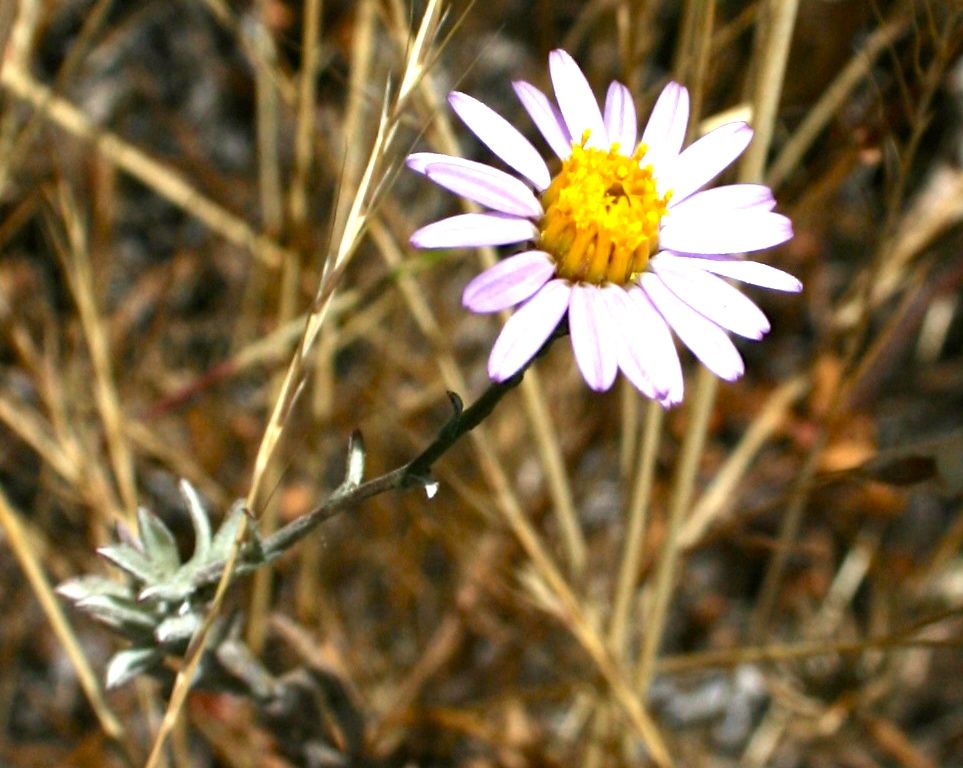
Photo by Chez Brungraber
Family: Asteraceae · Type: Subshrub · Native
Corethrogyne filaginifolia (Common sandaster) is a native California subshrub in the Asteraceae family.
Common sandaster is a California native perennial found in northern coastal, Klamath, central Sierra Nevada, Tehachapi, central western, southwestern, and western desert mountain regions in coastal scrub, chaparral, grassland, foothill woodland, and forest at elevations below 2,600 meters. Flowering from July to November, this plant produces white to pink or purple ray flowers with yellow disk centers in heads 6 to 14 millimeters wide. Growing 10 to 100 centimeters tall with multiple stems that are decumbent to ascending, densely white-tomentose and sometimes branching distally. Its leaves are alternate, linear to oblanceolate, 10 to 70 millimeters long, ranging from entire to toothed and often hairy. The fruit is a cylindric structure 2 to 5 millimeters long with 5 to 7 ribs, topped by a persistent pappus of 35 to 65 unequal, coarse bristles.
Identification and appearance
Key characters: 0 sympatric species - geographically isolated with wide distribution across multiple bioregions
Habitat and range
Habitat: Coastal scrub, chaparral, grassland, foothill woodland, forest
Elevation: < 2600 m
Outside California: southwestern Oregon, northern Baja California
Bloom period
Corethrogyne filaginifolia blooms Jul-Nov.
How to tell it apart
vs Symphyotrichum: Symphyotrichum has white pappus and fertile rays; Corethrogyne has brown pappus and sterile rays; vs Erigeron: Erigeron has many very thin rays (like 50+); Corethrogyne has fewer wider rays; vs Dieteria: Dieteria has white pappus and fertile rays; Corethrogyne has brown/red pappus; vs Pseudognaphalium: Pseudognaphalium has woolly white-gray foliage and no ray flowers; vs Artemisia: Artemisia has tiny rayless heads and deeply divided aromatic silver-gray leaves
Frequently asked questions
Is Corethrogyne filaginifolia native to California?
Yes. Corethrogyne filaginifolia is native to California (recorded as native).
When does Corethrogyne filaginifolia bloom?
Corethrogyne filaginifolia blooms Jul-Nov.
What plant family does Corethrogyne filaginifolia belong to?
Corethrogyne filaginifolia is in the Asteraceae family, genus Corethrogyne.
What habitat does Corethrogyne filaginifolia grow in?
Corethrogyne filaginifolia grows in Coastal scrub, chaparral, grassland, foothill woodland, forest.
Related species
Other California species in the same genus, family, or bioregion.
Sources: Jepson eFlora · Index of California Plant Names · CalPhotos
Last updated 2026-10-07
Data from The California Species Project — 14,000+ California species with verified data from CNPS, CDFW, USFWS, Cal-IPC, and more.