Coriandrum sativum
Coriander, cilantro, Cilantro
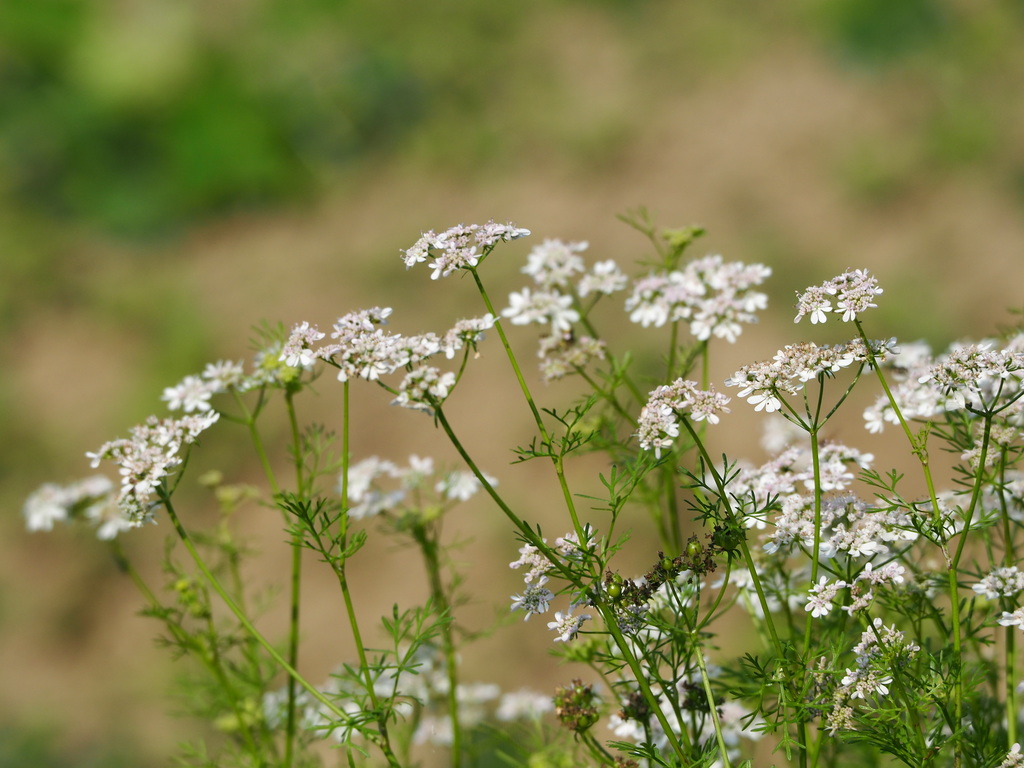
no rights reserved, uploaded by 葉子 · CC0
Family: Apiaceae · Type: Herb · Not Native
Coriandrum sativum (Coriander) is a non-native California herb in the Apiaceae family, recognized by Only Coriandrum in California, representing a small Mediterranean genus occasionally escaping cultivation.
Coriander is a naturalized annual herb found in northern California Coast Ranges and the Sacramento Valley in disturbed places near gardens at elevations generally below 1,000 meters. Flowering from May to July, this plant produces small white to pale pink flowers in delicate compound umbels. Growing with slender stems 20 to 80 centimeters tall, it develops a branching, open structure with finely divided foliage. Its lower leaves are clustered and complex, featuring delicate ternately or pinnately lobed segments with leaflets that are ovate to round, while upper leaves are finely dissected with thread-like linear segments. The small fruits are round and aromatic, typically 2.5 to 5 millimeters wide.
Identification and appearance
Key characters: Only Coriandrum in California, representing a small Mediterranean genus occasionally escaping cultivation
Habitat and range
Habitat: Disturbed places, generally near gardens
Elevation: generally < 1000 m
Outside California: to Mexico, tropical America, native to Mediterranean
Bloom period
Coriandrum sativum blooms May-Jul.
How to tell it apart
vs Ammi: Coriandrum smells of cilantro and its round fruits stay joined (indehiscent); Ammi (Bishop's weed) has dry ridged fruits that split into two halves and lacks the cilantro odor.; vs Daucus: Coriandrum has smooth globose fruit and an outer ring of enlarged petals; Daucus (wild carrot) has bristly fruit and a concave umbel that curls into a bird's-nest.; vs Conium: Coriandrum smells pleasantly of cilantro with green, unspotted stems; Conium (poison hemlock) has purple-spotted stems and a foul, mousy odor.; vs Anthriscus: Coriandrum lower leaves are broad with rounded lobes; Anthriscus (chervil) leaves are all finely fern-divided and its fruit is long and beaked.; vs Cyclospermum: Coriandrum has broad, rounded lower leaflets; Cyclospermum (marsh parsley) has all leaves finely dissected into linear segments with tiny fruit.
Frequently asked questions
Is Coriandrum sativum native to California?
No. Coriandrum sativum is not native to California (recorded as not native).
When does Coriandrum sativum bloom?
Coriandrum sativum blooms May-Jul.
What plant family does Coriandrum sativum belong to?
Coriandrum sativum is in the Apiaceae family, genus Coriandrum.
What habitat does Coriandrum sativum grow in?
Coriandrum sativum grows in Disturbed places, generally near gardens.
Related species
Other California species in the same genus, family, or bioregion.
Sources: Jepson eFlora · CalPhotos
Last updated 2026-10-07
Data from The California Species Project — 14,000+ California species with verified data from CNPS, CDFW, USFWS, Cal-IPC, and more.