Cornus glabrata
Brown dogwood
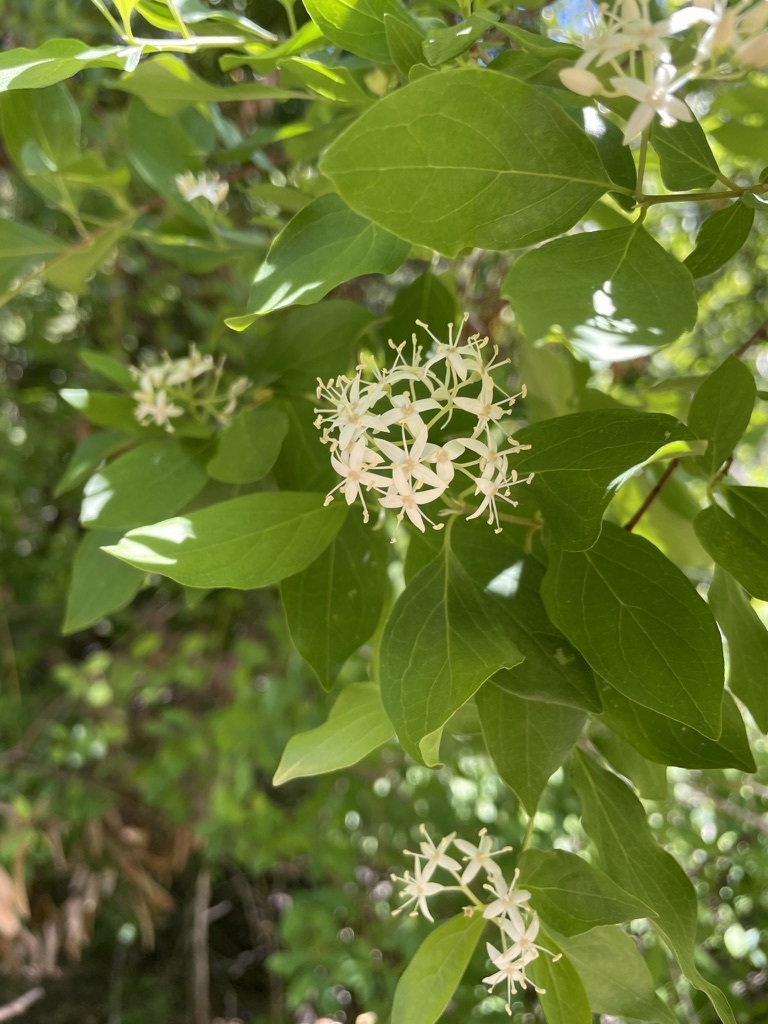
no rights reserved · CC0
Family: Cornaceae · Type: Shrub / Tree · Native
Cornus glabrata (Brown dogwood) is a native California shrub / tree in the Cornaceae family, recognized by Co-occurs with 5 other species; distinguished by clonal growth habit, small leaves, and lack of showy bracts.
Brown dogwood is a California native shrub found in the California Floristic Province, particularly in southern California, in generally moist places at elevations below 1,550 meters. Flowering from May to June, this plant produces dull white flowers in clusters 2.5 to 4.5 centimeters wide. Growing as a small shrub or tree 1.5 to 6 meters tall, it forms clonal thickets with slender stems that range from brown to red-purple in color. Its leaves are lanceolate to elliptic, 2 to 5 centimeters long, with 3 to 4 pairs of veins and a gray-green appearance that is paler on the underside. The fruit is white to bluish, approximately 8 to 9 millimeters long, with a smooth stone 5 to 6 millimeters wide.
Identification and appearance
Key characters: Co-occurs with 5 other species; distinguished by clonal growth habit, small leaves, and lack of showy bracts
Habitat and range
Habitat: Generally moist places
Elevation: < 1550 m
California counties: Humboldt, Kern, San Luis Obispo, Sonoma, Siskiyou, Trinity, San Mateo, Napa, Tulare, Santa Barbara, Santa Clara, Los Angeles, Mendocino, Lake, Tuolumne, Butte, Ventura, Monterey, Shasta, Riverside, Inyo, Yolo, San Diego, Modoc, Placer, El Dorado, Alameda, Amador, Colusa, Del Norte, Marin, Contra Costa, Nevada, Tehama, Sacramento, Solano, Stanislaus, Mariposa, San Benito
Outside California: Oregon
Bloom period
Cornus glabrata blooms May-Jun.
How to tell it apart
vs Prunus: Cornus has opposite leaves and 4-parted flowers; cherry has alternate leaves and 5-parted flowers.; vs Sambucus: Cornus has simple opposite leaves; elderberry has opposite compound leaves with 5-9 leaflets.; vs Rhamnus: Cornus has 4-parted flowers; buckthorn has 5-parted flowers with petals often smaller than sepals.; vs Philadelphus: Cornus has 4-parted flowers and opposite simple leaves; mock orange has 4-5 petals and shredding bark.; vs Magnolia: Cornus has opposite leaves and small 4-parted flowers; magnolia has alternate leaves and large showy flowers.
Frequently asked questions
Is Cornus glabrata native to California?
Yes. Cornus glabrata is native to California (recorded as native).
When does Cornus glabrata bloom?
Cornus glabrata blooms May-Jun.
Where in California does Cornus glabrata grow?
Cornus glabrata occurs in Humboldt, Kern, San Luis Obispo, Sonoma, Siskiyou, Trinity, San Mateo, Napa and other counties, at elevations of < 1550 m.
What plant family does Cornus glabrata belong to?
Cornus glabrata is in the Cornaceae family, genus Cornus.
What habitat does Cornus glabrata grow in?
Cornus glabrata grows in Generally moist places.
Related species
Other California species in the same genus, family, or bioregion.
Sources: Jepson eFlora · Index of California Plant Names · CalPhotos
Last updated 2026-10-07
Data from The California Species Project — 14,000+ California species with verified data from CNPS, CDFW, USFWS, Cal-IPC, and more.