Cotoneaster lacteus
Late cotoneaster, Late Cotoneaster
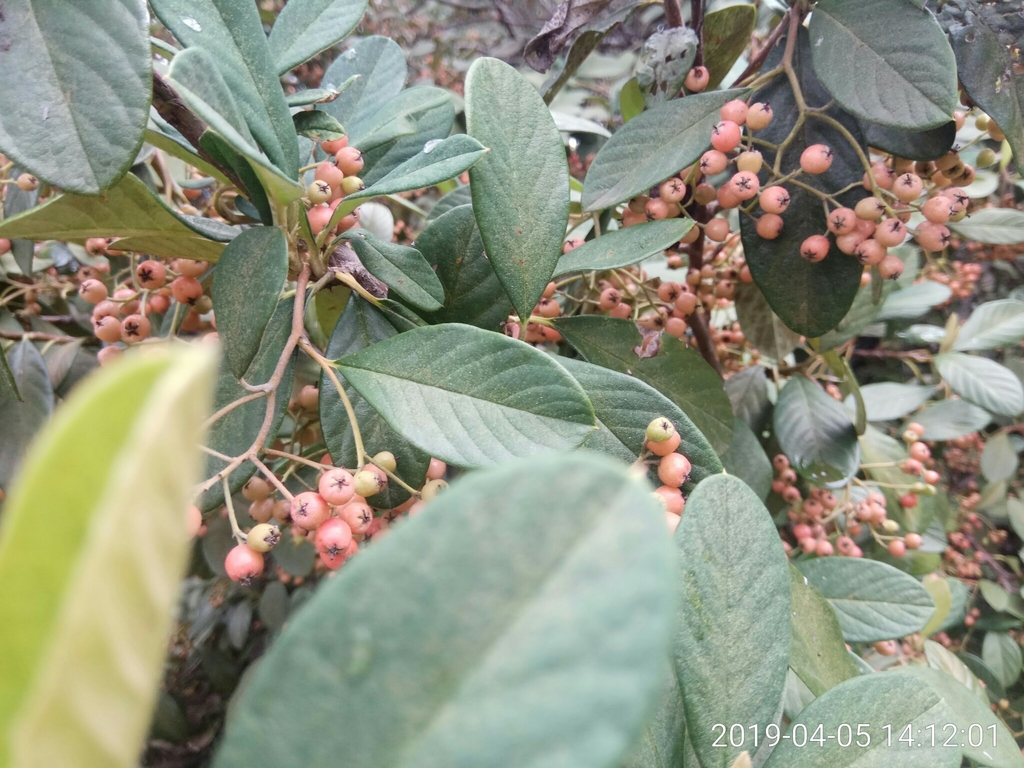
no rights reserved · CC0
Family: Rosaceae · Type: Shrub · Not Native
Conservation status: Cal-IPC Yes
Cotoneaster lacteus (Late cotoneaster) is a non-native California shrub in the Rosaceae family, recognized by largest size, thick large leaves, pale tomentose undersides.
Late cotoneaster is a naturalized shrub found in northern California coastal regions, Klamath Ranges, Sierra Nevada foothills, central coastal California, San Francisco Bay Area, southern California, and Peninsular Ranges in open forests, meadows, disturbed ground, and near creeks and ponds at elevations below 500 meters. Flowering from May to July, this plant produces white flowers in clusters approximately 8 to 9 millimeters wide with white filaments and purple anthers. Growing as an arching evergreen shrub 1 to 9 meters tall, it forms elegant spreading branches. Its thick leaves are 35 to 95 millimeters long, elliptic to obovate, with dark green surfaces and pale undersides that become less hairy with age. The plant produces bright red spherical fruits 6 to 7 millimeters wide, containing two stone-like seeds.
Identification and appearance
Key characters: 7 sympatric species; largest size, thick large leaves, pale tomentose undersides
Habitat and range
Habitat: Open forest, meadows, disturbed ground, thickets, creeks, ponds, canyons
Elevation: < 500 m
Outside California: to British Columbia, native to China
Bloom period
Cotoneaster lacteus blooms May-Jul, fruiting Nov--Apr.
Conservation status
Cal-IPC Yes
How to tell it apart
vs Pyracantha: Pyracantha has thorns; Cotoneaster is thornless with smooth stems.; vs Heteromeles: Heteromeles has sharp-toothed leaf edges; Cotoneaster has completely smooth leaf margins.; vs Frangula: Frangula has prominent parallel leaf veins curving toward the tip; Cotoneaster has typical pinnate venation.; vs Rhamnus: Rhamnus has finely toothed leaves; Cotoneaster has completely smooth leaf edges.; vs Ceanothus: Ceanothus has three main veins from the leaf base; Cotoneaster has standard single-midrib venation.
Frequently asked questions
Is Cotoneaster lacteus native to California?
No. Cotoneaster lacteus is not native to California (recorded as not native).
When does Cotoneaster lacteus bloom?
Cotoneaster lacteus blooms May-Jul, fruiting Nov--Apr.
What plant family does Cotoneaster lacteus belong to?
Cotoneaster lacteus is in the Rosaceae family, genus Cotoneaster.
Is Cotoneaster lacteus invasive in California?
Cotoneaster lacteus is listed by Cal-IPC with an invasiveness rating of Yes.
What habitat does Cotoneaster lacteus grow in?
Cotoneaster lacteus grows in Open forest, meadows, disturbed ground, thickets, creeks, ponds, canyons.
Related species
Other California species in the same genus, family, or bioregion.
Sources: Jepson eFlora · Index of California Plant Names · CalPhotos
Last updated 2026-10-07
Data from The California Species Project — 14,000+ California species with verified data from CNPS, CDFW, USFWS, Cal-IPC, and more.