Cotoneaster pannosus
Silverleaf cotoneaster, Silverleaf Cotoneaster
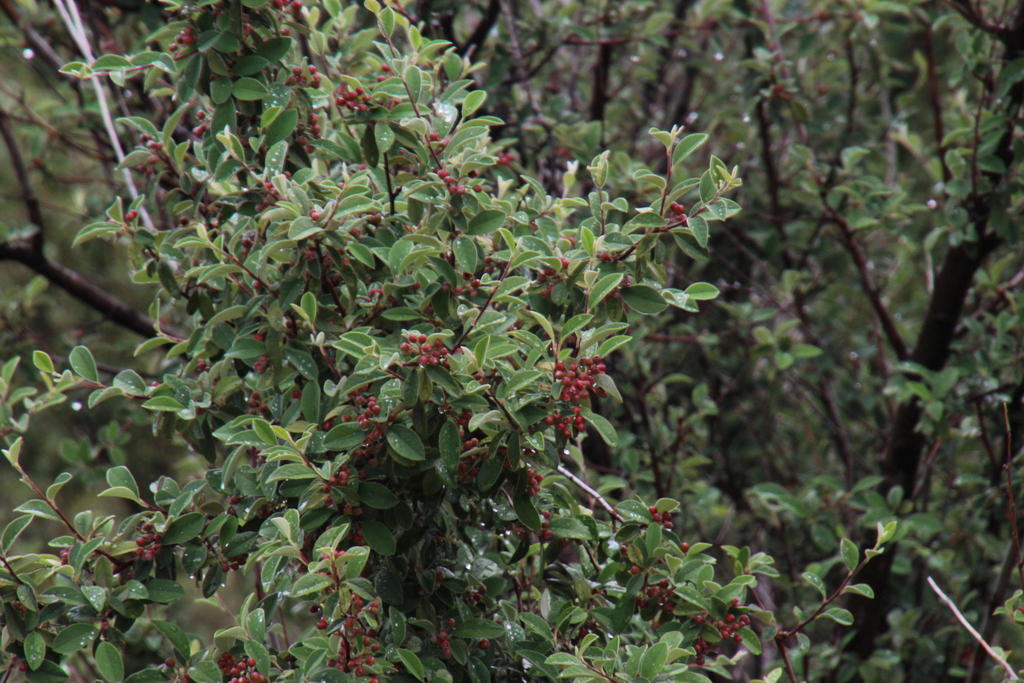
(c) Tony Rebelo, some rights reserved (CC BY-SA), uploaded by Tony Rebelo · licence
Family: Rosaceae · Type: Shrub · Not Native
Conservation status: Cal-IPC Yes
Cotoneaster pannosus (Silverleaf cotoneaster) is a non-native California shrub in the Rosaceae family, recognized by white-tomentose leaf undersides, dull blue-green tops, thin leaves.
Silverleaf cotoneaster is a naturalized shrub found in coastal and interior regions of California, including the North Coast, Central Valley, southern California coast, and western Transverse Ranges in meadows, rocky slopes, open forests, and disturbed ground at elevations generally below 1,000 meters. Flowering from May to July, this shrub produces white flowers 8.5 to 10 millimeters wide with purple-anthered stamens. Growing as an arching evergreen shrub 15 to 400 centimeters tall, it has a distinctive branching habit. Its leaves are elliptic to slightly ovate, 15 to 32 millimeters long, with a dull blue-green upper surface and white-woolly undersides. The fruit is a bright red, obovoid to slightly spherical drupe 7 to 9 millimeters long, persistent from October to May.
Identification and appearance
Key characters: 7 sympatric species; white-tomentose leaf undersides, dull blue-green tops, thin leaves
Habitat and range
Habitat: Meadows, rocky or brushy slopes, open forest, riparian zones, canyons, disturbed ground, thickets, mixed-evergreen forest
Elevation: generally < 1000 m
California counties: San Diego, Butte, Los Angeles, San Bernardino, Santa Clara, San Francisco, Ventura, Humboldt, Contra Costa, Alameda, Marin, Santa Cruz, Riverside, San Mateo, Santa Barbara, Mendocino, Monterey, Sonoma, San Luis Obispo, Napa, Orange, Sacramento, Yolo
Outside California: Oregon, native to southwestern China
Bloom period
Cotoneaster pannosus blooms May-Jul, fruiting Oct--May.
Conservation status
Cal-IPC Yes
How to tell it apart
vs Pyracantha: Pyracantha has thorns; Cotoneaster is thornless with smooth stems.; vs Heteromeles: Heteromeles has sharp-toothed leaf edges; Cotoneaster has completely smooth leaf margins.; vs Frangula: Frangula has prominent parallel leaf veins curving toward the tip; Cotoneaster has typical pinnate venation.; vs Rhamnus: Rhamnus has finely toothed leaves; Cotoneaster has completely smooth leaf edges.; vs Ceanothus: Ceanothus has three main veins from the leaf base; Cotoneaster has standard single-midrib venation.
Frequently asked questions
Is Cotoneaster pannosus native to California?
No. Cotoneaster pannosus is not native to California (recorded as not native).
When does Cotoneaster pannosus bloom?
Cotoneaster pannosus blooms May-Jul, fruiting Oct--May.
Where in California does Cotoneaster pannosus grow?
Cotoneaster pannosus occurs in San Diego, Butte, Los Angeles, San Bernardino, Santa Clara, San Francisco, Ventura, Humboldt and other counties, at elevations of generally < 1000 m.
What plant family does Cotoneaster pannosus belong to?
Cotoneaster pannosus is in the Rosaceae family, genus Cotoneaster.
Is Cotoneaster pannosus invasive in California?
Cotoneaster pannosus is listed by Cal-IPC with an invasiveness rating of Yes.
Related species
Other California species in the same genus, family, or bioregion.
- Cotoneaster simonsii — Himalayan cotoneaster
- Cotoneaster sp.
- Cotoneaster franchetii — Franchet's cotoneaster
- Cotoneaster frigidus — Tree cotoneaster
- Cotoneaster hodjingensis — Earthquake cotoneaster
- Cotoneaster horizontalis — Wall or herringbone cotoneaster
- Crataegus castlegarensis — Castlegar hawthorne
- Crataegus douglasii — Black hawthorn
Sources: Jepson eFlora · Index of California Plant Names · CalPhotos
Last updated 2026-10-07
Data from The California Species Project — 14,000+ California species with verified data from CNPS, CDFW, USFWS, Cal-IPC, and more.