Cotoneaster simonsii
Himalayan cotoneaster, Himalayan Cotoneaster
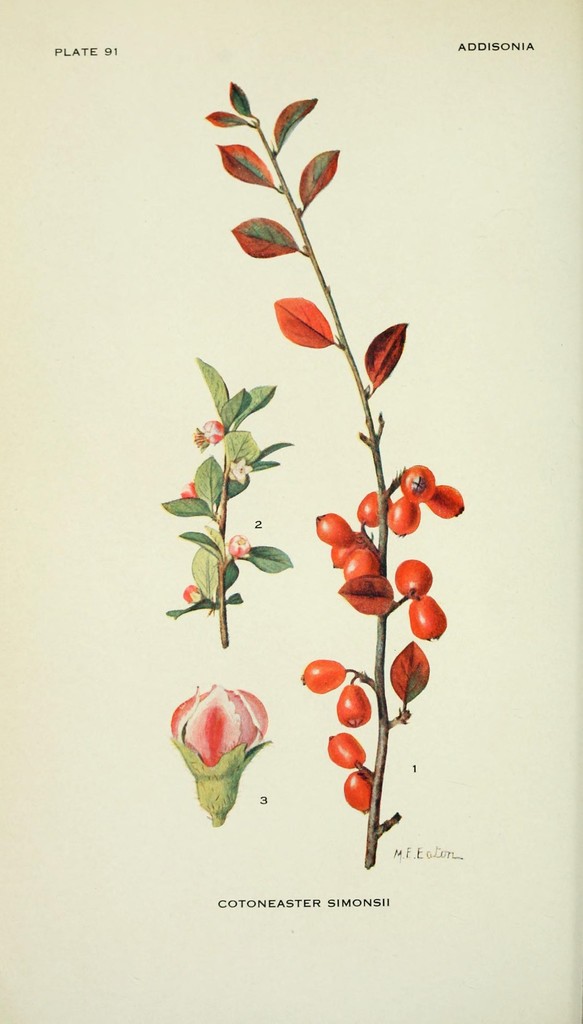
(c) Biodiversity Heritage Library, some rights reserved (CC BY) · licence
Family: Rosaceae · Type: Shrub · Not Native
Cotoneaster simonsii (Himalayan cotoneaster) is a non-native California shrub in the Rosaceae family, recognized by deciduous, pink flowers, 3-5 stones in fruit vs. 2 in most others.
Himalayan cotoneaster is a naturalized shrub found in northern California coastal, Klamath Ranges, and northern central western California regions in thickets, open forests, meadows, and disturbed ground at elevations below 1,000 meters. Flowering from May to June, this shrub produces delicate pink flowers with white anthers and pink filaments in small clusters. Growing 1 to 6 meters tall with a deciduous habit, it forms spreading branches with an open, arching structure. Its leaves are shiny, ovate, 10 to 30 millimeters long, with smooth upper surfaces and sparsely hairy undersides, featuring acute tips. In autumn and winter, the shrub develops bright red-orange obovate fruits 7 to 14 millimeters wide, adding visual interest to the landscape.
Identification and appearance
Key characters: 7 sympatric species; deciduous, pink flowers, 3-5 stones in fruit vs. 2 in most others
Habitat and range
Habitat: Thickets, open forest, meadows, pastures, disturbed ground
Elevation: < 1000 m
California counties: Alameda, Humboldt, Del Norte, Mendocino
Outside California: to British Columbia, native to Himalayas
Bloom period
Cotoneaster simonsii blooms May-Jun, fruiting Oct--Apr.
How to tell it apart
vs Pyracantha: Pyracantha has thorns; Cotoneaster is thornless with smooth stems.; vs Heteromeles: Heteromeles has sharp-toothed leaf edges; Cotoneaster has completely smooth leaf margins.; vs Frangula: Frangula has prominent parallel leaf veins curving toward the tip; Cotoneaster has typical pinnate venation.; vs Rhamnus: Rhamnus has finely toothed leaves; Cotoneaster has completely smooth leaf edges.; vs Ceanothus: Ceanothus has three main veins from the leaf base; Cotoneaster has standard single-midrib venation.
Frequently asked questions
Is Cotoneaster simonsii native to California?
No. Cotoneaster simonsii is not native to California (recorded as not native).
When does Cotoneaster simonsii bloom?
Cotoneaster simonsii blooms May-Jun, fruiting Oct--Apr.
Where in California does Cotoneaster simonsii grow?
Cotoneaster simonsii occurs in Alameda, Humboldt, Del Norte, Mendocino, at elevations of < 1000 m.
What plant family does Cotoneaster simonsii belong to?
Cotoneaster simonsii is in the Rosaceae family, genus Cotoneaster.
What habitat does Cotoneaster simonsii grow in?
Cotoneaster simonsii grows in Thickets, open forest, meadows, pastures, disturbed ground.
Related species
Other California species in the same genus, family, or bioregion.
- Cotoneaster sp.
- Cotoneaster franchetii — Franchet's cotoneaster
- Cotoneaster frigidus — Tree cotoneaster
- Cotoneaster hodjingensis — Earthquake cotoneaster
- Cotoneaster horizontalis — Wall or herringbone cotoneaster
- Cotoneaster integrifolius — Entire-leaved cotoneaster
- Crataegus castlegarensis — Castlegar hawthorne
- Crataegus douglasii — Black hawthorn
- Crataegus gaylussacia — Klamath hawthorn
Sources: Jepson eFlora · Index of California Plant Names · CalPhotos
Last updated 2026-10-07
Data from The California Species Project — 14,000+ California species with verified data from CNPS, CDFW, USFWS, Cal-IPC, and more.