Crassula ovata
Jade plant
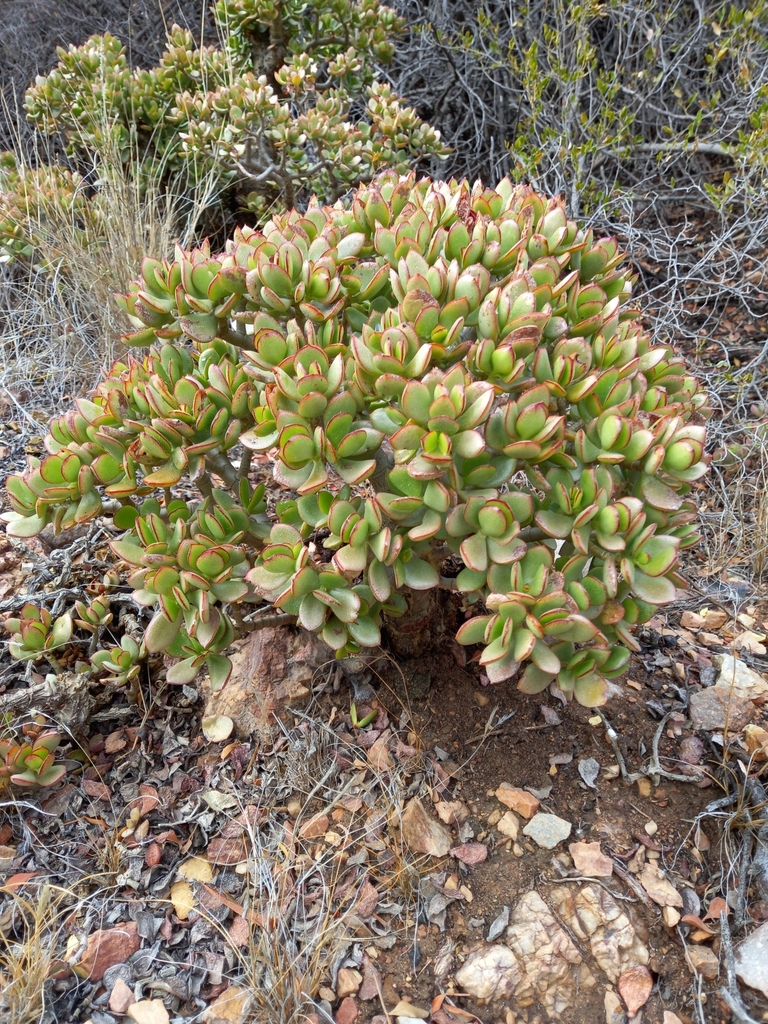
(c) Christiaan Viljoen, some rights reserved (CC BY) · licence
Family: Crassulaceae · Type: Shrub · Not Native
Crassula ovata (Jade plant) is a non-native California shrub in the Crassulaceae family, recognized by shrub form and large obovate leaves completely diagnostic.
Jade plant is a non-native shrub found in southern California coastal areas, persisting from cultivation and at dump sites at elevations below 100 meters. Flowering from December to February, this plant produces delicate white flowers tinged with pink, spreading in compact panicles. Growing with multiple erect stems up to 50 centimeters tall and 20 centimeters in diameter, it develops silvery smooth bark on younger branches. Its bright green leaves grow in multiple pairs, with obovate blades 20 to 70 millimeters long, featuring rounded tips and entire margins. The plant produces small ovoid fruits containing 30 to 50 oblong seeds with distinctive rows of pointed papillae.
Identification and appearance
Key characters: 6 sympatric species; shrub form and large obovate leaves completely diagnostic
Habitat and range
Habitat: Persisting from cultivation and at dump sites, wildland-urban interface, generally along coast
Elevation: < 100 m
California counties: San Diego, Santa Cruz, Los Angeles, Monterey, San Luis Obispo
Outside California: native to southern Africa
Bloom period
Crassula ovata blooms Dec-Feb.
How to tell it apart
vs Sedum: Sedum leaves are alternate or scattered; Crassula leaves are strictly opposite with fused bases.; vs Cotyledon: Cotyledon has large, fleshy leaves without fused bases; Crassula leaves clasp stem with fused bases.; vs Aeonium: Aeonium forms rosettes with many leaves per node; Crassula has two opposite leaves per node.; vs Kalanchoe: Kalanchoe has clusters of showy flowers; Crassula has tiny single flowers in leaf joints.; vs Portulacaria: Portulacaria has round, flat leaves on woody stems; Crassula has succulent opposite clasping leaves.
Frequently asked questions
Is Crassula ovata native to California?
No. Crassula ovata is not native to California (recorded as not native).
When does Crassula ovata bloom?
Crassula ovata blooms Dec-Feb.
Where in California does Crassula ovata grow?
Crassula ovata occurs in San Diego, Santa Cruz, Los Angeles, Monterey, San Luis Obispo, at elevations of < 100 m.
What plant family does Crassula ovata belong to?
Crassula ovata is in the Crassulaceae family, genus Crassula.
What habitat does Crassula ovata grow in?
Crassula ovata grows in Persisting from cultivation and at dump sites, wildland-urban interface, generally along coast.
Related species
Other California species in the same genus, family, or bioregion.
Sources: Jepson eFlora · Index of California Plant Names · CalPhotos
Last updated 2026-10-07
Data from The California Species Project — 14,000+ California species with verified data from CNPS, CDFW, USFWS, Cal-IPC, and more.