Crassula solieri
Little pygmy weed
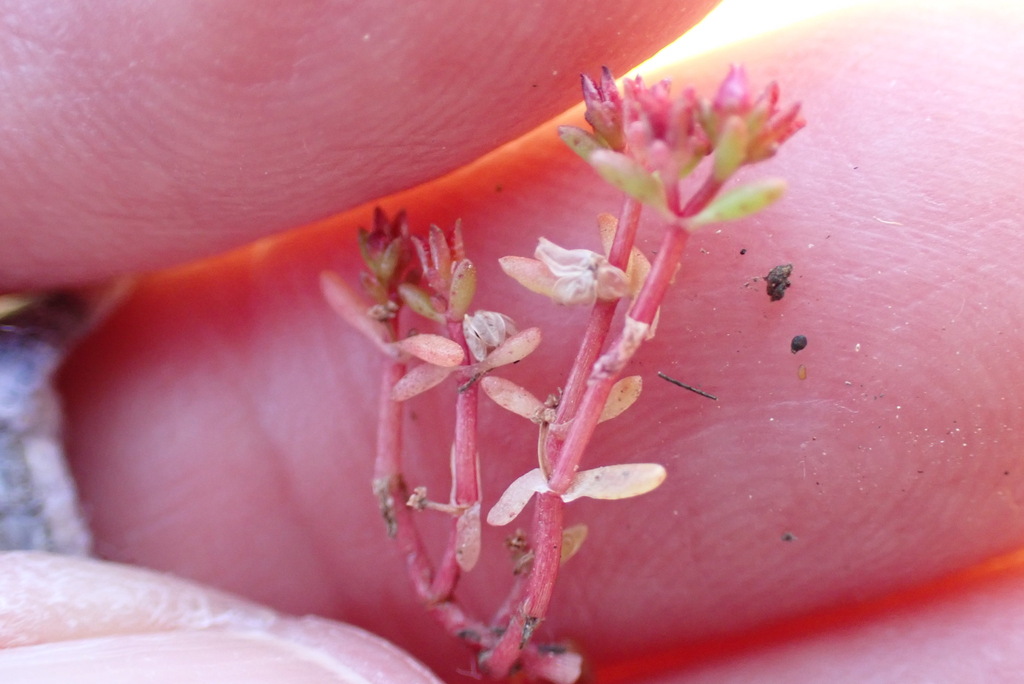
(c) Millie Basden, some rights reserved (CC BY) · licence
Family: Crassulaceae · Type: Herb · Native
Crassula solieri (Little pygmy weed) is a native California herb in the Crassulaceae family, recognized by seed shine and fruit tip shape separate from C. aquatica.
Little pygmy weed is a California native annual found in the northern Coast Ranges, northern Sierra Nevada foothills, Great Valley, southern California coastal areas, and Peninsular Ranges in vernal pools and lake or pond margins at elevations below 2,100 meters. Flowering from March to June, this plant produces small white to pale pink flowers less than 1.5 millimeters long, nestled individually at each leaf node. Growing with delicate decumbent or erect stems 2 to 7 centimeters tall that branch subtly, the plant forms compact clusters in wet habitats. Its tiny leaves are oblong to linear, measuring 1 to 5 millimeters long with slightly blunt tips, creating a dense, miniature ground-hugging appearance. The fruit produces 6 to 14 shiny, elliptic-oblong seeds with distinctive irregular longitudinal lines that glisten as if wet.
Identification and appearance
Key characters: 6 sympatric species; seed shine and fruit tip shape separate from C. aquatica
Habitat and range
Habitat: Vernal pools, margins of lakes, ponds
Elevation: < 2100 m
Outside California: to Oregon, Montana, Wyoming, Texas, Baja California, also Chile
Bloom period
Crassula solieri blooms Mar-Jun.
How to tell it apart
vs Sedum: Sedum leaves are alternate or scattered; Crassula leaves are strictly opposite with fused bases.; vs Cotyledon: Cotyledon has large, fleshy leaves without fused bases; Crassula leaves clasp stem with fused bases.; vs Aeonium: Aeonium forms rosettes with many leaves per node; Crassula has two opposite leaves per node.; vs Kalanchoe: Kalanchoe has clusters of showy flowers; Crassula has tiny single flowers in leaf joints.; vs Portulacaria: Portulacaria has round, flat leaves on woody stems; Crassula has succulent opposite clasping leaves.
Frequently asked questions
Is Crassula solieri native to California?
Yes. Crassula solieri is native to California (recorded as native).
When does Crassula solieri bloom?
Crassula solieri blooms Mar-Jun.
What plant family does Crassula solieri belong to?
Crassula solieri is in the Crassulaceae family, genus Crassula.
What habitat does Crassula solieri grow in?
Crassula solieri grows in Vernal pools, margins of lakes, ponds.
Related species
Other California species in the same genus, family, or bioregion.
Sources: Jepson eFlora · CalPhotos
Last updated 2026-10-07
Data from The California Species Project — 14,000+ California species with verified data from CNPS, CDFW, USFWS, Cal-IPC, and more.