Crassula tillaea
Mediterranean pygmy weed
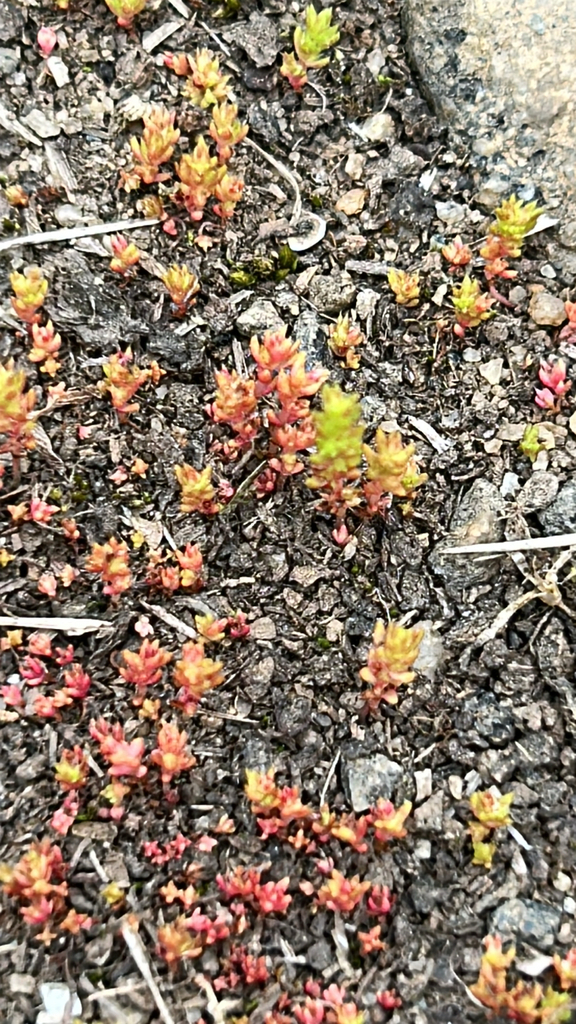
(c) caher001, some rights reserved (CC BY) · licence
Family: Crassulaceae · Type: Herb · Not Native
Crassula tillaea (Mediterranean pygmy weed) is a non-native California herb in the Crassulaceae family, recognized by 3-merous flowers and very short pedicels diagnostic.
Mediterranean pygmy weed is a naturalized annual found in northern California Interior Ranges, southern California Ranges, northern and central Sierra Nevada Foothills, Central Valley, Central Western, and Southwestern California in open, gravelly sites at elevations below 700 meters. Flowering from February to May, this plant produces tiny white to pinkish flowers less than one millimeter long. Growing with small erect stems 1 to 6 centimeters tall that turn reddish with age, it develops slender branches that remain upright. Its leaves are short and oblong, measuring 1 to 3 millimeters long with slightly pointed tips. The fruit develops as a small ascending ovoid structure containing one or two shiny, elliptic seeds with wavy longitudinal lines.
Identification and appearance
Key characters: 7 sympatric species; 3-merous flowers and very short pedicels diagnostic
Habitat and range
Habitat: Open, gravelly sites
Elevation: < 700 m
California counties: Yuba, Amador, Los Angeles, San Bernardino, Orange, Riverside, San Diego, Calaveras, Nevada, Tulare, Butte, San Joaquin, Yolo, Alameda, El Dorado, Fresno, Madera, Marin, Mendocino, Placer, Santa Clara, Solano, Stanislaus, Sutter, Kern, San Luis Obispo, Sacramento, Tehama, Colusa, Glenn, Merced, Shasta, Tuolumne, Contra Costa, San Mateo, Santa Cruz, Napa, Santa Barbara, Monterey, Lake
Outside California: to Washington, British Columbia, native to Mediterranean
Bloom period
Crassula tillaea blooms Feb-May.
How to tell it apart
vs Sedum: Sedum leaves are alternate or scattered; Crassula leaves are strictly opposite with fused bases.; vs Cotyledon: Cotyledon has large, fleshy leaves without fused bases; Crassula leaves clasp stem with fused bases.; vs Aeonium: Aeonium forms rosettes with many leaves per node; Crassula has two opposite leaves per node.; vs Kalanchoe: Kalanchoe has clusters of showy flowers; Crassula has tiny single flowers in leaf joints.; vs Portulacaria: Portulacaria has round, flat leaves on woody stems; Crassula has succulent opposite clasping leaves.
Frequently asked questions
Is Crassula tillaea native to California?
No. Crassula tillaea is not native to California (recorded as not native).
When does Crassula tillaea bloom?
Crassula tillaea blooms Feb-May.
Where in California does Crassula tillaea grow?
Crassula tillaea occurs in Yuba, Amador, Los Angeles, San Bernardino, Orange, Riverside, San Diego, Calaveras and other counties, at elevations of < 700 m.
What plant family does Crassula tillaea belong to?
Crassula tillaea is in the Crassulaceae family, genus Crassula.
What habitat does Crassula tillaea grow in?
Crassula tillaea grows in Open, gravelly sites.
Related species
Other California species in the same genus, family, or bioregion.
- Crassula aquatica — Aquatic pygmy weed
- Crassula colligata subsp. lamprosperma
- Crassula connata — Pygmy-weed
- Crassula multicava subsp. multicava — Fairy crassula
- Crassula ovata — Jade plant
- Crassula solieri — Little pygmy weed
- Crassulaceae sp. — Stonecrop family
- Dudleya abramsii — Abrams' dudleya
- Dudleya abramsii subsp. abramsii
- Dudleya abramsii subsp. affinis — San bernardino mountains dudleya
Sources: Jepson eFlora · Index of California Plant Names · CalPhotos
Last updated 2026-10-07
Data from The California Species Project — 14,000+ California species with verified data from CNPS, CDFW, USFWS, Cal-IPC, and more.