Crataegus castlegarensis
Castlegar hawthorne
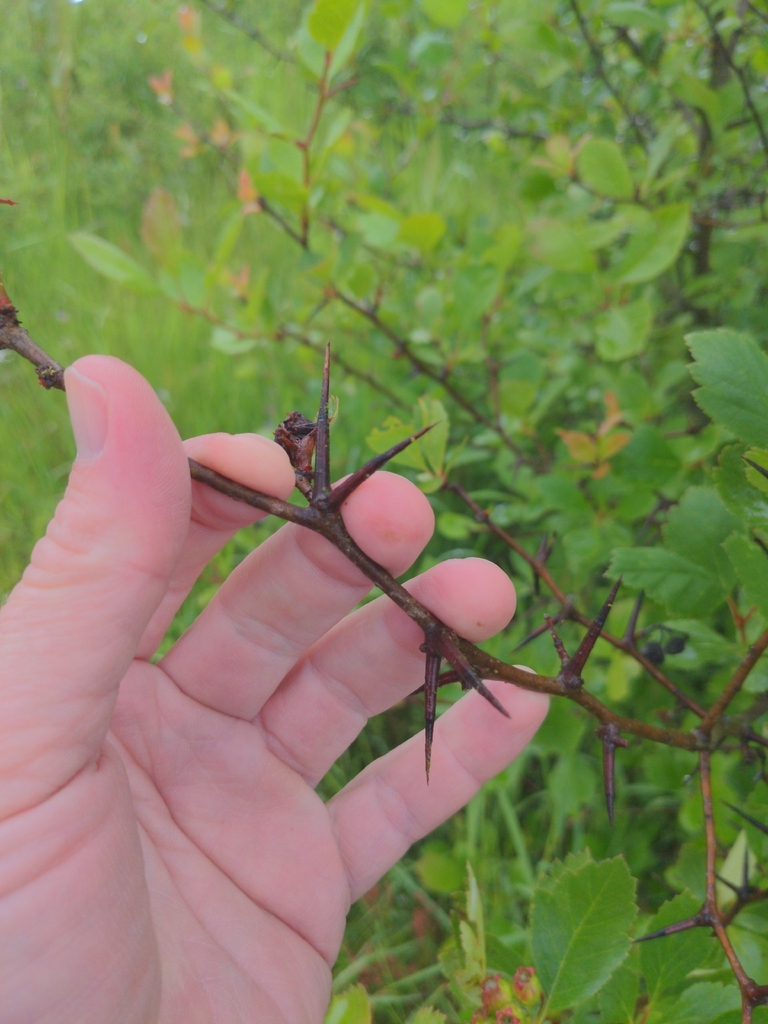
no rights reserved · CC0
Family: Rosaceae · Type: Tree · Native
Conservation status: CNPS 3
Crataegus castlegarensis (Castlegar hawthorne) is a native California tree in the Rosaceae family, recognized by hairy inflorescence is key distinguishing feature.
Castlegar hawthorn is a California native shrub found in the northern California Range and Modoc Plateau in streamsides, meadows, scrub, and forest at elevations of 900 to 1,300 meters. Flowering from May to August, this plant produces white flowers with pink anthers approximately 12 to 15 millimeters in diameter, arranged in hairy clusters. Growing with distinctive thorns 18 to 23 millimeters long, typically appearing in pairs or small groups, it forms a dense branching structure. Its leaves are short and relatively small, measuring 3.5 to 6 centimeters long, with an elliptic or narrow obovate shape, wedge-shaped base, and shallowly lobed edges with acute tips. The fruit is a nearly spherical deep purple to black drupe about 10 to 12 millimeters in diameter, containing 3 to 4 stones.
Identification and appearance
Key characters: 2 sympatric species; hairy inflorescence is key distinguishing feature
Habitat and range
Habitat: Streamsides in meadows, scrub, forest
Elevation: 900-1300 m
Outside California: to British Columbia, Saskatchewan, Montana
Bloom period
Crataegus castlegarensis blooms May-Aug.
Conservation status
CNPS 3
How to tell it apart
vs Ribes: Ribes lacks thorns and has maple-scented leaves; Crataegus has sharp thorns and unscented foliage.; vs Pyracantha: Pyracantha has narrow, unlobed evergreen leaves; Crataegus has broad, deeply lobed leaves that drop in fall.; vs Quercus: Quercus lacks thorns and has acorns; Crataegus has sharp thorns and small apple-like fruits.; vs Prunus: Prunus has smooth-edged or finely toothed leaves; Crataegus has prominently lobed leaves beyond the middle.; vs Pyrus: Pyrus has unlobed oval leaves and pear-shaped fruits; Crataegus has deeply lobed leaves and small round fruits.
Frequently asked questions
Is Crataegus castlegarensis native to California?
Yes. Crataegus castlegarensis is native to California (recorded as native).
When does Crataegus castlegarensis bloom?
Crataegus castlegarensis blooms May-Aug.
What plant family does Crataegus castlegarensis belong to?
Crataegus castlegarensis is in the Rosaceae family, genus Crataegus.
Is Crataegus castlegarensis rare or endangered?
Crataegus castlegarensis carries California Rare Plant Rank 3, state rank S3?.
What habitat does Crataegus castlegarensis grow in?
Crataegus castlegarensis grows in Streamsides in meadows, scrub, forest.
Related species
Other California species in the same genus, family, or bioregion.
Sources: Jepson eFlora · CalPhotos · CDFW CNDDB
Last updated 2026-10-07
Data from The California Species Project — 14,000+ California species with verified data from CNPS, CDFW, USFWS, Cal-IPC, and more.