Crepis occidentalis subsp. conjuncta
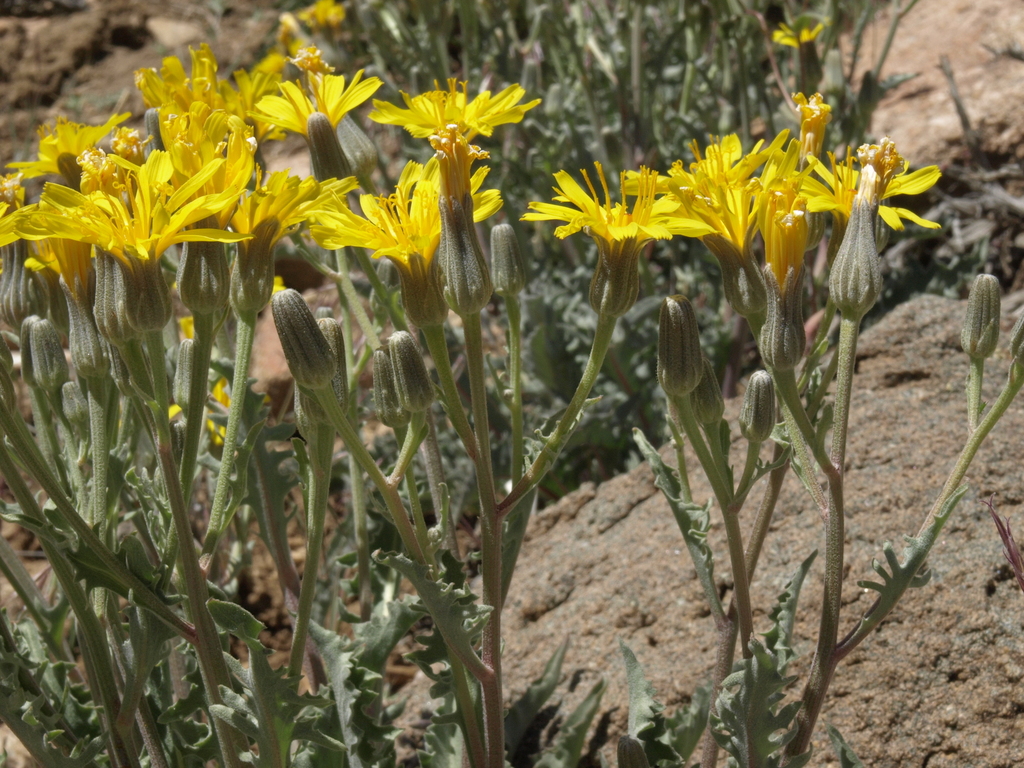
(c) Jim Morefield, some rights reserved (CC BY) · licence
Family: Asteraceae · Type: Herb · Native
Crepis occidentalis subsp. conjuncta is a native California herb in the Asteraceae family, recognized by compact habit, narrow leaf lobes, and lack of glandular hairs.
Western hawksbeard is a California native perennial found in the Klamath Ranges, northern Coast Ranges, California Ranges, northern Sierra Nevada, and Warner Mountains on ridgetops and gravelly soils at elevations of 1,400 to 2,100 meters. Flowering from June to July, this plant produces yellow flowers in heads with 12 to 40 individual florets. Growing with woolly stems 5 to 20 centimeters tall, it has a distinctive low-growing form that spreads across gravelly terrain. Its leaves are deeply pinnately lobed, with narrow lobes spaced distinctively along the leaf surface, extending 10 to 18 centimeters in length. The fruit develops as a dark brown seed cluster, reflecting the plant's adaptation to rocky, high-elevation environments.
Identification and appearance
Key characters: 17 sympatric species; distinguished by compact habit, narrow leaf lobes, and lack of glandular hairs
Habitat and range
Habitat: Ridgetops, gravelly soils
Elevation: 1400-2100 m
California counties: Alpine, Mendocino, Mono, Nevada, Placer, Plumas, Shasta, Siskiyou, Tulare, Modoc, El Dorado, Humboldt, Trinity, Tuolumne, Ventura, Lassen, Sierra, Calaveras, Santa Barbara, Tehama, Butte, Glenn, Del Norte
Outside California: to Washington, Montana, Colorado
Bloom period
Crepis occidentalis subsp. conjuncta blooms Jun-Jul.
How to tell it apart
vs Hypochaeris: Hypochaeris has mostly leafless stems with tiny bracts; Crepis has well-developed leaves up the stem.; vs Taraxacum: Taraxacum has all leaves basal with leafless stems; Crepis has leaves ascending the branched stem.; vs Agoseris: Agoseris has leafless flower stems from basal rosettes; Crepis has leafy branched stems.; vs Sonchus: Sonchus has clasping stem leaves with spiny margins; Crepis leaves are typically not clasping or spiny.; vs Helminthotheca: Helminthotheca has bristly leaves and bracts; Crepis typically lacks the dense bristly covering.
Frequently asked questions
Is Crepis occidentalis subsp. conjuncta native to California?
Yes. Crepis occidentalis subsp. conjuncta is native to California (recorded as native).
When does Crepis occidentalis subsp. conjuncta bloom?
Crepis occidentalis subsp. conjuncta blooms Jun-Jul.
Where in California does Crepis occidentalis subsp. conjuncta grow?
Crepis occidentalis subsp. conjuncta occurs in Alpine, Mendocino, Mono, Nevada, Placer, Plumas, Shasta, Siskiyou and other counties, at elevations of 1400-2100 m.
What plant family does Crepis occidentalis subsp. conjuncta belong to?
Crepis occidentalis subsp. conjuncta is in the Asteraceae family, genus Crepis.
What habitat does Crepis occidentalis subsp. conjuncta grow in?
Crepis occidentalis subsp. conjuncta grows in Ridgetops, gravelly soils.
Related species
Other California species in the same genus, family, or bioregion.
Sources: Jepson eFlora · Index of California Plant Names · CalPhotos
Last updated 2026-10-07
Data from The California Species Project — 14,000+ California species with verified data from CNPS, CDFW, USFWS, Cal-IPC, and more.