Crepis vesicaria subsp. taraxacifolia
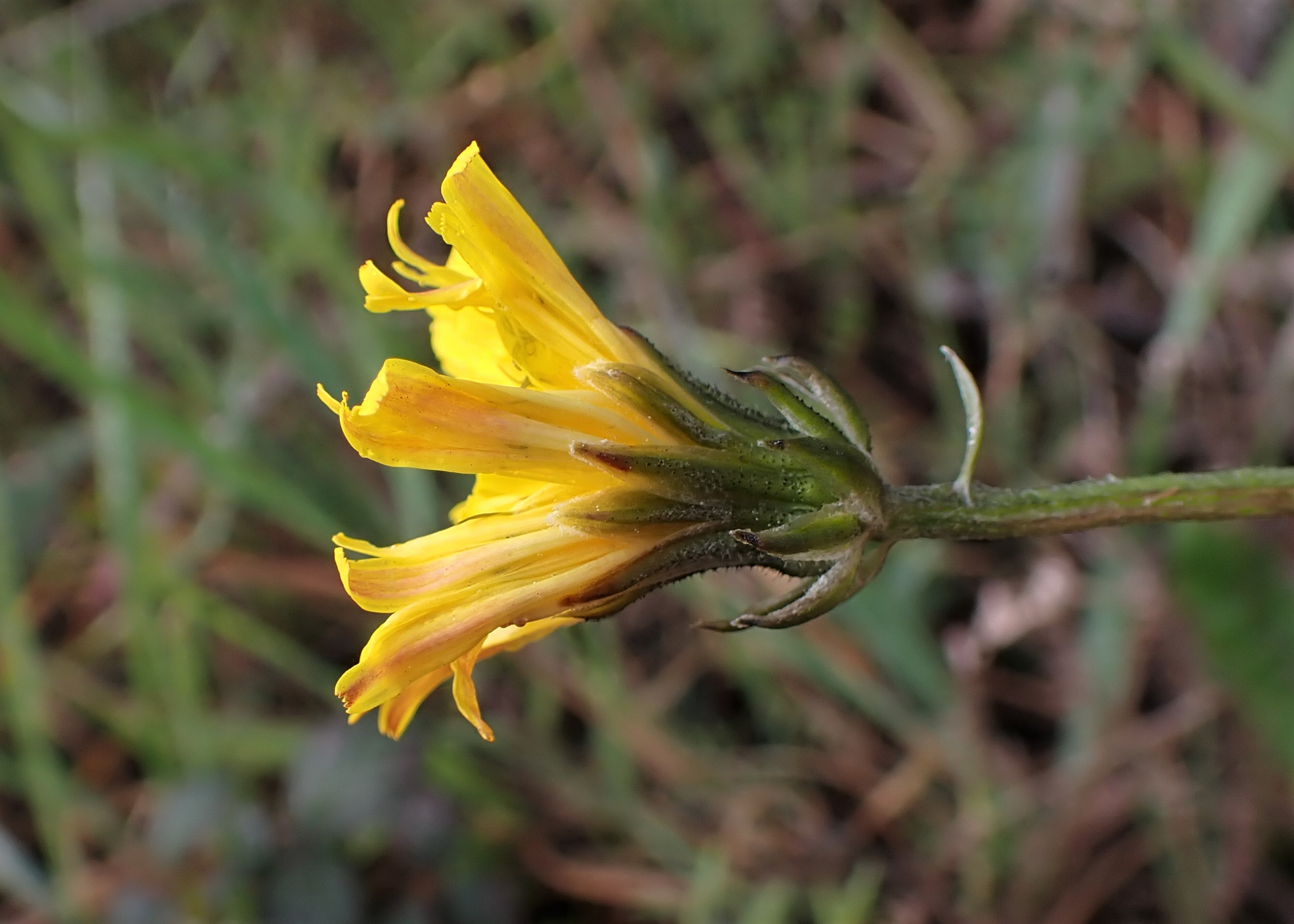
Krzysztof Ziarnek, Kenraiz (via Wikimedia Commons) · CC BY-SA
Family: Asteraceae · Type: Herb · Not Native
Crepis vesicaria subsp. taraxacifolia is a non-native California herb in the Asteraceae family, recognized by very low coastal elevation and dimorphic fruits with prominent beaks.
Hawksbeard is a naturalized perennial herb found in sandy clearings, hillsides, and disturbed places in the northern Coast Ranges, San Francisco Bay Area, and southern California at elevations below 300 meters. Flowering from February to October, this plant produces bright yellow flowers with reddish undersides in loose clusters of 10 to 20 heads. Growing with decumbent to erect stems 30 to 120 centimeters tall that are much-branched and short-hairy, it emerges from a swollen, woody caudex. Its leaves range 10 to 35 centimeters long, oblanceolate to ovate with pinnate lobes, featuring a large toothed terminal lobe and recurved lateral lobes. The fruit is pale brown to yellow, 4 to 9 millimeters long, with some developing a distinct beak 2 to 5 millimeters in length.
Identification and appearance
Key characters: 6 sympatric species; distinguished by very low coastal elevation and dimorphic fruits with prominent beaks
Habitat and range
Habitat: Sandy clearings, hillsides, disturbed places
Elevation: < 300 m
Outside California: native to Europe
Bloom period
Crepis vesicaria subsp. taraxacifolia blooms Feb-Oct.
How to tell it apart
vs Hypochaeris: Hypochaeris has mostly leafless stems with tiny bracts; Crepis has well-developed leaves up the stem.; vs Taraxacum: Taraxacum has all leaves basal with leafless stems; Crepis has leaves ascending the branched stem.; vs Agoseris: Agoseris has leafless flower stems from basal rosettes; Crepis has leafy branched stems.; vs Sonchus: Sonchus has clasping stem leaves with spiny margins; Crepis leaves are typically not clasping or spiny.; vs Helminthotheca: Helminthotheca has bristly leaves and bracts; Crepis typically lacks the dense bristly covering.
Frequently asked questions
Is Crepis vesicaria subsp. taraxacifolia native to California?
No. Crepis vesicaria subsp. taraxacifolia is not native to California (recorded as not native).
When does Crepis vesicaria subsp. taraxacifolia bloom?
Crepis vesicaria subsp. taraxacifolia blooms Feb-Oct.
What plant family does Crepis vesicaria subsp. taraxacifolia belong to?
Crepis vesicaria subsp. taraxacifolia is in the Asteraceae family, genus Crepis.
What habitat does Crepis vesicaria subsp. taraxacifolia grow in?
Crepis vesicaria subsp. taraxacifolia grows in Sandy clearings, hillsides, disturbed places.
Related species
Other California species in the same genus, family, or bioregion.
- Crepis acuminata — Long leaved hawk's beard
- Crepis bakeri — Baker's hawksbeard
- Crepis bakeri subsp. bakeri
- Crepis bakeri subsp. cusickii
- Crepis bakeri subsp. idahoensis
- Crepis bursifolia — Italian hawksbeard
- Crocidium multicaule — Common spring gold
- Crocidium sp. — Spring gold
- Crupina sp.
- Crupina vulgaris — Bearded creeper
Sources: Jepson eFlora · Index of California Plant Names · CalPhotos
Last updated 2026-10-07
Data from The California Species Project — 14,000+ California species with verified data from CNPS, CDFW, USFWS, Cal-IPC, and more.