Cressa truxillensis
Alkali weed
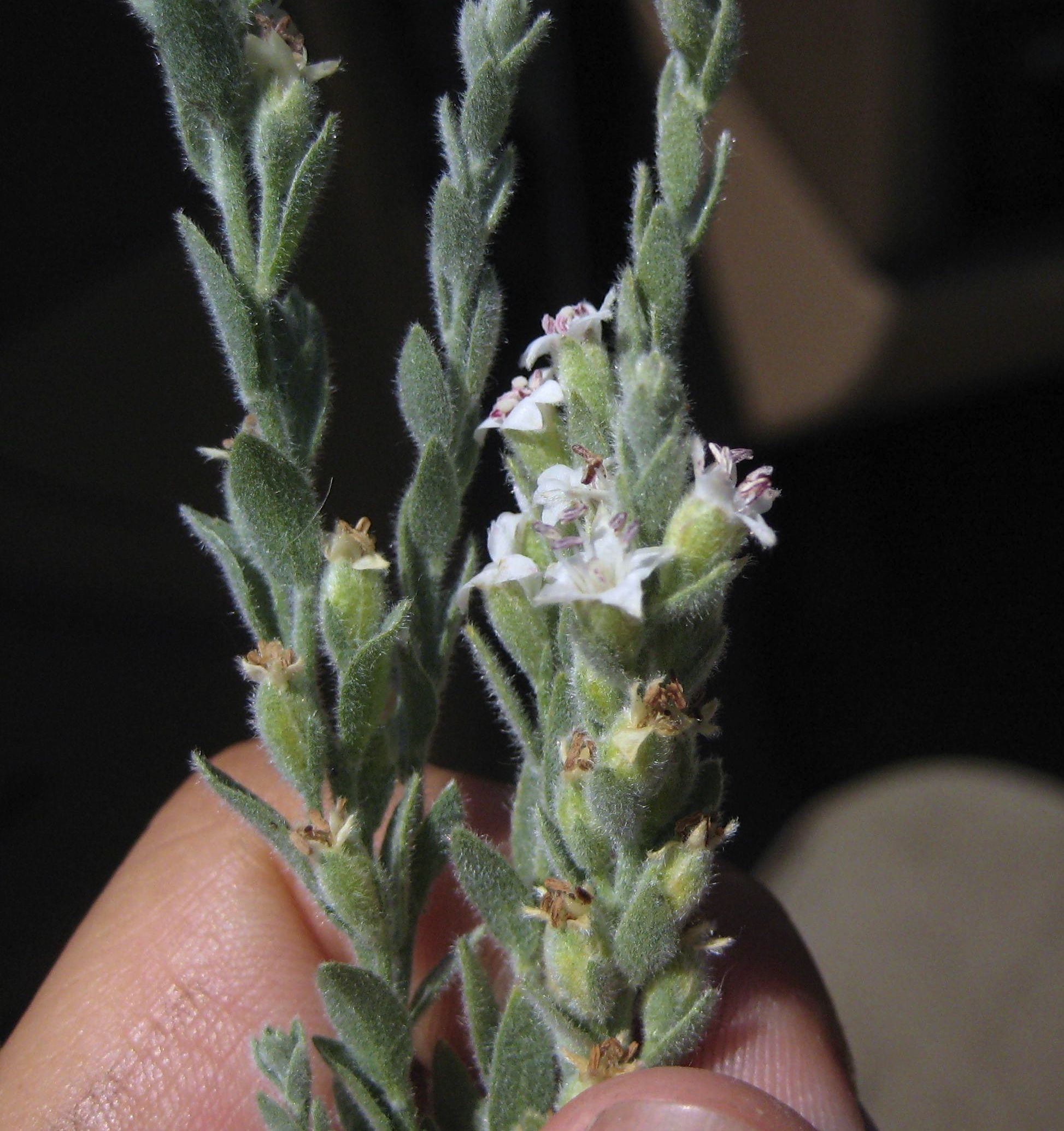
Photo by Chez Brungraber
Family: Convolvulaceae · Type: Subshrub · Native
Cressa truxillensis (Alkali weed) is a native California subshrub in the Convolvulaceae family, recognized by Only Cressa in California, representing a small genus adapted to saline habitats in warm regions worldwide.
Alkali weed is a California native perennial found in the Great Valley, central western California, southern California coastal areas, Channel Islands, Great Basin, and desert regions on saline and alkaline substrates at elevations below 1,500 meters. Flowering from May to October, this plant produces delicate white flowers 5 to 8 millimeters long with ovate, acute lobes. Growing as a tufted plant with much-branched stems 7 to 25 centimeters tall, it features densely silky-canescent stems that spread from the base. Its leaves are small, less than 1 centimeter long, sessile and elliptic in shape. The plant often produces a single seed and has distinctive white flowers with exserted stamens and styles.
Identification and appearance
Key characters: Only Cressa in California, representing a small genus adapted to saline habitats in warm regions worldwide
Habitat and range
Habitat: Saline and alkaline substrates
Elevation: < 1500 m
California counties: Los Angeles, San Bernardino, Inyo, Orange, Riverside, Contra Costa, Lassen, Sutter, Kern, Ventura, San Diego, Modoc, Fresno, San Joaquin, Sonoma, Santa Clara, Alameda, Santa Barbara, Yolo, Imperial, Santa Cruz, San Luis Obispo, Tulare, Colusa, Kings, Merced, Marin, Solano, Butte, Glenn, Napa, San Benito, Stanislaus, Sacramento, Monterey
Outside California: to Oregon, Texas, Mexico, South America
Bloom period
Cressa truxillensis blooms May-Oct.
How to tell it apart
vs Frankenia: Frankenia has needle-like or scale-like leaves; Cressa has small oval leaves.; vs Extriplex: Extriplex leaves are triangular or diamond-shaped; Cressa leaves are oval and densely silvery-hairy.; vs Heterotheca: Heterotheca has yellow daisy flowers; Cressa has small white morning-glory flowers.; vs Atriplex: Atriplex has scurfy or mealy coating; Cressa has dense silky-white hairs.; vs Chloropyron: Chloropyron has tubular flowers with visible lobes; Cressa has funnel-shaped morning-glory flowers.
Frequently asked questions
Is Cressa truxillensis native to California?
Yes. Cressa truxillensis is native to California (recorded as native).
When does Cressa truxillensis bloom?
Cressa truxillensis blooms May-Oct.
Where in California does Cressa truxillensis grow?
Cressa truxillensis occurs in Los Angeles, San Bernardino, Inyo, Orange, Riverside, Contra Costa, Lassen, Sutter and other counties, at elevations of < 1500 m.
What plant family does Cressa truxillensis belong to?
Cressa truxillensis is in the Convolvulaceae family, genus Cressa.
What habitat does Cressa truxillensis grow in?
Cressa truxillensis grows in Saline and alkaline substrates.
Related species
Other California species in the same genus, family, or bioregion.
Sources: Jepson eFlora · Index of California Plant Names · CalPhotos
Last updated 2026-10-07
Data from The California Species Project — 14,000+ California species with verified data from CNPS, CDFW, USFWS, Cal-IPC, and more.