Crocidium multicaule
Common spring gold
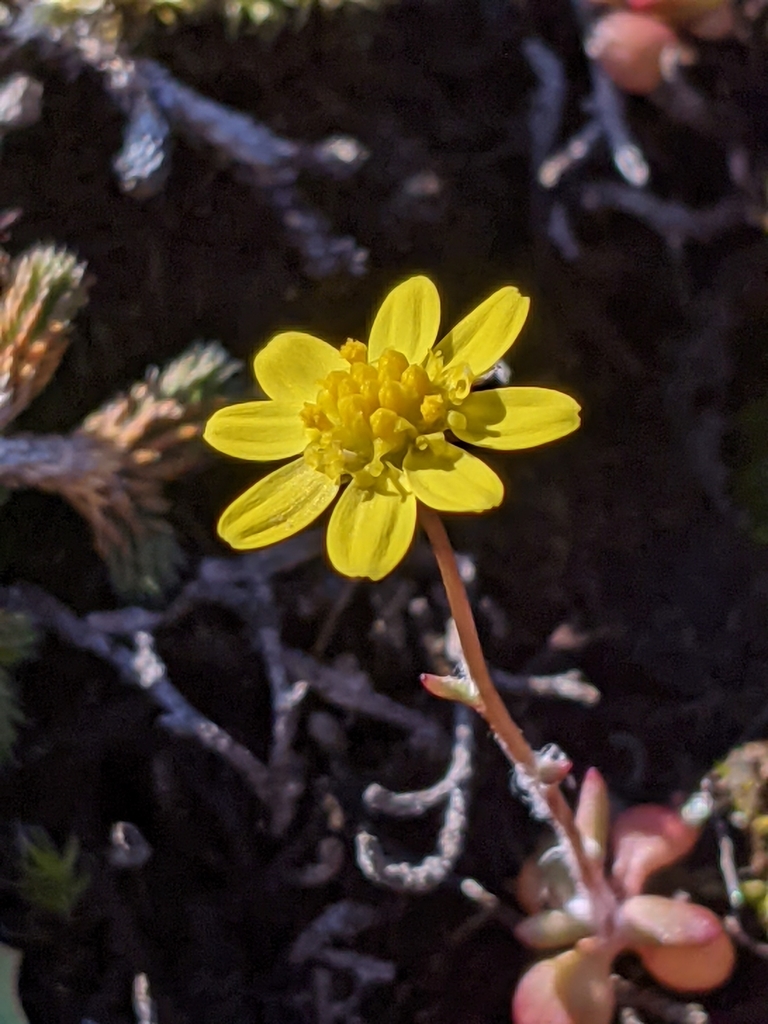
(c) David Anderson, some rights reserved (CC BY), uploaded by David Anderson · licence
Family: Asteraceae · Type: Herb · Native
Crocidium multicaule (Common spring gold) is a native California herb in the Asteraceae family, recognized by Sole representative of genus Crocidium in California, part of a small Pacific Northwest endemic genus.
Common spring gold is a California native annual found in the Klamath Ranges, northern California Coast Ranges, high Cascade Range, Sierra Nevada Foothills, eastern San Francisco Bay Area, and southern Coast Ranges in sandy soils, grasslands, and open woodlands at elevations up to 1,600 meters. Flowering from February to June, this plant produces bright yellow ray flowers 4 to 10 millimeters long with distinctive radiate heads. Growing with slender stems 5 to 30 centimeters tall, it emerges with 1 to few unbranched stems that are glabrous or slightly hairy, especially in lower axils. Its leaves are alternate, ranging from linear to obovate, approximately 10 to 25 millimeters long, and slightly fleshy with entire or few-toothed margins. The fruit is small, elliptic, and develops a gelatinous coating when wet, with early-deciduous bristles that often disappear quickly.
Identification and appearance
Key characters: Sole representative of genus Crocidium in California, part of a small Pacific Northwest endemic genus
Habitat and range
Habitat: Sandy soils, grassland, open woodland
Elevation: generally <= 1600 m
Outside California: to British Columbia, Idaho
Bloom period
Crocidium multicaule blooms Feb-Jun.
How to tell it apart
vs Blennosperma: Crocidium has cone-shaped receptacles and fused bracts; Blennosperma has flat receptacles and free bracts.; vs Lasthenia: Crocidium bracts fuse at base forming a cup; Lasthenia bracts remain completely separate.; vs Heterotheca: Crocidium bracts form single fused ring; Heterotheca has multiple overlapping layers of free bracts.; vs Pulicaria: Crocidium bracts lack papery edges; Pulicaria bracts have translucent papery margins.; vs Pentachaeta: Crocidium bracts fuse at base; Pentachaeta bracts are completely separate with papery edges.
Frequently asked questions
Is Crocidium multicaule native to California?
Yes. Crocidium multicaule is native to California (recorded as native).
When does Crocidium multicaule bloom?
Crocidium multicaule blooms Feb-Jun.
What plant family does Crocidium multicaule belong to?
Crocidium multicaule is in the Asteraceae family, genus Crocidium.
What habitat does Crocidium multicaule grow in?
Crocidium multicaule grows in Sandy soils, grassland, open woodland.
Related species
Other California species in the same genus, family, or bioregion.
Sources: Jepson eFlora · Index of California Plant Names · CalPhotos
Last updated 2026-10-07
Data from The California Species Project — 14,000+ California species with verified data from CNPS, CDFW, USFWS, Cal-IPC, and more.