Croton californicus
California croton
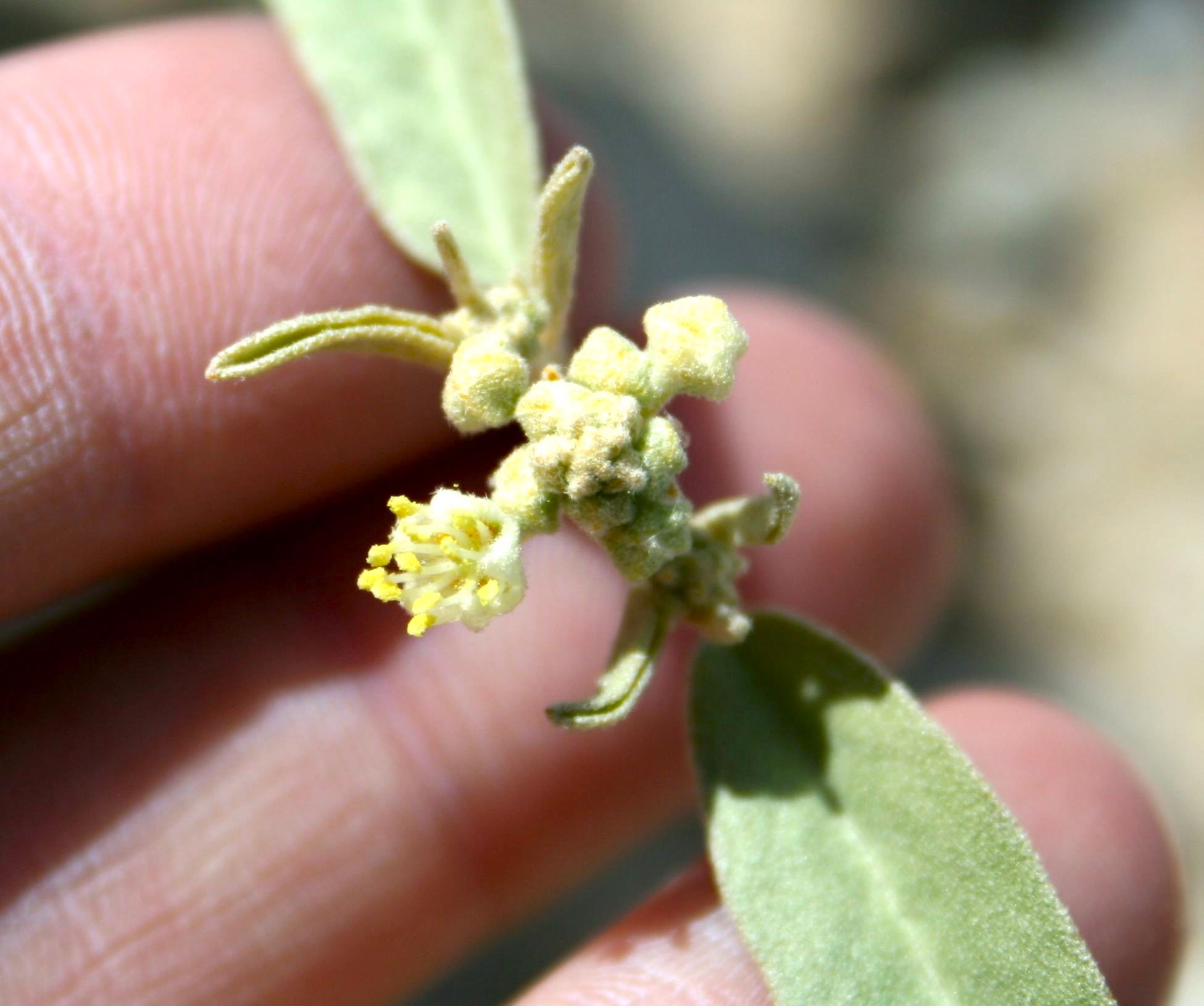
Photo by Chez Brungraber
Family: Euphorbiaceae · Type: Subshrub · Native
Croton californicus (California croton) is a native California subshrub in the Euphorbiaceae family, recognized by (C. setiger); key differences are life form (perennial vs annual) and leaf shape.
California croton is a California native perennial found in the Tehachapi Mountains, San Joaquin Valley, central Coast Ranges, southern Coast Ranges, southern California, Santa Catalina Island, Transverse Ranges, Peninsular Ranges, and desert regions in sandy soils, dunes, and washes at elevations below 900 meters. Flowering from April to July, this plant produces small flowers with distinctive stellate (star-shaped) hairs. Growing as a low subshrub to one meter tall with spreading branches, it has a sparse, open structure. Its leaves are elliptic to narrowly oblong, 2 to 5.5 centimeters long with rounded or obtuse tips, supported by petioles 1 to 4 centimeters long. The plant is dioecious, with separate male and female flowers arranged in racemes, featuring 10 to 15 stamens in male flowers and a three-chambered ovary in female flowers.
Identification and appearance
Key characters: 1 sympatric species (C. setiger); key differences are life form (perennial vs annual) and leaf shape
Habitat and range
Habitat: Sandy soils, dunes, washes
Elevation: < 900 m
California counties: Riverside, San Bernardino, Imperial, Ventura, Los Angeles, Kern, Orange, Santa Barbara, San Diego, Contra Costa, Monterey, San Luis Obispo, San Francisco, Santa Clara, Inyo, San Benito
Outside California: Arizona, Baja California
Bloom period
Croton californicus blooms Apr-Jul.
How to tell it apart
vs Tidestromia: Croton leaves feel scurfy from star-hairs; Tidestromia leaves are smooth and succulent-like.; vs Encelia: Croton has 3-part capsule fruits; Encelia has daisy-like flower heads with ray petals.; vs Eriogonum: Croton has alternate leaves; buckwheat leaves are whorled or basal rosettes.; vs Verbascum: Croton has smooth leaf edges; mullein leaves have wavy or toothed edges.; vs Marrubium: Croton stems are round; horehound stems are square with opposite leaves.
Frequently asked questions
Is Croton californicus native to California?
Yes. Croton californicus is native to California (recorded as native).
When does Croton californicus bloom?
Croton californicus blooms Apr-Jul.
Where in California does Croton californicus grow?
Croton californicus occurs in Riverside, San Bernardino, Imperial, Ventura, Los Angeles, Kern, Orange, Santa Barbara and other counties, at elevations of < 900 m.
What plant family does Croton californicus belong to?
Croton californicus is in the Euphorbiaceae family, genus Croton.
What habitat does Croton californicus grow in?
Croton californicus grows in Sandy soils, dunes, washes.
Related species
Other California species in the same genus, family, or bioregion.
Sources: Jepson eFlora · Index of California Plant Names · CalPhotos
Last updated 2026-10-07
Data from The California Species Project — 14,000+ California species with verified data from CNPS, CDFW, USFWS, Cal-IPC, and more.