Cryptantha decipiens
Gravel cryptantha, Gravel Cryptantha
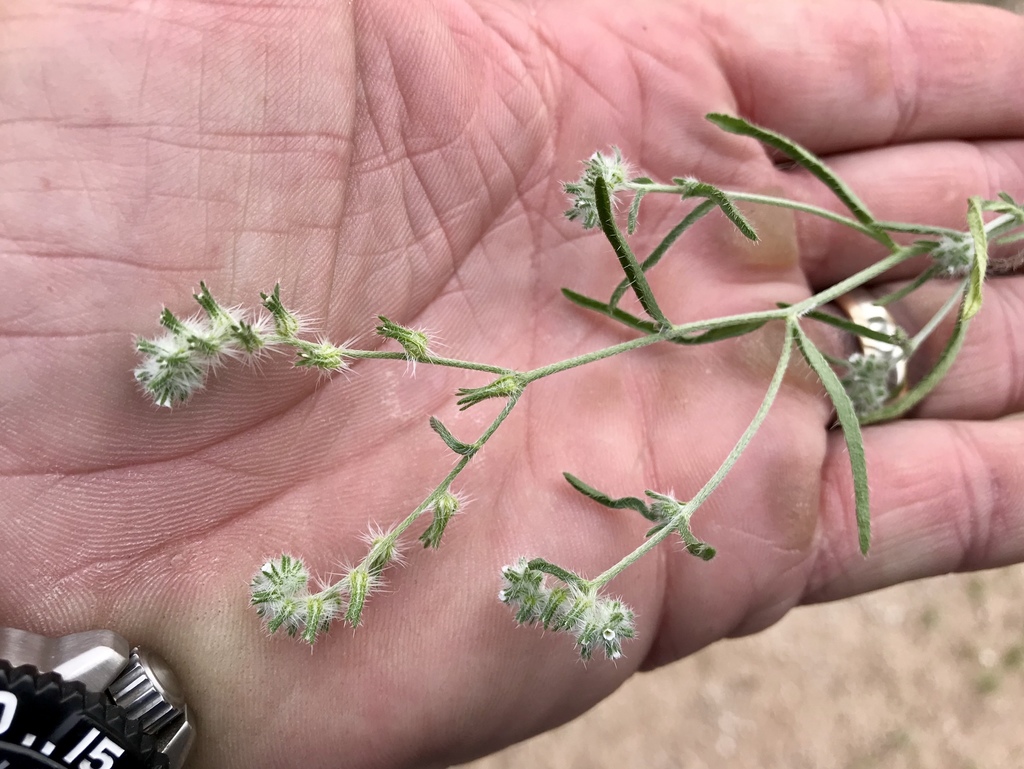
(c) CK2AZ, some rights reserved (CC BY) · licence
Family: Boraginaceae · Type: Herb · Native
Cryptantha decipiens (Gravel cryptantha) is a native California herb in the Boraginaceae family, recognized by 42 co-occurring species. Key feature: asymmetric urn-shaped calyx with outer 3 lobes having thickened midveins and coarse bristles.
Gravel cryptantha is a California native annual found in southeastern Sierra Nevada, Tehachapi, San Joaquin Valley, San Francisco Bay Area, and other southern California regions in open gravelly slopes, creosote-bush scrub, and Joshua-tree woodland at elevations of 60 to 1,400 meters. Flowering from March to May, this plant produces small white flowers with delicate petals in tight clusters. Growing 10 to 40 centimeters tall with slender erect stems covered in stiff, appressed hairs, the plant has a distinctive sparse branching pattern. Its leaves are narrow and linear, ranging from 0.5 to 3 centimeters long, with minute hairs that have bulbous bases. The fruit consists of lance-ovate nutlets 2.3 to 2.7 millimeters long, brown and textured with upward-pointing tubercles.
Identification and appearance
Key characters: 42 co-occurring species. Key feature: asymmetric urn-shaped calyx with outer 3 lobes having thickened midveins and coarse bristles.
Habitat and range
Habitat: Open, gravelly, occasionally coarse sandy slopes, washes, creosote-bush scrub, Joshua-tree woodland
Elevation: 60-1400 m
California counties: San Bernardino, Los Angeles, Inyo, Riverside, San Diego, Kern, Imperial, San Luis Obispo, Ventura, Santa Barbara, San Benito, Fresno, Contra Costa, Monterey, Merced, Stanislaus, Alameda, Tulare
Outside California: to southwestern Utah, Arizona
Bloom period
Cryptantha decipiens blooms Mar-May.
How to tell it apart
vs Plagiobothrys: Seeds have a groove down the inner face, not a raised ridge like Plagiobothrys.; vs Johnstonella: Cryptantha nutlets have grooves; Johnstonella nutlets lack distinct grooves on inner face.; vs Eremocarya: Cryptantha has grooved nutlets; Eremocarya nutlets are smooth without grooves.; vs Phacelia: Cryptantha has coiled flower clusters; Phacelia flowers are in looser, more open arrangements.; vs Pectocarya: Seeds lack the comb-like marginal barbs that give Pectocarya its combseed name.
Frequently asked questions
Is Cryptantha decipiens native to California?
Yes. Cryptantha decipiens is native to California (recorded as native).
When does Cryptantha decipiens bloom?
Cryptantha decipiens blooms Mar-May.
Where in California does Cryptantha decipiens grow?
Cryptantha decipiens occurs in San Bernardino, Los Angeles, Inyo, Riverside, San Diego, Kern, Imperial, San Luis Obispo and other counties, at elevations of 60-1400 m.
What plant family does Cryptantha decipiens belong to?
Cryptantha decipiens is in the Boraginaceae family, genus Cryptantha.
What habitat does Cryptantha decipiens grow in?
Cryptantha decipiens grows in Open, gravelly, occasionally coarse sandy slopes, washes, creosote-bush scrub, Joshua-tree woodland.
Related species
Other California species in the same genus, family, or bioregion.
Sources: Jepson eFlora · Index of California Plant Names · CalPhotos
Last updated 2026-10-07
Data from The California Species Project — 14,000+ California species with verified data from CNPS, CDFW, USFWS, Cal-IPC, and more.