Cryptantha glomeriflora
Clustered-flower cryptantha, Clustered-Flower Cryptantha
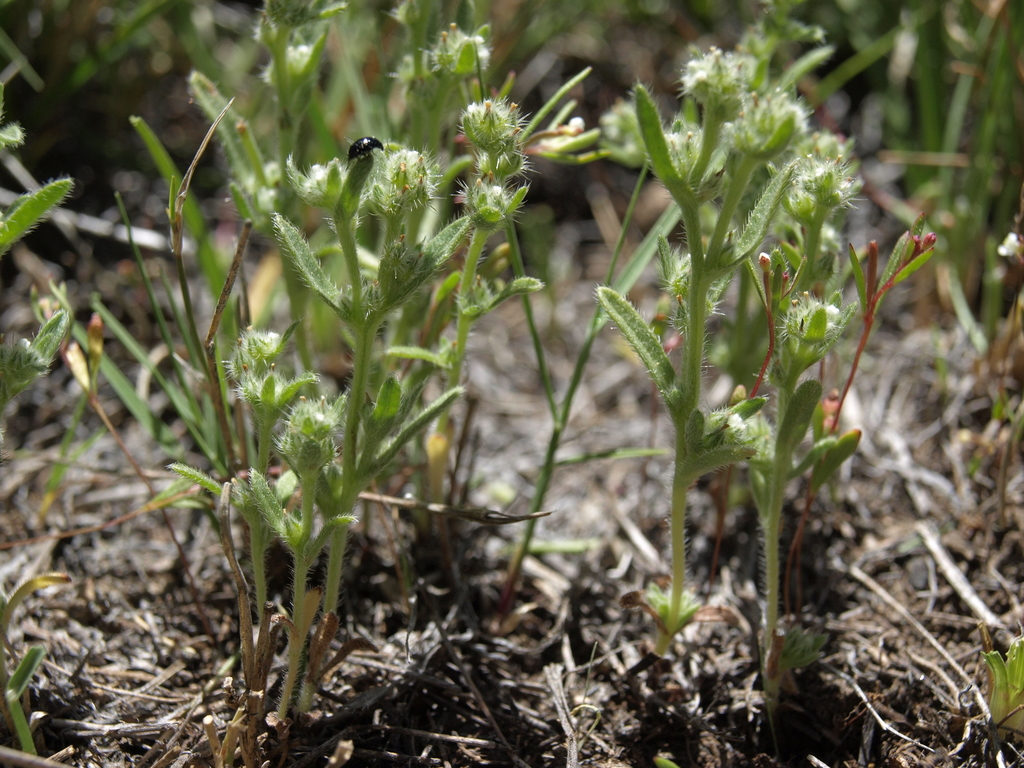
(c) Jim Morefield, some rights reserved (CC BY), uploaded by Jim Morefield · licence
Family: Boraginaceae · Type: Herb · Native
Conservation status: CNPS 4.3
Cryptantha glomeriflora (Clustered-flower cryptantha) is a native California herb in the Boraginaceae family, recognized by 31 co-occurring species. CNPS 4.3. Key feature: flowers in dense spherical clusters, high elevation subalpine habitat.
Clustered-flower cryptantha is a California native annual found in the Sierra Nevada high and eastern ranges in open gravelly slopes, dry meadows, and snowmelt creek beds at elevations of 1,800 to 3,750 meters. Flowering from June to September, this plant produces tiny white flowers in dense, spheric clusters with only 2 to 4 blossoms per cluster. Growing with spreading to erect stems 3 to 15 centimeters tall, densely covered in stiff bristly hairs, some with bulbous bases. Its narrow leaves range from 0.5 to 2 centimeters long, linear to lance-oblong, and are similarly covered in strigose to bristly hairs. The fruit consists of smooth, shiny, pale gray nutlets that are approximately 1.5 to 2 millimeters long, with a slightly asymmetric, wide-ovate shape.
Identification and appearance
Key characters: 31 co-occurring species. CNPS 4.3. Key feature: flowers in dense spherical clusters, high elevation subalpine habitat.
Habitat and range
Habitat: Open gravelly slopes, dry meadows, snowmelt creek beds, generally red fir forest, subalpine herbaceous associations
Elevation: 1800-3750 m
California counties: Inyo, Nevada, Fresno, Mono, Tulare, Tuolumne, Alpine, Madera, Alameda, El Dorado, Butte, Lassen
Outside California: western Nevada
Bloom period
Cryptantha glomeriflora blooms Jun-Sep.
Conservation status
CNPS 4.3
How to tell it apart
vs Plagiobothrys: Seeds have a groove down the inner face, not a raised ridge like Plagiobothrys.; vs Johnstonella: Cryptantha nutlets have grooves; Johnstonella nutlets lack distinct grooves on inner face.; vs Eremocarya: Cryptantha has grooved nutlets; Eremocarya nutlets are smooth without grooves.; vs Phacelia: Cryptantha has coiled flower clusters; Phacelia flowers are in looser, more open arrangements.; vs Pectocarya: Seeds lack the comb-like marginal barbs that give Pectocarya its combseed name.
Frequently asked questions
Is Cryptantha glomeriflora native to California?
Yes. Cryptantha glomeriflora is native to California (recorded as native).
When does Cryptantha glomeriflora bloom?
Cryptantha glomeriflora blooms Jun-Sep.
Where in California does Cryptantha glomeriflora grow?
Cryptantha glomeriflora occurs in Inyo, Nevada, Fresno, Mono, Tulare, Tuolumne, Alpine, Madera and other counties, at elevations of 1800-3750 m.
What plant family does Cryptantha glomeriflora belong to?
Cryptantha glomeriflora is in the Boraginaceae family, genus Cryptantha.
Is Cryptantha glomeriflora rare or endangered?
Cryptantha glomeriflora carries California Rare Plant Rank 4.3, state rank S4.
Related species
Other California species in the same genus, family, or bioregion.
Sources: Jepson eFlora · CNPS Rare Plant Inventory · Index of California Plant Names · CalPhotos · CDFW CNDDB
Last updated 2026-10-07
Data from The California Species Project — 14,000+ California species with verified data from CNPS, CDFW, USFWS, Cal-IPC, and more.