Cryptantha muricata var. denticulata
Prickly-nut cryptantha
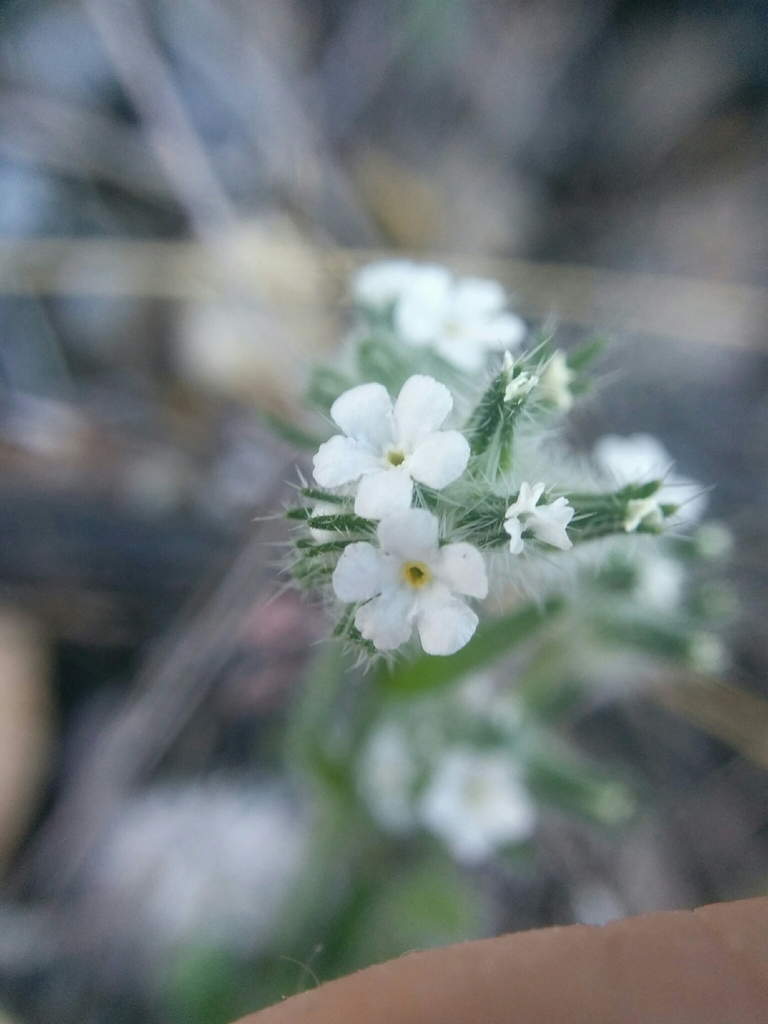
(c) kweitemier, some rights reserved (CC BY-SA) · licence
Family: Boraginaceae · Type: Annual · Native
Cryptantha muricata var. denticulata (Prickly-nut cryptantha) is a native California annual in the Boraginaceae family, recognized by high elevation, early-deciduous calyx, and specific nutlet features.
Prickly-nut cryptantha is a California native annual found on the eastern slope of the Sierra Nevada Mountains, Tehachapi Mountains, San Gabriel Mountains, San Bernardino Mountains, northeastern Peninsular Ranges, northern eastern Sierra Nevada, southern White and Inyo Mountains, and Deserts in gravelly, generally granitic soils of open conifer forest and sagebrush scrub at elevations of 1,800 to 2,770 meters. Flowering from April to August, this plant produces pale yellow flowers with small corolla limbs approximately 1 to 2 millimeters in diameter. Growing 10 to 40 centimeters tall with generally a single stem and few long, laxly-ascending branches, it has sparse strigose and soft hairs with conspicuously spreading rough hairiness. Its scattered leaves are sparingly covered with appressed soft hairs and spreading rough bristles, creating a distinctively textured appearance. The fruits are small nutlets 1.8 to 2 millimeters long with low tubercles and triangular bases that are slightly flared and gapped.
Identification and appearance
Key characters: 33 sympatric species; high elevation, early-deciduous calyx, and specific nutlet features
Habitat and range
Habitat: Locally common, gravelly soils, generally granitic, open conifer forest, often sagebrush scrub (or desert scrub)
Elevation: 1800-2770 m
California counties: San Bernardino, Ventura, Los Angeles, Mono, Alpine, San Diego, Santa Barbara, Riverside, Monterey, Mariposa, Inyo, Tulare, Kern, El Dorado
Outside California: western Nevada, Arizona, Baja California
Bloom period
Cryptantha muricata var. denticulata blooms Apr-Aug.
How to tell it apart
vs Plagiobothrys: Seeds have a groove down the inner face, not a raised ridge like Plagiobothrys.; vs Johnstonella: Cryptantha nutlets have grooves; Johnstonella nutlets lack distinct grooves on inner face.; vs Eremocarya: Cryptantha has grooved nutlets; Eremocarya nutlets are smooth without grooves.; vs Phacelia: Cryptantha has coiled flower clusters; Phacelia flowers are in looser, more open arrangements.; vs Pectocarya: Seeds lack the comb-like marginal barbs that give Pectocarya its combseed name.
Frequently asked questions
Is Cryptantha muricata var. denticulata native to California?
Yes. Cryptantha muricata var. denticulata is native to California (recorded as native).
When does Cryptantha muricata var. denticulata bloom?
Cryptantha muricata var. denticulata blooms Apr-Aug.
Where in California does Cryptantha muricata var. denticulata grow?
Cryptantha muricata var. denticulata occurs in San Bernardino, Ventura, Los Angeles, Mono, Alpine, San Diego, Santa Barbara, Riverside and other counties, at elevations of 1800-2770 m.
What plant family does Cryptantha muricata var. denticulata belong to?
Cryptantha muricata var. denticulata is in the Boraginaceae family, genus Cryptantha.
What habitat does Cryptantha muricata var. denticulata grow in?
Cryptantha muricata var. denticulata grows in Locally common, gravelly soils, generally granitic, open conifer forest, often sagebrush scrub (or desert scrub).
Related species
Other California species in the same genus, family, or bioregion.
Sources: Jepson eFlora · Index of California Plant Names · CalPhotos
Last updated 2026-09-30
Data from The California Species Project — 14,000+ California species with verified data from CNPS, CDFW, USFWS, Cal-IPC, and more.