Cryptogramma acrostichoides
American parsley fern
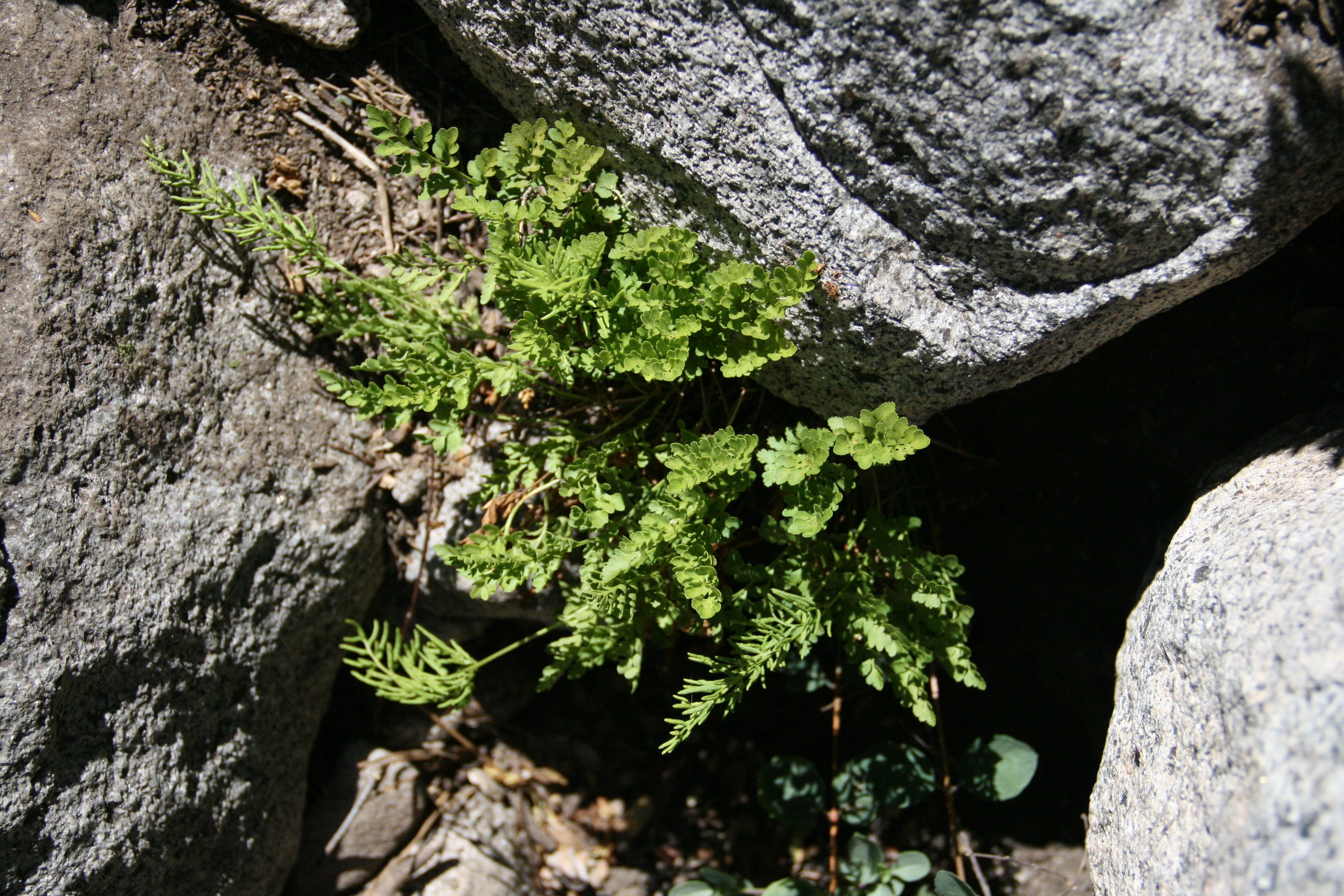
Photo by Chez Brungraber
Family: Pteridaceae · Type: Herb · Native
Cryptogramma acrostichoides (American parsley fern) is a native California herb in the Pteridaceae family, recognized by key difference appears to be frond color (dark green vs green) and slight habitat preferences.
American parsley fern is a California native perennial found in the Klamath Ranges, northern Coast Ranges, high Cascade Range, Sierra Nevada, San Bernardino Mountains, and San Jacinto Mountains on moist to rocky slopes and crevices at elevations of 1,400 to 3,400 meters. Lacking specific flowering data, this fern is characterized by its distinctive fronds that form small, dense clumps. Growing with rhizomatous roots, it produces fertile fronds 10 to 30 centimeters tall and sterile fronds 6 to 22 centimeters long, with lance-ovate blades in a distinctive dark green color. Its leaves are finely divided, creating a delicate, lacy appearance typical of parsley ferns, with fertile and sterile fronds showing slightly different shapes and sizes.
Identification and appearance
Key characters: 1 sympatric species; key difference appears to be frond color (dark green vs green) and slight habitat preferences
Habitat and range
Habitat: Moist to +- dry rocky slopes, crevices
Elevation: 1400-3400 m
California counties: San Bernardino, Tuolumne, Siskiyou, Trinity, Tulare, Plumas, Placer, Sierra, Fresno, Alpine, El Dorado, Humboldt, Inyo, Lassen, Madera, Mariposa, Mono, Nevada, Riverside, Shasta, Tehama, Del Norte, Butte, Lake, Marin, Amador, Calaveras
Outside California: to Alaska, central Canada, Michigan, Colorado, New Mexico
How to tell it apart
vs Aspidotis: Cryptogramma has strongly dimorphic fronds (broad sterile vs narrow fertile); Aspidotis (lace fern) fronds are all alike, finely dissected with sharply pointed segments.; vs Pellaea: Cryptogramma has thin, bright-green, parsley-like blades; Pellaea (cliffbrake) has thick, leathery, blue-gray pinnae on wiry dark stalks.; vs Pentagramma: Cryptogramma segments have inrolled margins hiding the sporangia and no powder beneath; Pentagramma (goldback fern) has flat blades coated below with yellow or white waxy farina.; vs Myriopteris: Cryptogramma is glabrous and green with rolled fertile margins; Myriopteris lip ferns are densely hairy or scaly and bead-like beneath.; vs Cystopteris: Cryptogramma has two frond types and rolled marginal false indusia; Cystopteris (fragile fern) has uniform fronds with a hood-like indusium attached beside each sorus.
Frequently asked questions
Is Cryptogramma acrostichoides native to California?
Yes. Cryptogramma acrostichoides is native to California (recorded as native).
Where in California does Cryptogramma acrostichoides grow?
Cryptogramma acrostichoides occurs in San Bernardino, Tuolumne, Siskiyou, Trinity, Tulare, Plumas, Placer, Sierra and other counties, at elevations of 1400-3400 m.
What plant family does Cryptogramma acrostichoides belong to?
Cryptogramma acrostichoides is in the Pteridaceae family, genus Cryptogramma.
What habitat does Cryptogramma acrostichoides grow in?
Cryptogramma acrostichoides grows in Moist to +- dry rocky slopes, crevices.
Related species
Other California species in the same genus, family, or bioregion.
Sources: Jepson eFlora · Index of California Plant Names · CalPhotos
Last updated 2026-10-07
Data from The California Species Project — 14,000+ California species with verified data from CNPS, CDFW, USFWS, Cal-IPC, and more.