Cucumis myriocarpus
Paddy melon, Paddy Melon
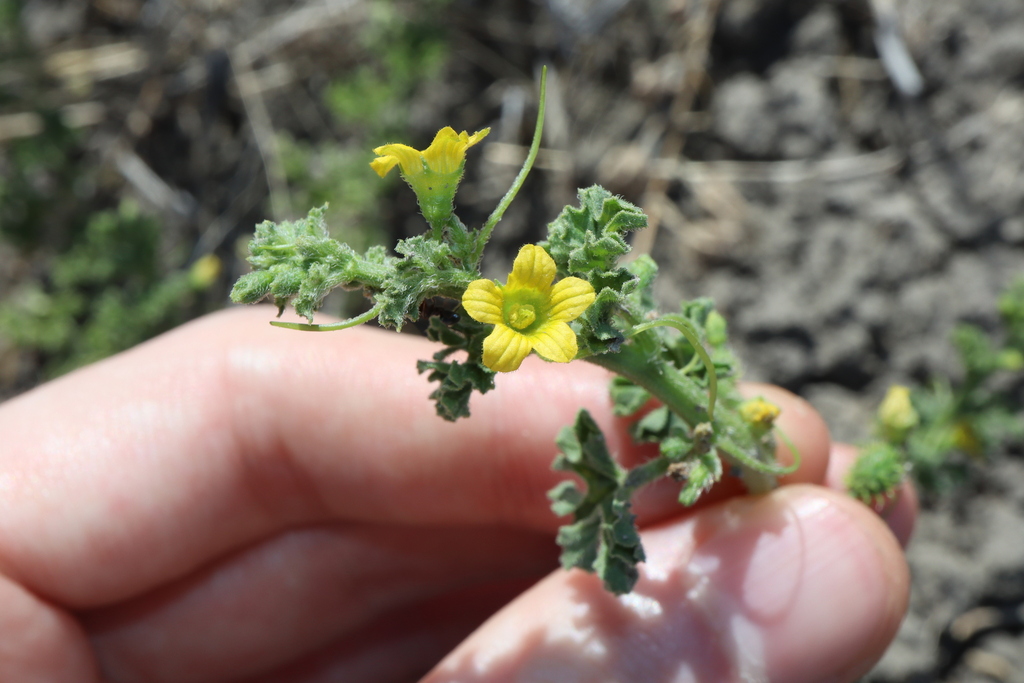
(c) Thomas Mesaglio, some rights reserved (CC BY) · licence
Family: Cucurbitaceae · Type: Vine · Not Native
Cucumis myriocarpus (Paddy melon) is a non-native California vine in the Cucurbitaceae family, recognized by distinctive yellow-green striped fruit.
Paddy melon is a naturalized annual found in southern Santa Barbara County (SCoRO) in fields and disturbed areas at elevations below 300 meters. Flowering from March to September, this plant produces yellow-green to green-striped spherical fruits. Growing with sprawling vines typical of its melon family, it quickly spreads across open ground. Its leaves are likely broad and lobed, characteristic of cucurbit plants. The fruit develops as a distinctive yellow-green sphere with green stripes, marking its presence in disturbed landscapes.
Identification and appearance
Key characters: Geographically isolated in southern Outer South Coast Ranges; distinctive yellow-green striped fruit
Habitat and range
Habitat: Fields, disturbed areas
Elevation: < 300 m
Outside California: native to southern Africa
Bloom period
Cucumis myriocarpus blooms Mar-Sep.
How to tell it apart
vs Marah: Cucumis flowers are yellow; Marah flowers are white or cream.; vs Cucurbita: Cucumis flowers are flat and plate-like under 3 cm; Cucurbita flowers are deep cups over 3 cm.; vs Citrullus: Cucumis leaves have simple, broad lobes; Citrullus leaves are lacy and finely divided.; vs Sicyos: Cucumis has yellow flowers and unbranched tendrils; Sicyos has greenish-white flowers.; vs Solanum: Cucumis has tendrils and vine habit; Solanum lacks tendrils.
Frequently asked questions
Is Cucumis myriocarpus native to California?
No. Cucumis myriocarpus is not native to California (recorded as not native).
When does Cucumis myriocarpus bloom?
Cucumis myriocarpus blooms Mar-Sep.
What plant family does Cucumis myriocarpus belong to?
Cucumis myriocarpus is in the Cucurbitaceae family, genus Cucumis.
What habitat does Cucumis myriocarpus grow in?
Cucumis myriocarpus grows in Fields, disturbed areas.
Related species
Other California species in the same genus, family, or bioregion.
Sources: Jepson eFlora · CalPhotos
Last updated 2026-10-07
Data from The California Species Project — 14,000+ California species with verified data from CNPS, CDFW, USFWS, Cal-IPC, and more.