Cuscuta californica var. californica
California dodder
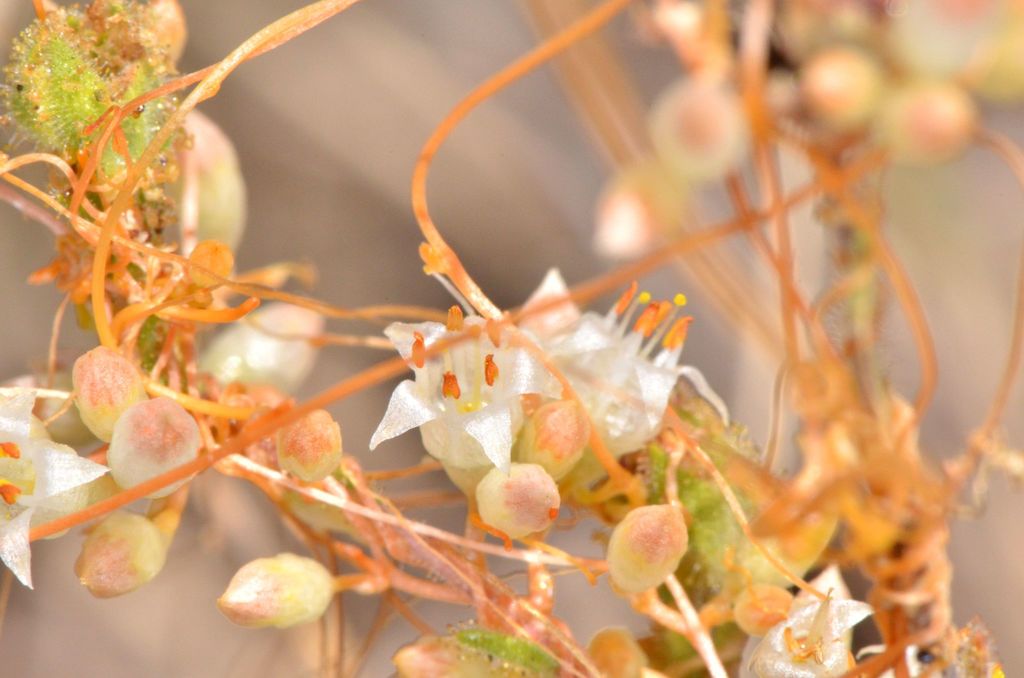
(c) dloarie, some rights reserved (CC BY), uploaded by dloarie · licence
Family: Convolvulaceae · Type: Vine · Native
Cuscuta californica var. californica (California dodder) is a native California vine in the Convolvulaceae family, recognized by var. papillosa by lack of papillae.
California dodder is a native parasitic plant found in the California Floristic Province and southeastern desert regions on herbs, shrubs, and roadsides in chaparral, grassland, and yellow-pine forest at elevations generally below 2,500 meters. Flowering from May to September, this plant produces small spheric flowers with delicate white to cream-colored perianth. Growing as a thin, stringy parasitic vine that lacks chlorophyll and winds around host plants, it attaches directly to other vegetation to extract nutrients. Its threadlike stems are yellow to orange-yellow, completely lacking typical leaf structures and instead developing specialized structures to penetrate and feed from host plant tissues. The tiny spheric seeds, typically two to four per flower cluster, allow this unique plant to spread and establish on a variety of host plants across its native range.
Identification and appearance
Key characters: Co-occurs with 17 species; distinguished from var. papillosa by lack of papillae
Habitat and range
Habitat: On herbs, shrubs, roadsides, chaparral, grassland, yellow-pine forest
Elevation: generally < 2500 m
California counties: San Diego, Kern, Los Angeles, San Bernardino, Mendocino, Tehama, Inyo, Mono, Monterey, Riverside, Tulare, Marin, San Luis Obispo, El Dorado, Placer, Orange, Ventura, Fresno, San Benito, Butte, Santa Barbara, Plumas, Glenn, Nevada, Sierra, Humboldt, San Mateo, Merced, Colusa, Contra Costa, Lassen, Santa Clara, Sonoma, Mariposa, Madera
Outside California: to Washington, Colorado, Mexico
Bloom period
Cuscuta californica var. californica blooms May-Sep.
How to tell it apart
vs Cassytha: Cassytha has green color visible on close inspection; Cuscuta is pure orange/yellow with no green.; vs Funastrum: Funastrum has leaves and grows from the ground; Cuscuta is leafless and grows on other plants.; vs Eriogonum: Eriogonum grows from soil with visible leaves; Cuscuta wraps around other plants with no leaves.; vs Epilobium: Epilobium has green leaves and stands upright; Cuscuta is leafless orange strings on host plants.; vs Brandegea: Brandegea has tendrils and leaves; Cuscuta has no leaves, just orange thread-like stems.
Frequently asked questions
Is Cuscuta californica var. californica native to California?
Yes. Cuscuta californica var. californica is native to California (recorded as native).
When does Cuscuta californica var. californica bloom?
Cuscuta californica var. californica blooms May-Sep.
Where in California does Cuscuta californica var. californica grow?
Cuscuta californica var. californica occurs in San Diego, Kern, Los Angeles, San Bernardino, Mendocino, Tehama, Inyo, Mono and other counties, at elevations of generally < 2500 m.
What plant family does Cuscuta californica var. californica belong to?
Cuscuta californica var. californica is in the Convolvulaceae family, genus Cuscuta.
What habitat does Cuscuta californica var. californica grow in?
Cuscuta californica var. californica grows in On herbs, shrubs, roadsides, chaparral, grassland, yellow-pine forest.
Related species
Other California species in the same genus, family, or bioregion.
Sources: Jepson eFlora · Index of California Plant Names · CalPhotos
Last updated 2026-10-07
Data from The California Species Project — 14,000+ California species with verified data from CNPS, CDFW, USFWS, Cal-IPC, and more.