Cuscuta occidentalis
California dodder
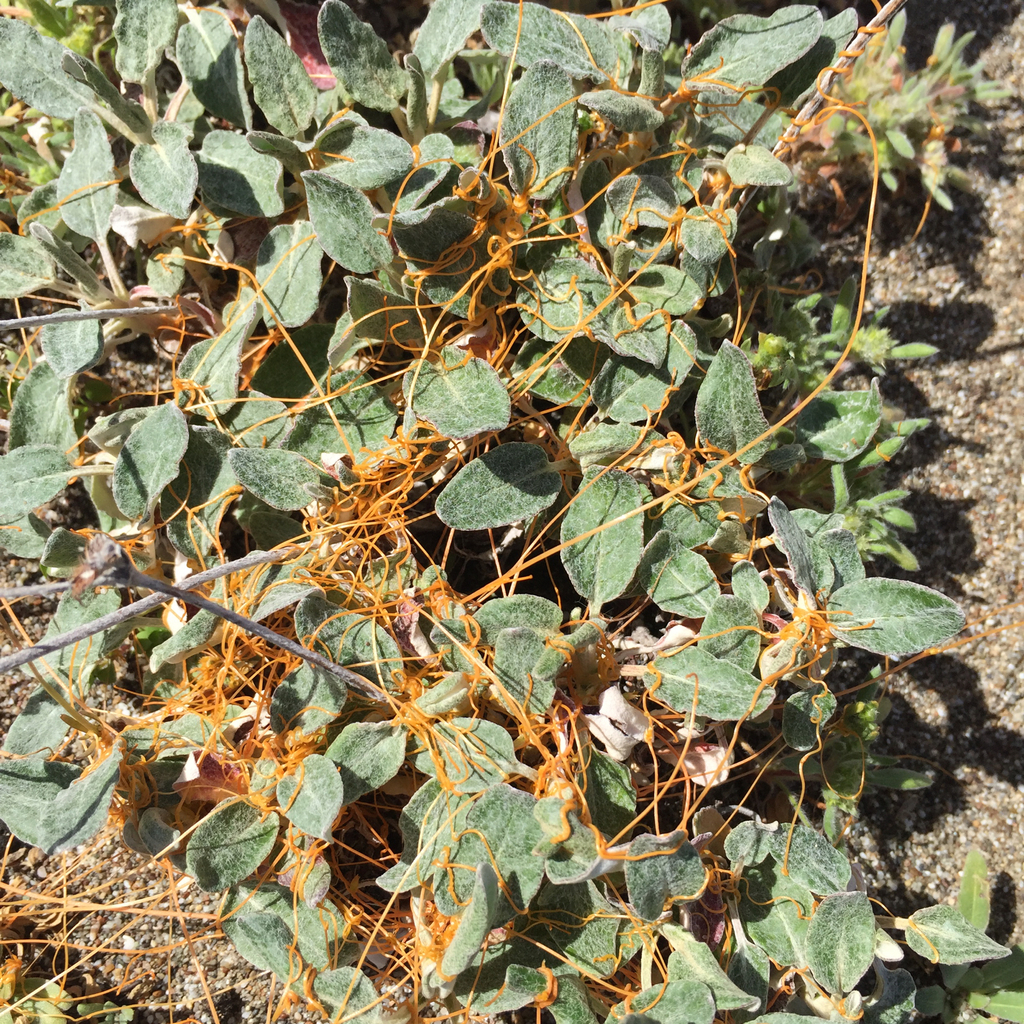
no rights reserved · CC0
Family: Convolvulaceae · Type: Perennial · Native
Cuscuta occidentalis (California dodder) is a native California perennial in the Convolvulaceae family, recognized by absence of scales and reflexed lobes diagnostic.
California dodder is a native parasitic plant found in northwestern California, central Sierra Nevada, Great Valley, central western California, and southeastern Sierra Nevada regions, growing on various herbs at elevations up to 2,000 meters. Flowering from March to September, this plant produces small, delicate flowers in compact clusters with membranous, bell-shaped calyxes and cream to white corollas. Growing as a thin, thread-like parasitic vine that winds around host plants, it lacks chlorophyll and relies entirely on its host for nutrients. Its flowers are distinctive, with lanceolate lobes approximately 3 millimeters long, forming spherical to slightly flattened fruits that are translucent and contain two to four tiny seeds. The plant's unique parasitic nature allows it to attach and extract nutrients directly from the tissues of its host herbs.
Identification and appearance
Key characters: 20 sympatric species; absence of scales and reflexed lobes diagnostic
Habitat and range
Habitat: Generally on herbs
Elevation: < 2000 m
California counties: Siskiyou, Mono, Tehama, San Bernardino, Marin, Trinity, Alpine, Mendocino, Monterey, Los Angeles, Fresno, Nevada, Butte, Plumas, Napa, Contra Costa, Humboldt, Glenn, Santa Barbara, Sonoma, San Francisco, San Luis Obispo, Sierra, Del Norte, San Mateo, Lassen, Tulare, San Diego, Tuolumne, Solano, San Joaquin, El Dorado, Merced, Inyo
Outside California: to Washington, Colorado, Mexico
Bloom period
Cuscuta occidentalis blooms Mar-Sep.
How to tell it apart
vs Cassytha: Cassytha has green color visible on close inspection; Cuscuta is pure orange/yellow with no green.; vs Funastrum: Funastrum has leaves and grows from the ground; Cuscuta is leafless and grows on other plants.; vs Eriogonum: Eriogonum grows from soil with visible leaves; Cuscuta wraps around other plants with no leaves.; vs Epilobium: Epilobium has green leaves and stands upright; Cuscuta is leafless orange strings on host plants.; vs Brandegea: Brandegea has tendrils and leaves; Cuscuta has no leaves, just orange thread-like stems.
Frequently asked questions
Is Cuscuta occidentalis native to California?
Yes. Cuscuta occidentalis is native to California (recorded as native).
When does Cuscuta occidentalis bloom?
Cuscuta occidentalis blooms Mar-Sep.
Where in California does Cuscuta occidentalis grow?
Cuscuta occidentalis occurs in Siskiyou, Mono, Tehama, San Bernardino, Marin, Trinity, Alpine, Mendocino and other counties, at elevations of < 2000 m.
What plant family does Cuscuta occidentalis belong to?
Cuscuta occidentalis is in the Convolvulaceae family, genus Cuscuta.
What habitat does Cuscuta occidentalis grow in?
Cuscuta occidentalis grows in Generally on herbs.
Related species
Other California species in the same genus, family, or bioregion.
Sources: Jepson eFlora · Index of California Plant Names · CalPhotos
Last updated 2026-09-30
Data from The California Species Project — 14,000+ California species with verified data from CNPS, CDFW, USFWS, Cal-IPC, and more.