Cuscuta pacifica var. pacifica
Dodder
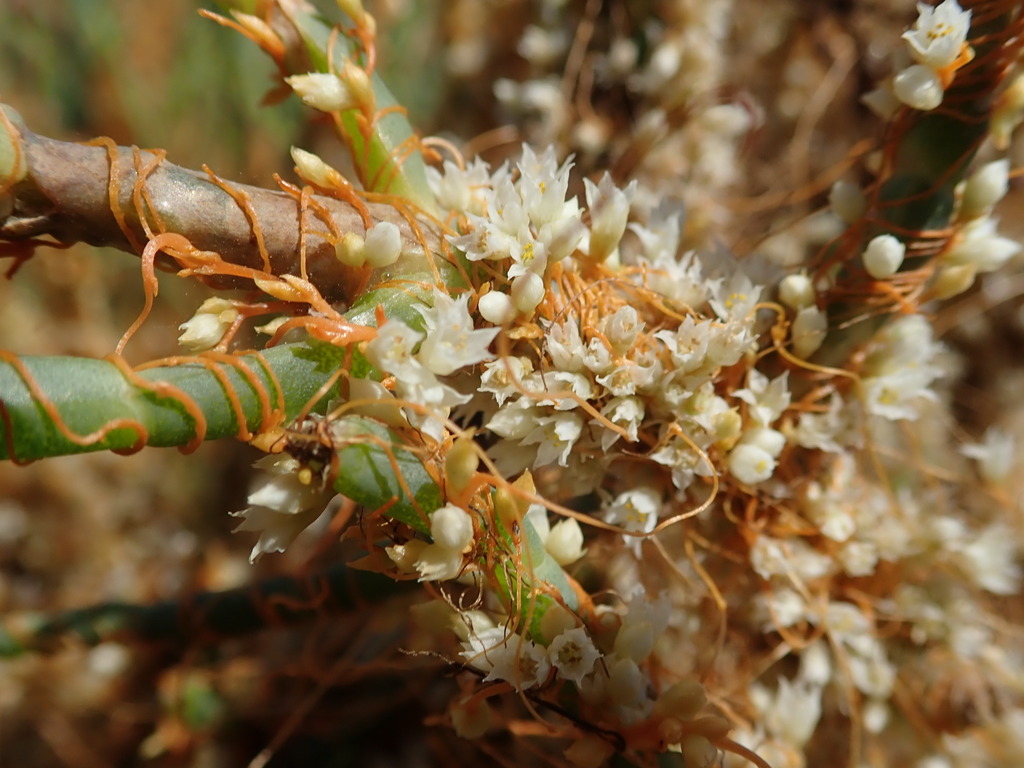
Photo: parent species Cuscuta pacifica · (c) joergmlpts, some rights reserved (CC BY) · licence
Family: Convolvulaceae · Type: Vine · Native
Cuscuta pacifica var. pacifica (Dodder) is a native California vine in the Convolvulaceae family, recognized by coastal habitat and non-papillate surfaces diagnostic from var. papillata.
Dodder is a California native perennial found in coastal regions including northern, central, and southern California in coastal habitats near sea level. Flowering from July to October, this parasitic plant produces small, delicate flowers with subtle cream or white coloration. Growing as a thin, thread-like vine that lacks chlorophyll and wraps around host plants, it attaches itself directly to other vegetation for nutrition. Its stems are slender, pale yellow to orange, and completely lack typical leaf structures, instead developing specialized haustorial connections to extract nutrients from host plants. This unique parasitic species demonstrates an extraordinary adaptation for survival by completely depending on other plants for its growth and sustenance.
Identification and appearance
Key characters: 12 sympatric species; coastal habitat and non-papillate surfaces diagnostic from var. papillata
Habitat and range
Habitat: Generally on
Elevation: +- 0 m.
California counties: San Diego, Alameda, Contra Costa, Napa, Del Norte, Humboldt, Santa Clara, San Mateo, San Luis Obispo, Marin
Outside California: to British Columbia
Bloom period
Cuscuta pacifica var. pacifica blooms Jul-Oct.
How to tell it apart
vs Cassytha: Cassytha has green color visible on close inspection; Cuscuta is pure orange/yellow with no green.; vs Funastrum: Funastrum has leaves and grows from the ground; Cuscuta is leafless and grows on other plants.; vs Eriogonum: Eriogonum grows from soil with visible leaves; Cuscuta wraps around other plants with no leaves.; vs Epilobium: Epilobium has green leaves and stands upright; Cuscuta is leafless orange strings on host plants.; vs Brandegea: Brandegea has tendrils and leaves; Cuscuta has no leaves, just orange thread-like stems.
Frequently asked questions
Is Cuscuta pacifica var. pacifica native to California?
Yes. Cuscuta pacifica var. pacifica is native to California (recorded as native).
When does Cuscuta pacifica var. pacifica bloom?
Cuscuta pacifica var. pacifica blooms Jul-Oct.
Where in California does Cuscuta pacifica var. pacifica grow?
Cuscuta pacifica var. pacifica occurs in San Diego, Alameda, Contra Costa, Napa, Del Norte, Humboldt, Santa Clara, San Mateo and other counties, at elevations of +- 0 m..
What plant family does Cuscuta pacifica var. pacifica belong to?
Cuscuta pacifica var. pacifica is in the Convolvulaceae family, genus Cuscuta.
What habitat does Cuscuta pacifica var. pacifica grow in?
Cuscuta pacifica var. pacifica grows in Generally on.
Related species
Other California species in the same genus, family, or bioregion.
Sources: Jepson eFlora · Index of California Plant Names · CalPhotos
Last updated 2026-10-07
Data from The California Species Project — 14,000+ California species with verified data from CNPS, CDFW, USFWS, Cal-IPC, and more.