Cuscuta suksdorfii
Mountain dodder
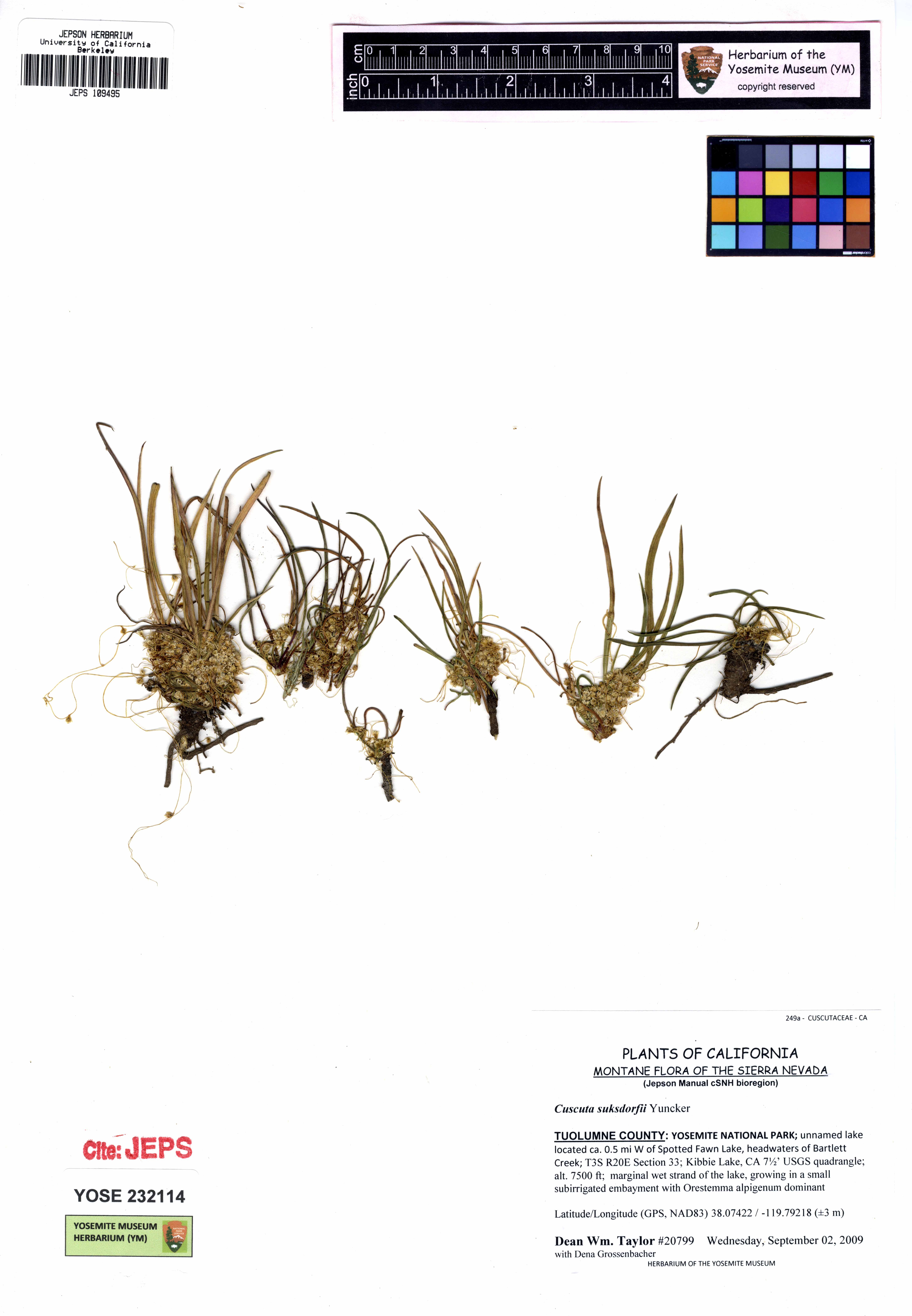
Dean Wm. Taylor (via Wikimedia Commons) · CC BY
Family: Convolvulaceae · Type: Vine · Native
Cuscuta suksdorfii (Mountain dodder) is a native California vine in the Convolvulaceae family, recognized by high elevation, long-acuminate parts, and reduced scales diagnostic.
Mountain dodder is a California native perennial found in the Klamath Ranges, northern Sierra Nevada Mountains, and San Bernardo Mountains on herbs in the Asteraceae family at elevations of 1,500 to 2,600 meters. Flowering from July to September, this parasitic plant produces small membranous flowers in umbel-like clusters with 2 to 7 blooms. Growing as a thin, twining parasitic vine, it attaches to host plants without roots or typical stems. Its flowers are distinctive, with a calyx larger than the corolla tube, bell-shaped structures with ovate lobes and triangular-ovate petals. The small translucent fruits contain 2 to 4 seeds, each approximately one millimeter wide.
Identification and appearance
Key characters: 8 sympatric species; high elevation, long-acuminate parts, and reduced scales diagnostic
Habitat and range
Habitat: Generally on herbs in Asteraceae,
Elevation: 1500-2600 m
California counties: San Bernardino, Mariposa, Placer, Tuolumne, Butte, Humboldt, Siskiyou, Plumas, Fresno, Tulare, Mono, Kern, Inyo
Outside California: to Washington
Bloom period
Cuscuta suksdorfii blooms Jul-Sep.
How to tell it apart
vs Cassytha: Cassytha has green color visible on close inspection; Cuscuta is pure orange/yellow with no green.; vs Funastrum: Funastrum has leaves and grows from the ground; Cuscuta is leafless and grows on other plants.; vs Eriogonum: Eriogonum grows from soil with visible leaves; Cuscuta wraps around other plants with no leaves.; vs Epilobium: Epilobium has green leaves and stands upright; Cuscuta is leafless orange strings on host plants.; vs Brandegea: Brandegea has tendrils and leaves; Cuscuta has no leaves, just orange thread-like stems.
Frequently asked questions
Is Cuscuta suksdorfii native to California?
Yes. Cuscuta suksdorfii is native to California (recorded as native).
When does Cuscuta suksdorfii bloom?
Cuscuta suksdorfii blooms Jul-Sep.
Where in California does Cuscuta suksdorfii grow?
Cuscuta suksdorfii occurs in San Bernardino, Mariposa, Placer, Tuolumne, Butte, Humboldt, Siskiyou, Plumas and other counties, at elevations of 1500-2600 m.
What plant family does Cuscuta suksdorfii belong to?
Cuscuta suksdorfii is in the Convolvulaceae family, genus Cuscuta.
What habitat does Cuscuta suksdorfii grow in?
Cuscuta suksdorfii grows in Generally on herbs in Asteraceae,.
Related species
Other California species in the same genus, family, or bioregion.
- Cuscuta veatchii — Desert dodder
- Cuscuta approximata — Alfalfa dodder
- Cuscuta brachycalyx — San joaquin dodder
- Cuscuta californica — Chaparral dodder
- Cuscuta californica var. apiculata — Chaparral dodder
- Cuscuta californica var. californica — California dodder
- Dichondra donelliana — California ponysfoot
- Dichondra micrantha — Asian ponysfoot
- Dichondra occidentalis — Western dichondra
Sources: Jepson eFlora · Index of California Plant Names · CalPhotos
Last updated 2026-10-07
Data from The California Species Project — 14,000+ California species with verified data from CNPS, CDFW, USFWS, Cal-IPC, and more.