Cymbalaria muralis
Kenilworth ivy
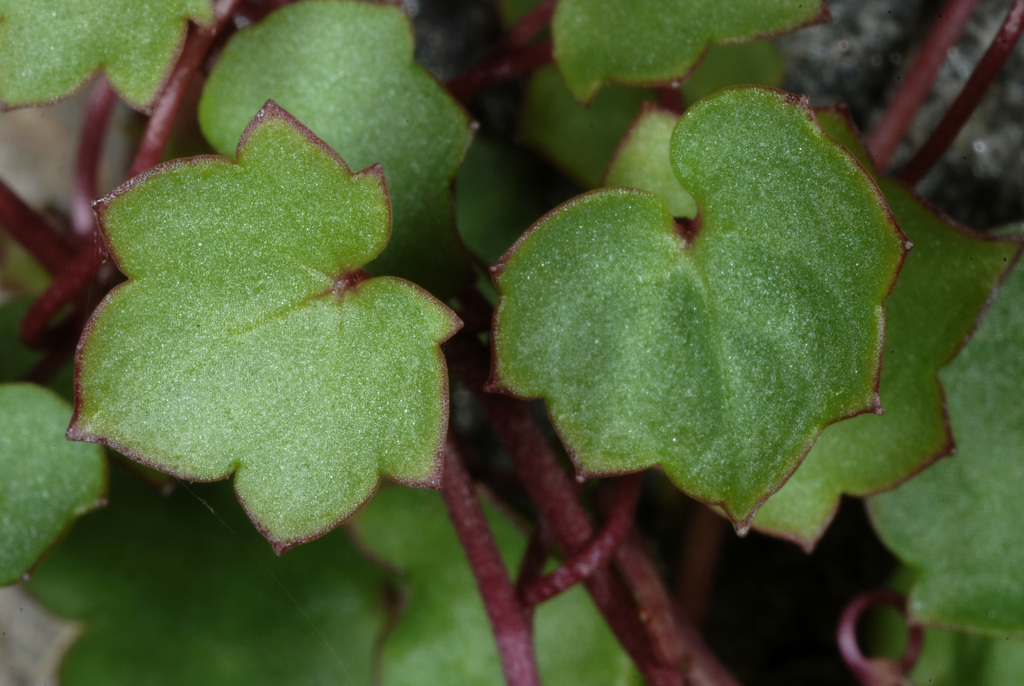
(c) Douglas Goldman, some rights reserved (CC BY-SA), uploaded by Douglas Goldman · licence
Family: Plantaginaceae · Type: Herb · Not Native
Cymbalaria muralis (Kenilworth ivy) is a non-native California herb in the Plantaginaceae family, recognized by European wall specialist, only Cymbalaria naturalized in California.
Kenilworth ivy is a naturalized perennial found in coastal regions of California, including Northern, Central, and Southern Coast ranges, inhabiting rock walls and shady disturbed areas at elevations below 1,000 meters. Flowering from May to September, this plant produces pale lilac to violet flowers with a subtle yellow base, approximately 9 to 15 millimeters long. Growing with delicate, spreading stems, it forms low-growing clusters that quickly colonize rocky surfaces. Its distinctive rounded to triangular leaves are 1 to 3 centimeters wide, featuring 5 to 9 shallow lobes that often end in an abrupt point. The plant's tiny fruits are approximately 4 millimeters long, with an unusual characteristic of developing pedicels that grow away from light.
Identification and appearance
Key characters: European wall specialist, only Cymbalaria naturalized in California
Habitat and range
Habitat: rock walls, shady, disturbed areas
Elevation: < 1000 m
California counties: San Francisco, Alameda, Riverside, San Diego, Monterey, San Mateo, Contra Costa, Humboldt, San Luis Obispo, Santa Barbara, Santa Clara, Solano
Outside California: native to Mediterranean
Bloom period
Cymbalaria muralis blooms May-Sep.
How to tell it apart
vs Linaria: Cymbalaria has rounded, kidney-shaped leaves on long stalks; Linaria has narrow, linear leaves without stalks.; vs Geranium: Cymbalaria has snapdragon flowers with spurs; Geranium has symmetrical 5-petaled flowers with no spur.; vs Mohavea: Cymbalaria trails with kidney-shaped leaves; Mohavea stands upright with narrow leaves.; vs Antirrhinum: Cymbalaria has kidney-shaped leaves on visible petioles; Antirrhinum has narrow, stalkless leaves.; vs Nuttallanthus: Cymbalaria has broad kidney-shaped leaves; Nuttallanthus has very narrow thread-like leaves.
Frequently asked questions
Is Cymbalaria muralis native to California?
No. Cymbalaria muralis is not native to California (recorded as not native).
When does Cymbalaria muralis bloom?
Cymbalaria muralis blooms May-Sep.
Where in California does Cymbalaria muralis grow?
Cymbalaria muralis occurs in San Francisco, Alameda, Riverside, San Diego, Monterey, San Mateo, Contra Costa, Humboldt and other counties, at elevations of < 1000 m.
What plant family does Cymbalaria muralis belong to?
Cymbalaria muralis is in the Plantaginaceae family, genus Cymbalaria.
What habitat does Cymbalaria muralis grow in?
Cymbalaria muralis grows in rock walls, shady, disturbed areas.
Related species
Other California species in the same genus, family, or bioregion.
Sources: Jepson eFlora · Index of California Plant Names · CalPhotos
Last updated 2026-10-07
Data from The California Species Project — 14,000+ California species with verified data from CNPS, CDFW, USFWS, Cal-IPC, and more.