Cymopterus panamintensis var. acutifolius
Panamint indian parsnip
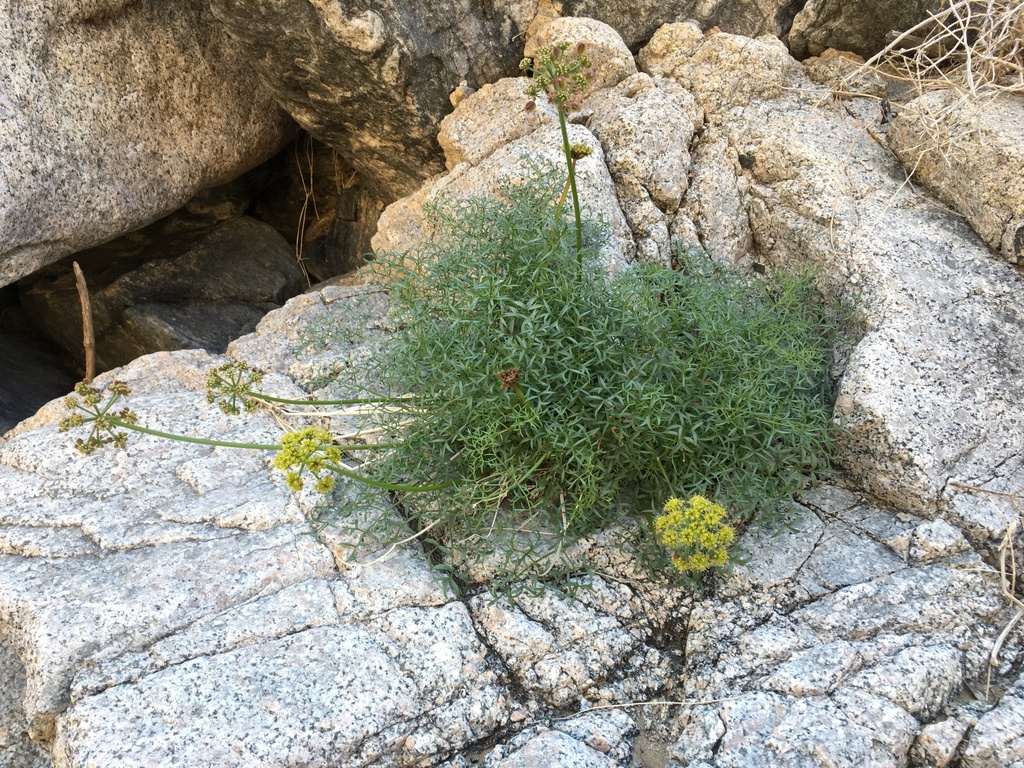
Photo: parent species Cymopterus panamintensis · (c) Matt Berger, some rights reserved (CC BY) · licence
Family: Apiaceae · Type: Herb · Native
Cymopterus panamintensis var. acutifolius (Panamint indian parsnip) is a native California herb in the Apiaceae family, recognized by . Distinguished by leaf segment characteristics and yellow flowers.
Panamint indian parsnip is a California native perennial found in the Mojave Desert on rocky canyon walls at elevations of 700 to 1,000 meters. Flowering from March to April, this plant produces white to cream flowers in small umbels characteristic of desert parsnip species. Growing with slender, flexible stems emerging from a woody base, it develops delicate branching structures adapted to harsh desert environments. Its leaves feature widely spaced segments three to 20 millimeters long, which remain flexible and enable the plant to move with desert winds. The compact growth form and distinctive leaf structure allow this parsnip to survive in challenging rocky canyon habitats.
Identification and appearance
Key characters: 8 sympatric species. Distinguished by leaf segment characteristics and yellow flowers.
Habitat and range
Habitat: Rocky canyon walls
Elevation: 700-1000 m
California counties: Inyo, San Bernardino, San Diego, Riverside, San Benito, Alameda, Kern
Bloom period
Cymopterus panamintensis var. acutifolius blooms Mar-Apr.
How to tell it apart
vs Lomatium: Cymopterus is stemless and grows flat to ground; Lomatium has an upright stem.; vs Sanicula: Cymopterus has open umbrella clusters and blue-green leaves; Sanicula has dense ball-like heads and green leaves.; vs Vesper: Cymopterus is a low carrot family plant with umbrella clusters; Vesper is unrelated (evening primrose family).; vs Tauschia: Cymopterus is stemless spreading flat; Tauschia has an upright stem.; vs Angelica: Cymopterus is low and stemless; Angelica is tall and erect with a distinct main stem.
Frequently asked questions
Is Cymopterus panamintensis var. acutifolius native to California?
Yes. Cymopterus panamintensis var. acutifolius is native to California (recorded as native).
When does Cymopterus panamintensis var. acutifolius bloom?
Cymopterus panamintensis var. acutifolius blooms Mar-Apr.
Where in California does Cymopterus panamintensis var. acutifolius grow?
Cymopterus panamintensis var. acutifolius occurs in Inyo, San Bernardino, San Diego, Riverside, San Benito, Alameda, Kern, at elevations of 700-1000 m.
What plant family does Cymopterus panamintensis var. acutifolius belong to?
Cymopterus panamintensis var. acutifolius is in the Apiaceae family, genus Cymopterus.
What habitat does Cymopterus panamintensis var. acutifolius grow in?
Cymopterus panamintensis var. acutifolius grows in Rocky canyon walls.
Related species
Other California species in the same genus, family, or bioregion.
Sources: Jepson eFlora · Index of California Plant Names · CalPhotos
Last updated 2026-10-07
Data from The California Species Project — 14,000+ California species with verified data from CNPS, CDFW, USFWS, Cal-IPC, and more.