Cymopterus terebinthinus var. californicus
Pteryxia
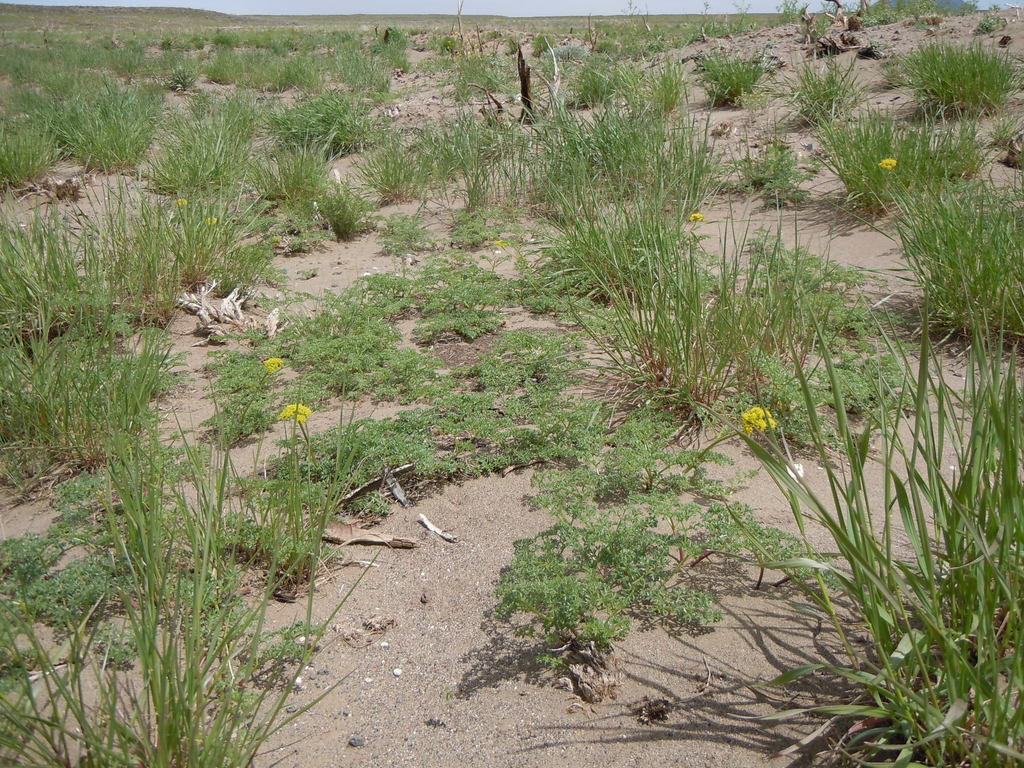
(c) Matt Lavin, some rights reserved (CC BY-SA) · licence
Family: Apiaceae · Type: Herb · Native
Cymopterus terebinthinus var. californicus (Pteryxia) is a native California herb in the Apiaceae family, recognized by . Distinguished by leaf proportions and yellow flowers with curled wings.
Pteryxia is a California native perennial found in the Klamath Ranges, northern Coast Ranges, California High Sierra, Sierra Nevada, and northern eastern Sierra Nevada in sandy or rocky serpentine habitats at elevations of 150 to 3,500 meters. Flowering from May to June, this plant produces delicate flowers in distinctive umbels with gray-green to bright green herbage. Growing with minimal stems, the plant develops compact leaf segments that are nearly as wide as they are long. Its leaves feature crowded, intricate segments that create a distinctive dense foliage pattern. The plant's low-growing, tightly clustered form allows it to thrive in challenging serpentine environments.
Identification and appearance
Key characters: 6 sympatric species. Distinguished by leaf proportions and yellow flowers with curled wings.
Habitat and range
Habitat: Sand, rocks, serpentine at lowest elevations
Elevation: 150-3500 m
California counties: Fresno, Alpine, Siskiyou, Mono, Lassen, Tulare, Butte, Kern, Placer, Modoc, Amador, El Dorado, Shasta, Plumas, Tehama, Sierra, Sonoma, Tuolumne, Madera, Humboldt, Trinity, Inyo, Nevada, Mariposa
Outside California: northern Nevada
Bloom period
Cymopterus terebinthinus var. californicus blooms May-Jun.
How to tell it apart
vs Lomatium: Cymopterus is stemless and grows flat to ground; Lomatium has an upright stem.; vs Sanicula: Cymopterus has open umbrella clusters and blue-green leaves; Sanicula has dense ball-like heads and green leaves.; vs Vesper: Cymopterus is a low carrot family plant with umbrella clusters; Vesper is unrelated (evening primrose family).; vs Tauschia: Cymopterus is stemless spreading flat; Tauschia has an upright stem.; vs Angelica: Cymopterus is low and stemless; Angelica is tall and erect with a distinct main stem.
Frequently asked questions
Is Cymopterus terebinthinus var. californicus native to California?
Yes. Cymopterus terebinthinus var. californicus is native to California (recorded as native).
When does Cymopterus terebinthinus var. californicus bloom?
Cymopterus terebinthinus var. californicus blooms May-Jun.
Where in California does Cymopterus terebinthinus var. californicus grow?
Cymopterus terebinthinus var. californicus occurs in Fresno, Alpine, Siskiyou, Mono, Lassen, Tulare, Butte, Kern and other counties, at elevations of 150-3500 m.
What plant family does Cymopterus terebinthinus var. californicus belong to?
Cymopterus terebinthinus var. californicus is in the Apiaceae family, genus Cymopterus.
What habitat does Cymopterus terebinthinus var. californicus grow in?
Cymopterus terebinthinus var. californicus grows in Sand, rocks, serpentine at lowest elevations.
Related species
Other California species in the same genus, family, or bioregion.
- Cymopterus terebinthinus var. petraeus — Rock cymopterus
- Cymopterus aboriginum — Indian parsnip
- Cymopterus cinerarius — Gray springparsley
- Cymopterus deserticola — Desert cymopterus
- Cymopterus gilmanii — Gilman's cymopterus
- Cymopterus globosus — Globose cymopterus
- Daucus carota — Carrot
- Daucus pusillus — American wild carrot
- Daucus sp.
Sources: Jepson eFlora · Index of California Plant Names · CalPhotos
Last updated 2026-10-07
Data from The California Species Project — 14,000+ California species with verified data from CNPS, CDFW, USFWS, Cal-IPC, and more.