Cynodon dactylon
Bermuda grass
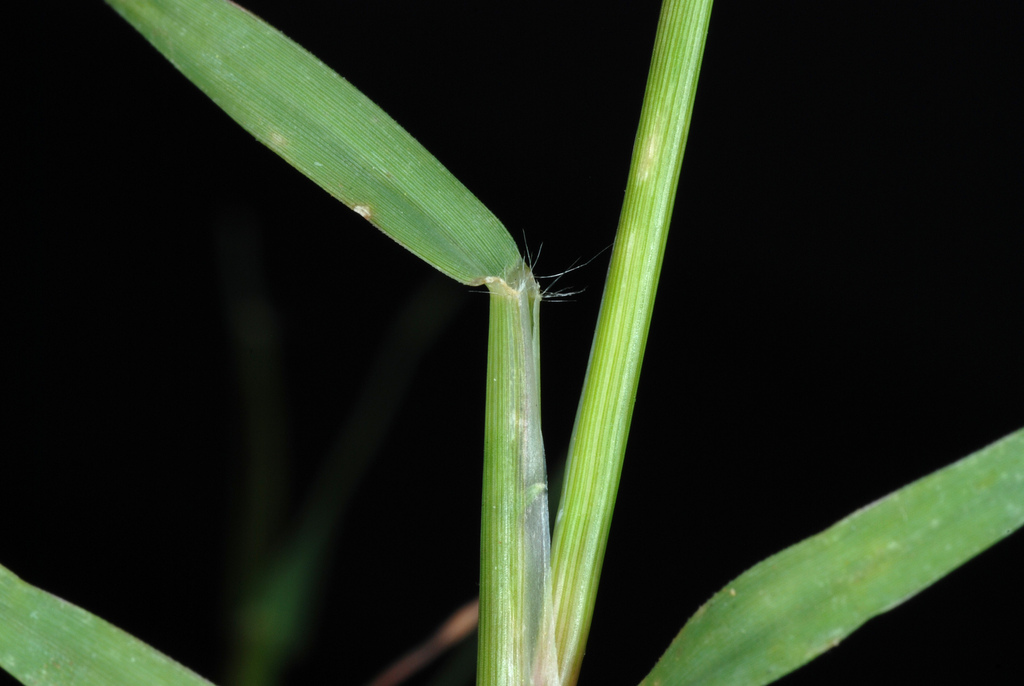
(c) Douglas Goldman, some rights reserved (CC BY-SA), uploaded by Douglas Goldman · licence
Family: Poaceae · Type: Grass · Not Native
Conservation status: Cal-IPC Yes
Cynodon dactylon (Bermuda grass) is a non-native California grass in the Poaceae family, recognized by African native, only Cynodon species in California, major turf and forage grass.
Bermuda grass is a naturalized perennial grass found throughout California in disturbed sites at elevations below 1,600 meters. Flowering from June to August, this grass produces small purplish spikelets in distinctive finger-like clusters with 4 to 7 branches. Growing with creeping rhizomes and stolons, it forms dense mats with erect stems 10 to 40 centimeters tall. Its leaf blades are typically less than 6 centimeters long, with white-hairy ligules and occasionally hairy upper surfaces. The grass spreads aggressively through underground runners, creating thick ground cover in disturbed and open areas.
Identification and appearance
Key characters: African native, only Cynodon species in California, major turf and forage grass
Habitat and range
Habitat: Disturbed sites
Elevation: < 1600 m
California counties: Kern, San Luis Obispo, San Bernardino, Los Angeles, Butte, Humboldt, Imperial, Inyo, Lake, Marin, Mendocino, Merced, Monterey, Orange, Riverside, San Diego, San Francisco, San Mateo, Santa Barbara, Santa Clara, Sonoma, Ventura, Alameda, Sacramento, San Joaquin, Tuolumne, Yolo, Tulare, Fresno, Colusa, Sutter, Glenn, Amador, Placer, Shasta, Santa Cruz, Napa, Mariposa, Madera, Kings, Contra Costa, Calaveras, Nevada, Tehama, Yuba, Plumas, Stanislaus, Trinity, Solano, El Dorado, Mono
Outside California: most of United States, Canada, warm temperate, tropics, native to Africa
Bloom period
Cynodon dactylon blooms Jun-Aug.
Conservation status
Cal-IPC Yes
How to tell it apart
vs Cenchrus: Bermuda grass has finger spikes with bristle extensions; sandbur has spiny burs enclosing seeds.; vs Eleusine: Bermuda grass has round stems with single florets; goose grass has flattened stems with multiple florets.; vs Distichlis: Bermuda grass has finger spikes and runners; saltgrass has dense spike-like panicles and rhizomes.; vs Digitaria: Bermuda grass has bristle behind each floret; crabgrass lacks bristle extensions.; vs Eragrostis: Bermuda grass has finger spikes; lovegrass has open, diffuse panicles.
Frequently asked questions
Is Cynodon dactylon native to California?
No. Cynodon dactylon is not native to California (recorded as not native).
When does Cynodon dactylon bloom?
Cynodon dactylon blooms Jun-Aug.
Where in California does Cynodon dactylon grow?
Cynodon dactylon occurs in Kern, San Luis Obispo, San Bernardino, Los Angeles, Butte, Humboldt, Imperial, Inyo and other counties, at elevations of < 1600 m.
What plant family does Cynodon dactylon belong to?
Cynodon dactylon is in the Poaceae family, genus Cynodon.
Is Cynodon dactylon invasive in California?
Cynodon dactylon is listed by Cal-IPC with an invasiveness rating of Yes.
Related species
Other California species in the same genus, family, or bioregion.
Sources: Jepson eFlora · Index of California Plant Names · CalPhotos
Last updated 2026-10-07
Data from The California Species Project — 14,000+ California species with verified data from CNPS, CDFW, USFWS, Cal-IPC, and more.