Cynoglossum officinale
Common hound's tongue, Common Hound's Tongue
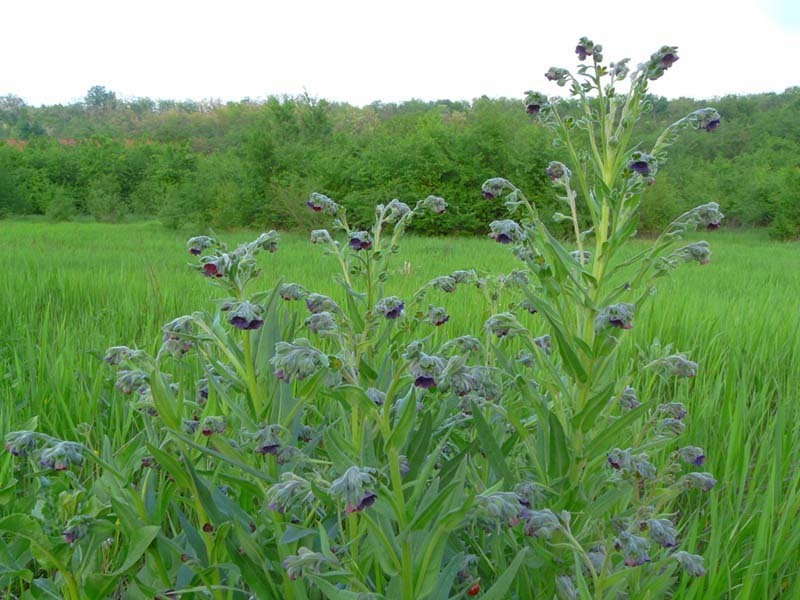
(c) Radu Chibzii, some rights reserved (CC BY-SA) · licence
Family: Boraginaceae · Type: Herb · Not Native
Conservation status: Cal-IPC Yes
Cynoglossum officinale (Common hound's tongue) is a non-native California herb in the Boraginaceae family, recognized by Eurasian species, true Cynoglossum remaining in California after recent genus splits.
Common hound's tongue is a naturalized biennial found in the Klamath Ranges, northern High Sierra Nevada, and northern Sierra Nevada Mountains in disturbed areas, often associated with logging activities, at elevations of 850 to 1,850 meters. Flowering from May to July, this plant produces small reddish-purple flowers with a limb 4 to 9 millimeters in diameter. Growing with soft-hairy stems 30 to 120 centimeters tall, it develops multiple stems that spread widely. Its leaves are soft-hairy, with basal leaves having long petioles and oblanceolate or narrow-elliptic blades 8 to 20 centimeters long, tapering at the base. The plant produces distinctive nutlets that spread downward with slightly raised margins.
Identification and appearance
Key characters: Eurasian species, true Cynoglossum remaining in California after recent genus splits
Habitat and range
Habitat: Disturbed areas, often associated with logging activities
Elevation: 850-1850 m
California counties: Shasta, Mariposa, Siskiyou, Plumas, Alpine, Marin, Sierra
Outside California: North America, native to Eurasia
Bloom period
Cynoglossum officinale blooms May-Jul.
Conservation status
Cal-IPC Yes
How to tell it apart
vs Adelinia: Cynoglossum has burr-like seeds with barbed prickles; Adelinia has smooth nutlets without prickles.; vs Myosotis: Cynoglossum has burr-like sticky seeds; Myosotis has smooth, shiny black nutlets.; vs Hackelia: Cynoglossum nutlets are rounded burrs; Hackelia nutlets are triangular with prickles on edges/back.; vs Pentaglottis: Cynoglossum has burr-like barbed seeds; Pentaglottis has smooth, hard, wrinkled nutlets.; vs Salvia: Cynoglossum has 5-lobed flowers and burr seeds; Salvia has 2-lipped flowers and smooth nutlets.
Frequently asked questions
Is Cynoglossum officinale native to California?
No. Cynoglossum officinale is not native to California (recorded as not native).
When does Cynoglossum officinale bloom?
Cynoglossum officinale blooms May-Jul.
Where in California does Cynoglossum officinale grow?
Cynoglossum officinale occurs in Shasta, Mariposa, Siskiyou, Plumas, Alpine, Marin, Sierra, at elevations of 850-1850 m.
What plant family does Cynoglossum officinale belong to?
Cynoglossum officinale is in the Boraginaceae family, genus Cynoglossum.
Is Cynoglossum officinale invasive in California?
Cynoglossum officinale is listed by Cal-IPC with an invasiveness rating of Yes.
Related species
Other California species in the same genus, family, or bioregion.
Sources: Jepson eFlora · Index of California Plant Names · CalPhotos
Last updated 2026-10-07
Data from The California Species Project — 14,000+ California species with verified data from CNPS, CDFW, USFWS, Cal-IPC, and more.