Cyperus strigosus
False nutsedge
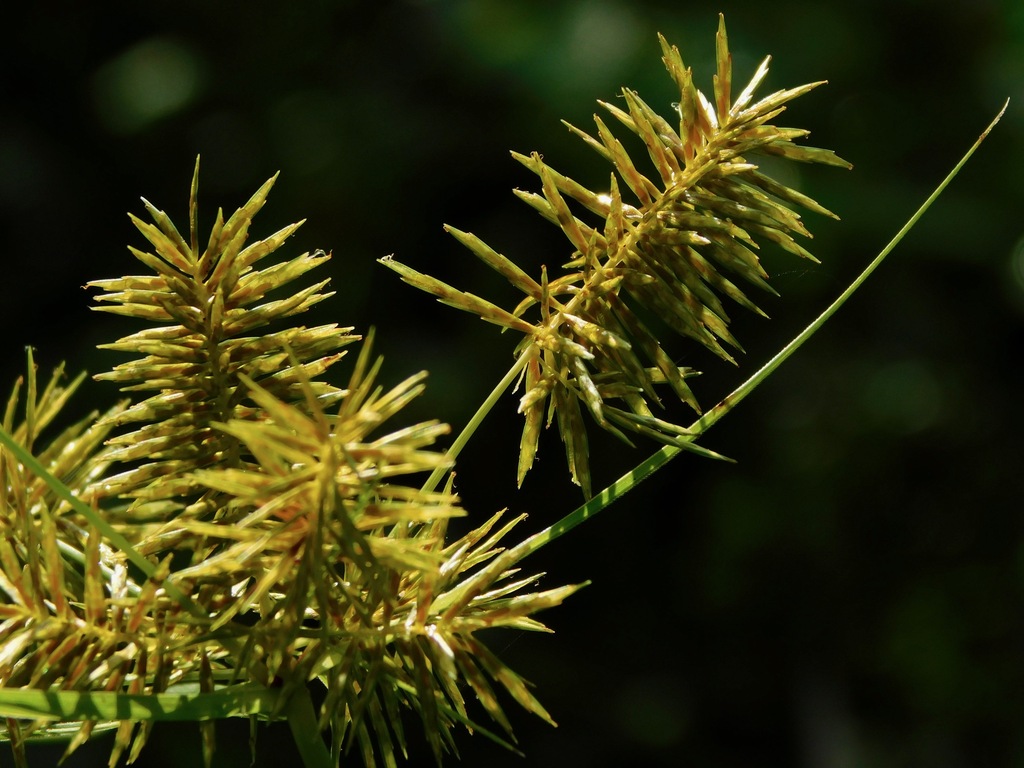
(c) Michael J. Papay, some rights reserved (CC BY), uploaded by Michael J. Papay · licence
Family: Cyperaceae · Type: Grass · Native
Cyperus strigosus (False nutsedge) is a native California grass in the Cyperaceae family, recognized by corm-like base, large multi-veined bracts, and large fruits distinctive.
False nutsedge is a California native perennial found in moist habitats including pond margins and roadsides at elevations below 1,000 meters. Flowering from July to October, this sedge produces pale brown to straw-colored flowers in compact spikes 1 to 5 centimeters wide. Growing with stems 5 to 70 centimeters tall that have a distinctive corm-like base, it forms clusters with multiple slender rays. Its inflorescence bracts are 3 to 6 in number, extending 5 to 30 centimeters, with each spike containing 15 to 50 narrow spikelets. The plant develops fruits that are narrow-elliptic, measuring 1.8 to 2.4 millimeters long.
Identification and appearance
Key characters: 19 sympatric species; corm-like base, large multi-veined bracts, and large fruits distinctive
Habitat and range
Habitat: Moist soils, pond margins, roadsides
Elevation: < 1000 m
California counties: Butte, Colusa, Sutter, San Diego, Ventura, Imperial, Nevada, Santa Cruz, Shasta, Plumas, Mariposa, El Dorado, Amador, Contra Costa, Merced, Humboldt, Tuolumne, Calaveras, Fresno, Siskiyou, Tulare, Sacramento, Mendocino, Tehama, Glenn, Placer, Stanislaus, Yuba, San Joaquin, Santa Barbara
Outside California: United States, southern Canada
Bloom period
Cyperus strigosus blooms Jul-Oct.
How to tell it apart
vs Carex: Cyperus has umbrella clusters with flat spikes; Carex has brown/green spikelets with seeds in individual flasks.; vs Scirpus: Cyperus has flattened ribbon-like spikes; Scirpus has rounded, cylindrical spikelets.; vs Juncus: Cyperus has triangular stems and flat flower spikes; Juncus has round stems and individual flowers.; vs Sticherus: Cyperus is a sedge with triangular stem; Sticherus is a fern with fronds.; vs Eleusine: Cyperus has triangular stems; Eleusine is a grass with round stems and obvious grass flowers.
Frequently asked questions
Is Cyperus strigosus native to California?
Yes. Cyperus strigosus is native to California (recorded as native).
When does Cyperus strigosus bloom?
Cyperus strigosus blooms Jul-Oct.
Where in California does Cyperus strigosus grow?
Cyperus strigosus occurs in Butte, Colusa, Sutter, San Diego, Ventura, Imperial, Nevada, Santa Cruz and other counties, at elevations of < 1000 m.
What plant family does Cyperus strigosus belong to?
Cyperus strigosus is in the Cyperaceae family, genus Cyperus.
What habitat does Cyperus strigosus grow in?
Cyperus strigosus grows in Moist soils, pond margins, roadsides.
Related species
Other California species in the same genus, family, or bioregion.
- Cyperus acuminatus — Short pointed cyperus
- Cyperus bipartitus — Slender flatsedge
- Cyperus difformis — Variable flatsedge
- Cyperus eragrostis — Tall cyperus
- Cyperus erythrorhizos — Red rooted cyperus
- Cyperus esculentus — Chufa flatsedge
- Dulichium arundinaceum var. arundinaceum — Three-way sedge
- Dulichium sp.
- Eleocharis acicularis — Needle spikerush
- Eleocharis acicularis var. acicularis — Needle spike rush
Sources: Jepson eFlora · Index of California Plant Names · CalPhotos
Last updated 2026-10-07
Data from The California Species Project — 14,000+ California species with verified data from CNPS, CDFW, USFWS, Cal-IPC, and more.