Cypripedium fasciculatum
Clustered lady's-slipper
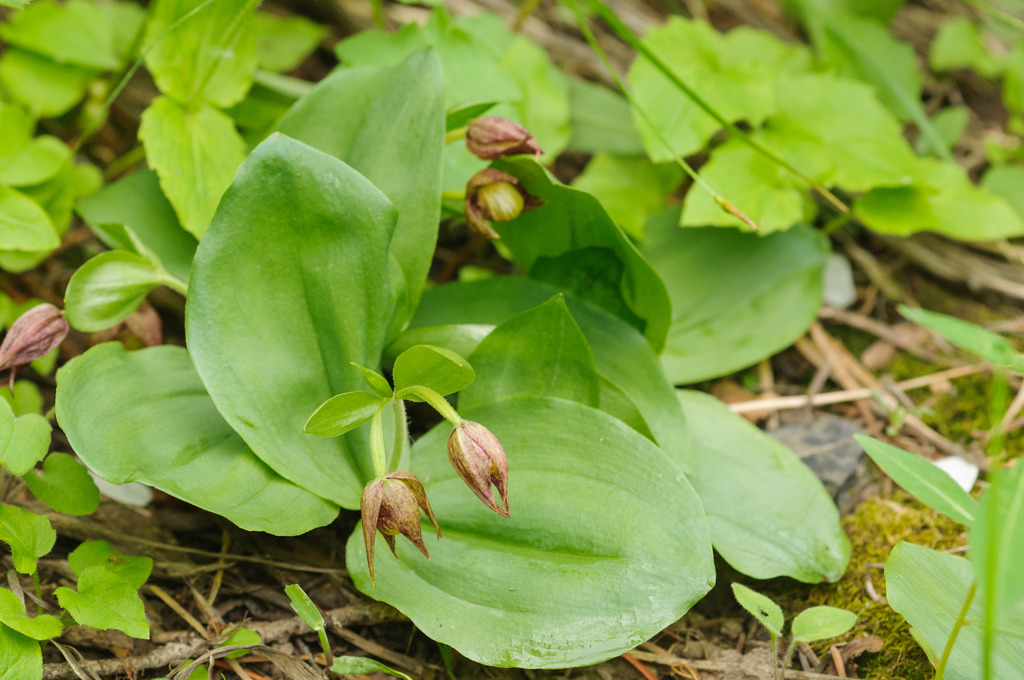
(c) Rolf Lawrenz, some rights reserved (CC BY) · licence
Family: Orchidaceae · Type: Herb · Native
Conservation status: CNPS 4.2
Cypripedium fasciculatum (Clustered lady's-slipper) is a native California herb in the Orchidaceae family, recognized by distinctive 2-leaf structure and clustered flowers.
Clustered lady's-slipper is a California native perennial with a rare (CNPS 4.2) status found in northwestern California, northern Sierra Nevada, and southwestern San Francisco Bay bioregions in mesic to moist, shady conifer forest at elevations of 100 to 2,000 meters. Flowering from March to July, this plant produces yellow-green and purple flowers with distinctive nodding blooms and a characteristically shaped slipper-like lip. Growing 12 to 20 centimeters tall with a delicate, clustered appearance, it emerges with two opposite, wide-elliptic leaves each 5 to 12 centimeters long. Its leaves are a rich green with an elegant, broad shape, and the flowers feature a complex coloration with upper sepals in green to brown tones and lateral petals that curve downward. The plant bears between 1 to 14 flowers in a loose cluster, creating a subtle yet intricate botanical display in its forest understory habitat.
Identification and appearance
Key characters: 3 sympatric species; distinctive 2-leaf structure and clustered flowers
Habitat and range
Habitat: Mesic to moist, shady conifer forest
Elevation: 100-2000 m
California counties: Santa Clara, Tehama, Del Norte, Siskiyou, Butte, Nevada, Plumas, San Mateo, Santa Cruz, Trinity, Mendocino, Humboldt, Sierra
Outside California: to Washington, Montana, Wyoming, Colorado
Bloom period
Cypripedium fasciculatum blooms Mar-Jul.
Conservation status
CNPS 4.2
How to tell it apart
vs Calypso: Cypripedium has a large inflated slipper lip and several leaves along a leafy stem; Calypso (fairy slipper) has a single basal leaf and a smaller pink lip that is spotted and whiskered.; vs Epipactis: Cypripedium has a hollow pouch-shaped lip and a shield-like staminode; Epipactis (stream orchid) has an open cup-and-tongue lip with no inflated pouch.; vs Platanthera: Cypripedium's lip is an inflated slipper; Platanthera (bog orchids) has a small lip drawn back into a nectar spur, with many small flowers in a spike.; vs Corallorhiza: Cypripedium is green with broad pleated leaves; Corallorhiza (coralroot) is leafless and non-green (saprophytic) with a flat, notched or spotted lip.; vs Cephalanthera: Cypripedium has a showy inflated yellow slipper lip; Cephalanthera (phantom orchid) is entirely white and waxy with an erect flower and a small, non-pouched lip.
Frequently asked questions
Is Cypripedium fasciculatum native to California?
Yes. Cypripedium fasciculatum is native to California (recorded as native).
When does Cypripedium fasciculatum bloom?
Cypripedium fasciculatum blooms Mar-Jul.
Where in California does Cypripedium fasciculatum grow?
Cypripedium fasciculatum occurs in Santa Clara, Tehama, Del Norte, Siskiyou, Butte, Nevada, Plumas, San Mateo and other counties, at elevations of 100-2000 m.
What plant family does Cypripedium fasciculatum belong to?
Cypripedium fasciculatum is in the Orchidaceae family, genus Cypripedium.
Is Cypripedium fasciculatum rare or endangered?
Cypripedium fasciculatum carries California Rare Plant Rank 4.2, state rank S4.
Related species
Other California species in the same genus, family, or bioregion.
Sources: Jepson eFlora · CNPS Rare Plant Inventory · Index of California Plant Names · CalPhotos · CDFW CNDDB
Last updated 2026-10-07
Data from The California Species Project — 14,000+ California species with verified data from CNPS, CDFW, USFWS, Cal-IPC, and more.