Cystopteris fragilis
Bladder fern
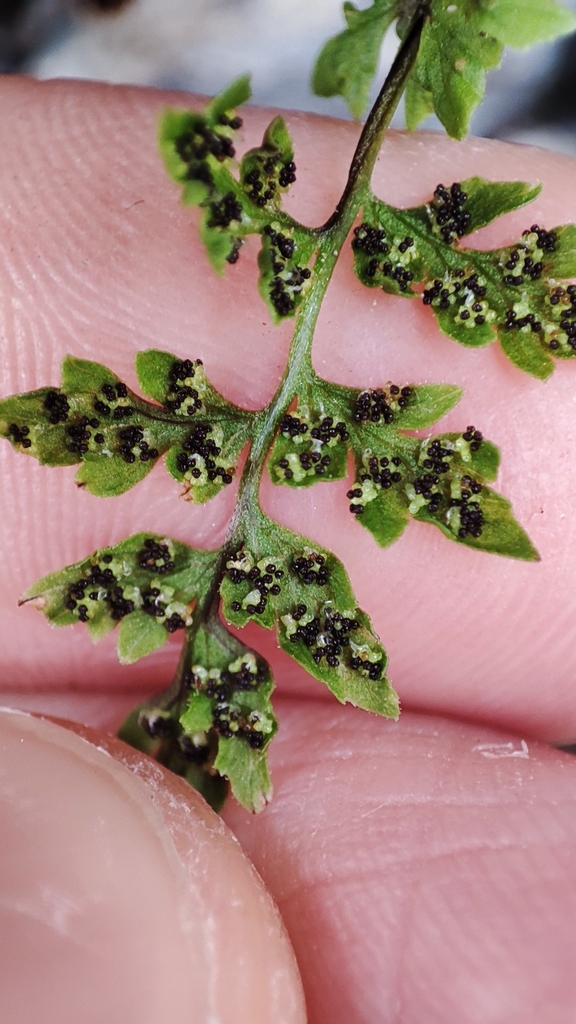
no rights reserved · CC0
Family: Cystopteridaceae · Type: Herb · Native
Cystopteris fragilis (Bladder fern) is a native California herb in the Cystopteridaceae family, recognized by Cosmopolitan species, only Cystopteris in California, represents widespread northern temperate lineage.
Bladder fern is a native perennial found in the Klamath Ranges, northern California Coast Ranges, Cascade Range, northern and central Sierra Nevada Foothills, Sierra Nevada, Tehachapi Mountains, San Francisco Bay Area, southern Coast Ranges, northern Channel Islands, Transverse Ranges, Peninsular Ranges, Great Basin, and Desert Mountains in shady, moist rock crevices, meadows, and streamsides at elevations of 50 to 4,100 meters. Its delicate, lance-ovate fronds grow 8 to 30 centimeters long with fine, straw-colored to red-brown stems typically shorter than the blade. Growing from a thin rhizome covered in shining, brown lanceolate scales, this fern forms elegant, feathery clusters with finely divided pinnae. The light green fronds are typically 10 to 24 centimeters long and 3 to 9 centimeters wide, with the lowest two to four pinnae slightly shorter than the upper ones. White indusia protect the delicate sporangia, creating a distinctive feature of this widespread and adaptable fern.
Identification and appearance
Key characters: Cosmopolitan species, only Cystopteris in California, represents widespread northern temperate lineage
Habitat and range
Habitat: Shady, moist rock crevices, meadows, streamsides
Elevation: 50-4100 m
California counties: Plumas, Riverside, Shasta, Santa Barbara, Siskiyou, San Diego, San Bernardino, Tulare, Placer, Santa Cruz, Tuolumne, Sierra, Tehama, Inyo, Fresno, Los Angeles, El Dorado, Mono, Alpine, Butte, Del Norte, Humboldt, Kern, Lake, Lassen, Madera, Mariposa, Mendocino, Modoc, Monterey, Napa, Nevada, Trinity, San Luis Obispo, Amador, Alameda, Marin, Ventura, Santa Clara, Sonoma, Glenn, Sutter, San Joaquin, San Mateo, Contra Costa, Colusa, Calaveras, San Benito, Kings
Outside California: worldwide
How to tell it apart
vs Athyrium: Cystopteris is delicate and under 1 foot; Athyrium is robust and 1-5 feet with thick stems.; vs Woodsia: Cystopteris has hood-shaped spore covers and smooth leaf axes; Woodsia has star-shaped hairs underneath and on axes.; vs Polystichum: Cystopteris leaflets are asymmetric with no spiny tips; Polystichum leaflets are symmetric with sharp spiny points.; vs Dryopteris: Cystopteris has hood-shaped covers and smooth axes; Dryopteris has kidney-shaped covers and often glandular axes.; vs Phacelia: Cystopteris is a fern with spores underneath; Phacelia is a flowering plant with coiled flower clusters.
Frequently asked questions
Is Cystopteris fragilis native to California?
Yes. Cystopteris fragilis is native to California (recorded as native).
Where in California does Cystopteris fragilis grow?
Cystopteris fragilis occurs in Plumas, Riverside, Shasta, Santa Barbara, Siskiyou, San Diego, San Bernardino, Tulare and other counties, at elevations of 50-4100 m.
What plant family does Cystopteris fragilis belong to?
Cystopteris fragilis is in the Cystopteridaceae family, genus Cystopteris.
What habitat does Cystopteris fragilis grow in?
Cystopteris fragilis grows in Shady, moist rock crevices, meadows, streamsides.
Related species
Other California species in the same genus, family, or bioregion.
Sources: Jepson eFlora · Index of California Plant Names · CalPhotos
Last updated 2026-10-07
Data from The California Species Project — 14,000+ California species with verified data from CNPS, CDFW, USFWS, Cal-IPC, and more.