Cytisus scoparius
Scotch broom
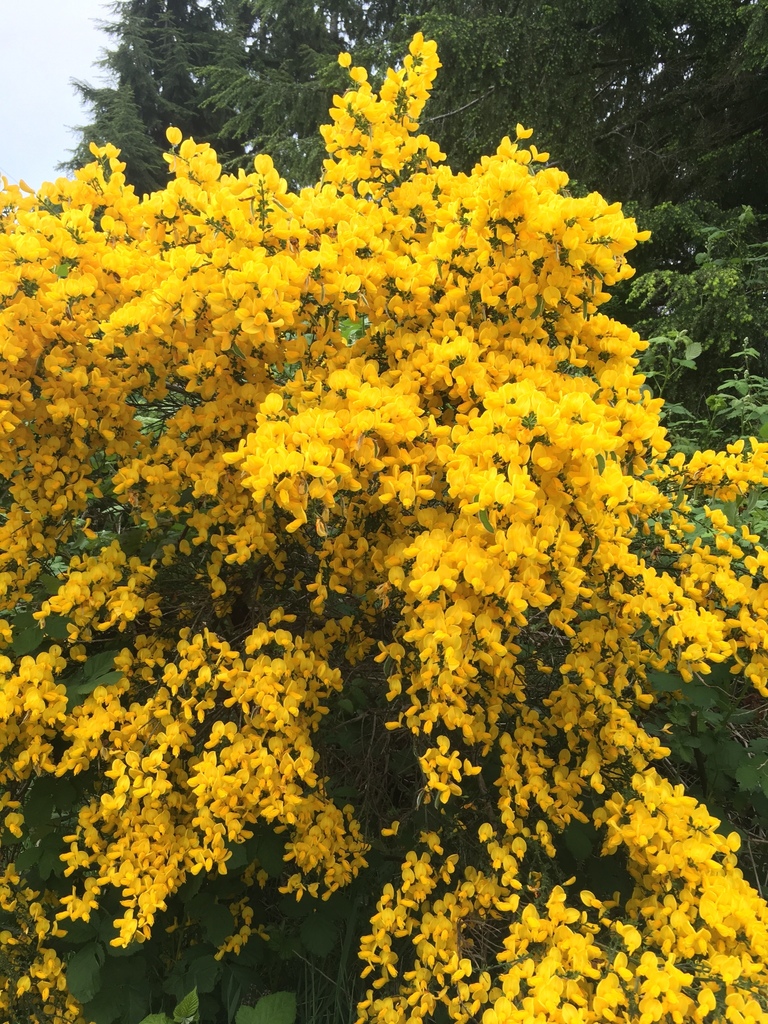
(c) Jonathan Eyestone, some rights reserved (CC BY), uploaded by Jonathan Eyestone · licence
Family: Fabaceae · Type: Shrub · Not Native
Conservation status: Cal-IPC Yes
Cytisus scoparius (Scotch broom) is a non-native California shrub in the Fabaceae family, recognized by golden yellow flowers and glabrous characteristics diagnostic.
Scotch broom is a naturalized shrub found in northwestern California, the Sierra Nevada foothills, northern Sierra Nevada, northern Sierra Nevada high country, Central Valley, San Francisco Bay Area, southern California coastal areas, and San Bernardino Mountains in disturbed places at elevations below 1,000 meters. Flowering from April to July, this plant produces abundant golden yellow flowers with distinctive reflexed banner petals about 15 to 20 millimeters long. Growing as a robust shrub two to two and a half meters tall with five-angled green branches that become increasingly glabrous with age, it develops a distinctive architectural form. Its leaves are initially simple on younger stems and become compound with three leaflets on older branches, each leaflet 5 to 20 millimeters long and obovate to oblong in shape. The fruit is a flat brown or black pod 2.5 to 4 centimeters long, producing numerous seeds that contribute to its aggressive spread in disturbed habitats.
Identification and appearance
Key characters: 3 sympatric species; golden yellow flowers and glabrous characteristics diagnostic
Habitat and range
Habitat: Common. Disturbed places
Elevation: < 1000 m
California counties: El Dorado, Humboldt, San Bernardino, Trinity, San Mateo, Mariposa, Mendocino, Nevada, Los Angeles, San Francisco, Marin, Sonoma, Santa Cruz, Madera, Butte, Calaveras, Monterey, Plumas, Santa Clara, Shasta, Sierra, Del Norte, Placer, Amador, Contra Costa, Yuba, Glenn, Santa Barbara, San Diego, Tehama, Solano, Alameda
Outside California: native to southern Europe, northern Africa
Bloom period
Cytisus scoparius blooms Apr-Jul.
Conservation status
Cal-IPC Yes
How to tell it apart
vs Genista: Cytisus style curves in middle; Genista style bends sharply at tip only.; vs Spartium: Cytisus has leafy 3-part leaves; Spanish broom has nearly leafless rush-like stems.; vs Acmispon: Cytisus is tall woody shrub with ridged stems; deerweed is low herbaceous without ridged stems.; vs Baccharis: Cytisus has yellow pea flowers; baccharis has tiny white fuzzy flowers and lacks showy petals.; vs Ephedra: Cytisus has yellow flowers and leaves; Mormon tea has no flowers/leaves, only tiny scales on jointed stems.
Frequently asked questions
Is Cytisus scoparius native to California?
No. Cytisus scoparius is not native to California (recorded as not native).
When does Cytisus scoparius bloom?
Cytisus scoparius blooms Apr-Jul.
Where in California does Cytisus scoparius grow?
Cytisus scoparius occurs in El Dorado, Humboldt, San Bernardino, Trinity, San Mateo, Mariposa, Mendocino, Nevada and other counties, at elevations of < 1000 m.
What plant family does Cytisus scoparius belong to?
Cytisus scoparius is in the Fabaceae family, genus Cytisus.
Is Cytisus scoparius invasive in California?
Cytisus scoparius is listed by Cal-IPC with an invasiveness rating of Yes.
Related species
Other California species in the same genus, family, or bioregion.
Sources: Jepson eFlora · Index of California Plant Names · CalPhotos
Last updated 2026-10-07
Data from The California Species Project — 14,000+ California species with verified data from CNPS, CDFW, USFWS, Cal-IPC, and more.