Cytisus striatus
Portuguese broom
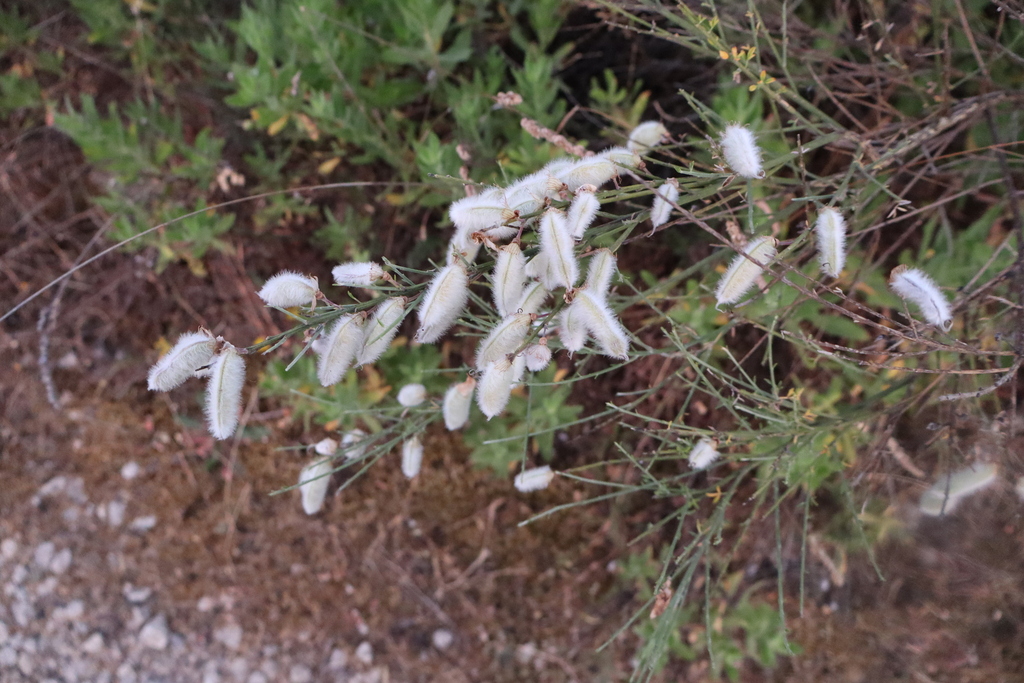
(c) zebedeugalinha, some rights reserved (CC BY) · licence
Family: Fabaceae · Type: Shrub · Not Native
Conservation status: Cal-IPC Yes
Cytisus striatus (Portuguese broom) is a non-native California shrub in the Fabaceae family, recognized by pale yellow flowers, inflated hairy pods, and glaucous leaves diagnostic.
Portuguese broom is a naturalized shrub found in southern coastal California regions including San Francisco Bay, Santa Cruz, Santa Catalina Island, San Gabriel Mountains, and Peninsular Ranges in disturbed places at elevations below 300 meters. Flowering from May to August, this plant produces pale yellow flowers in small axillary clusters with banner petals 10 to 25 millimeters long. Growing two to three meters tall with many slender branches that are eight to ten-angled and initially silky-hairy, it develops a complex branching structure. Its leaves feature one to three obovate leaflets that are glaucous and glabrous on the upper surface, with silky hairs on the lower surface, varying between sessile and petioled configurations depending on branch location. The fruit is an inflated pod one and a half to four centimeters long, densely covered in white hairs and containing several seeds.
Identification and appearance
Key characters: 3 sympatric species; pale yellow flowers, inflated hairy pods, and glaucous leaves diagnostic
Habitat and range
Habitat: Uncommon but locally abundant. Disturbed places
Elevation: < 300 m
California counties: Los Angeles, Riverside, San Bernardino, San Francisco, Marin, Alameda, Contra Costa, Humboldt, San Diego, Santa Cruz, San Mateo, Sonoma, Monterey, San Luis Obispo
Outside California: native to Spain, Portugal
Bloom period
Cytisus striatus blooms May-Aug.
Conservation status
Cal-IPC Yes
How to tell it apart
vs Genista: Cytisus style curves in middle; Genista style bends sharply at tip only.; vs Spartium: Cytisus has leafy 3-part leaves; Spanish broom has nearly leafless rush-like stems.; vs Acmispon: Cytisus is tall woody shrub with ridged stems; deerweed is low herbaceous without ridged stems.; vs Baccharis: Cytisus has yellow pea flowers; baccharis has tiny white fuzzy flowers and lacks showy petals.; vs Ephedra: Cytisus has yellow flowers and leaves; Mormon tea has no flowers/leaves, only tiny scales on jointed stems.
Frequently asked questions
Is Cytisus striatus native to California?
No. Cytisus striatus is not native to California (recorded as not native).
When does Cytisus striatus bloom?
Cytisus striatus blooms May-Aug.
Where in California does Cytisus striatus grow?
Cytisus striatus occurs in Los Angeles, Riverside, San Bernardino, San Francisco, Marin, Alameda, Contra Costa, Humboldt and other counties, at elevations of < 300 m.
What plant family does Cytisus striatus belong to?
Cytisus striatus is in the Fabaceae family, genus Cytisus.
Is Cytisus striatus invasive in California?
Cytisus striatus is listed by Cal-IPC with an invasiveness rating of Yes.
Related species
Other California species in the same genus, family, or bioregion.
Sources: Jepson eFlora · Index of California Plant Names · CalPhotos
Last updated 2026-10-07
Data from The California Species Project — 14,000+ California species with verified data from CNPS, CDFW, USFWS, Cal-IPC, and more.