Dactylis glomerata
Orchard grass
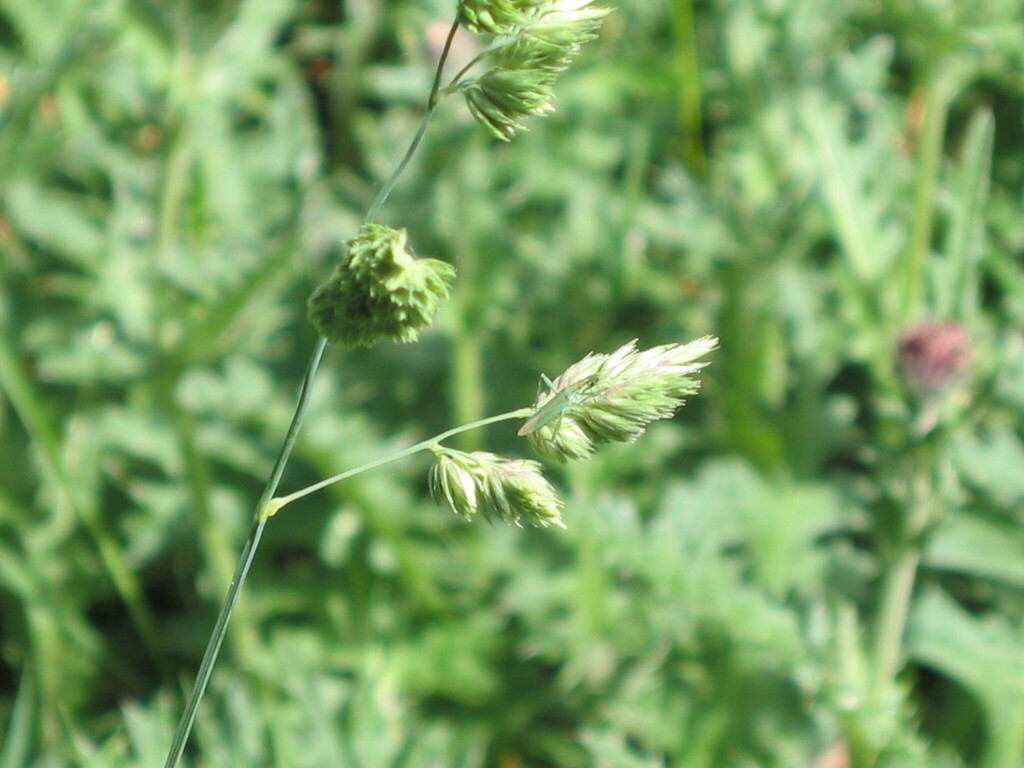
(c) zebedeugalinha, some rights reserved (CC BY) · licence
Family: Poaceae · Type: Grass · Not Native
Conservation status: Cal-IPC Yes
Dactylis glomerata (Orchard grass) is a non-native California grass in the Poaceae family, recognized by Eurasian forage grass, only Dactylis species naturalized in California.
Orchard grass is a naturalized perennial grass found in California Floristic Province and Great Basin regions in disturbed, often moist sites at elevations below 2,410 meters. Flowering from May to August, this introduced grass produces dense, cluster-like panicles with green to greenish-gray flowers in compact, one-sided clusters. Growing in dense tufts with multiple stems 30 to 200 centimeters tall from short underground rhizomes, it forms thick clumps in open areas. Its leaf blades are 3 to 6 millimeters wide, slightly rough-textured, with translucent membranous ligules 4 to 9 millimeters long that are fringed or toothed at the tip. The spikelets are laterally compressed with 2 to 6 florets, each with short-awned tips that give the grass a distinctive textured appearance.
Identification and appearance
Key characters: Eurasian forage grass, only Dactylis species naturalized in California
Habitat and range
Habitat: Disturbed, often moist sites
Elevation: < 2410 m
California counties: Humboldt, San Luis Obispo, El Dorado, Alameda, Colusa, Fresno, Inyo, Los Angeles, Mendocino, Mono, Orange, Riverside, San Bernardino, San Diego, San Francisco, San Mateo, Santa Barbara, Siskiyou, Solano, Sonoma, Tulare, Ventura, Marin, Placer, Shasta, Tehama, Yuba, Butte, Nevada, Amador, Lassen, Calaveras, Sierra, Kern, Modoc, Sutter, Santa Cruz, San Joaquin, Napa, Lake, Glenn, Alpine, Del Norte, Madera, Monterey, Plumas, Santa Clara, Trinity, Tuolumne, Stanislaus, Contra Costa, Yolo, Mariposa, Sacramento
Outside California: to Alaska, Canada, widespread in United States, native to Eurasia
Bloom period
Dactylis glomerata blooms May-Aug.
Conservation status
Cal-IPC Yes
How to tell it apart
vs Phalaris: Dactylis has lumpy one-sided clusters; Phalaris has dense, cylindrical spike-like panicles with shiny spikelets.; vs Holcus: Dactylis has one-sided clusters with rough keels; Holcus has even panicles and soft, velvety pubescence throughout.; vs Bromus: Dactylis has one-sided lumpy clusters; Bromus has evenly distributed, hanging or nodding spikelets on branches.; vs Koeleria: Dactylis has dense one-sided clusters; Koeleria has narrow, spike-like panicles with evenly distributed small spikelets.; vs Leymus: Dactylis has branched panicles with one-sided clusters; Leymus has unbranched spikes with spikelets in two rows.
Frequently asked questions
Is Dactylis glomerata native to California?
No. Dactylis glomerata is not native to California (recorded as not native).
When does Dactylis glomerata bloom?
Dactylis glomerata blooms May-Aug.
Where in California does Dactylis glomerata grow?
Dactylis glomerata occurs in Humboldt, San Luis Obispo, El Dorado, Alameda, Colusa, Fresno, Inyo, Los Angeles and other counties, at elevations of < 2410 m.
What plant family does Dactylis glomerata belong to?
Dactylis glomerata is in the Poaceae family, genus Dactylis.
Is Dactylis glomerata invasive in California?
Dactylis glomerata is listed by Cal-IPC with an invasiveness rating of Yes.
Related species
Other California species in the same genus, family, or bioregion.
Sources: Jepson eFlora · Index of California Plant Names · CalPhotos
Last updated 2026-10-07
Data from The California Species Project — 14,000+ California species with verified data from CNPS, CDFW, USFWS, Cal-IPC, and more.