Danthonia unispicata
One-spike oat grass
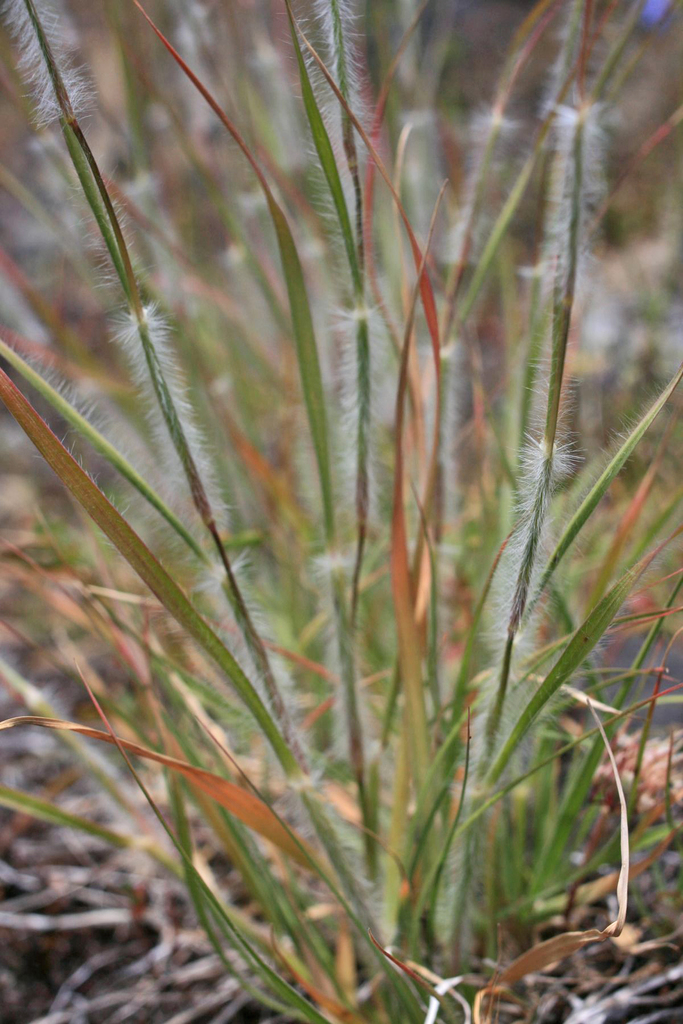
(c) Ed Alverson, some rights reserved (CC BY), uploaded by Ed Alverson · licence
Family: Poaceae · Type: Grass · Native
Danthonia unispicata (One-spike oat grass) is a native California grass in the Poaceae family, recognized by readily distinguished by solitary spikelet and densely hairy sheaths.
One-spike oat grass is a California native perennial found in the Klamath Ranges, northern Coast Ranges, high Cascades, Sierra Nevada, San Joaquin Valley, Transverse Ranges, Southeastern desert mountains, and Mojave Province in dry meadows, rocky slopes, and open conifer forests at elevations of 400 to 3,200 meters. Flowering from May to August, this plant produces pale straw-colored flowers in slender, typically solitary spikelets up to 25 millimeters long. Growing with erect stems 10 to 30 centimeters tall, it forms dense tufted clusters with hairy leaf sheaths. Its leaves are narrow and sparse, with blades 3 to 8 centimeters long and 1 to 3 millimeters wide, slightly flat to rolled, and covered in papillate hairs. Each leaf lemma bears a distinctive 4 to 9 millimeter-long awn with delicate marginal hairs.
Identification and appearance
Key characters: 2 sympatric species; readily distinguished by solitary spikelet and densely hairy sheaths
Habitat and range
Habitat: dry meadows, rocky slopes, open sites in conifer forest
Elevation: 400-3200 m
California counties: Del Norte, El Dorado, Fresno, Humboldt, Lassen, Mariposa, Modoc, Mono, Nevada, Plumas, San Bernardino, San Diego, Shasta, Sierra, Siskiyou, Tehama, Tulare, Yuba, Alpine, Merced, Trinity, Butte, Glenn, Inyo, Madera, Placer, Tuolumne, Mendocino, Colusa, Lake, Riverside, Ventura
Outside California: to western Canada, western United States
Bloom period
Danthonia unispicata blooms May-Aug.
How to tell it apart
vs Avena: Danthonia glumes wrap tightly around florets; Avena glumes are shorter, leaving florets exposed.; vs Bromus: Danthonia glumes are longer than florets; Bromus glumes are shorter than florets.; vs Nassella: Danthonia has multiple florets per spikelet; Nassella has single florets with twisted awns.; vs Lolium: Danthonia spikelets have 2 prominent glumes; Lolium spikelets sit edgewise with only 1 visible glume.; vs Carex: Danthonia is a grass with open flower clusters; Carex is a sedge with flowers in dense spikes.
Frequently asked questions
Is Danthonia unispicata native to California?
Yes. Danthonia unispicata is native to California (recorded as native).
When does Danthonia unispicata bloom?
Danthonia unispicata blooms May-Aug.
Where in California does Danthonia unispicata grow?
Danthonia unispicata occurs in Del Norte, El Dorado, Fresno, Humboldt, Lassen, Mariposa, Modoc, Mono and other counties, at elevations of 400-3200 m.
What plant family does Danthonia unispicata belong to?
Danthonia unispicata is in the Poaceae family, genus Danthonia.
What habitat does Danthonia unispicata grow in?
Danthonia unispicata grows in dry meadows, rocky slopes, open sites in conifer forest.
Related species
Other California species in the same genus, family, or bioregion.
- Danthonia californica — California oat grass
- Danthonia decumbens — Mountain heath grass
- Danthonia intermedia subsp. intermedia — Intermediate oat grass
- Danthonia sp. — Oat grass
- Dasyochloa pulchella — Low woollygrass
- Dasyochloa sp. — Fluff grass
- Deschampsia bolanderi — Scribner's grass
- Deschampsia cespitosa — Tufted hair grass
Sources: Jepson eFlora · Index of California Plant Names · CalPhotos
Last updated 2026-10-07
Data from The California Species Project — 14,000+ California species with verified data from CNPS, CDFW, USFWS, Cal-IPC, and more.