Datura discolor
Desert thorn-apple
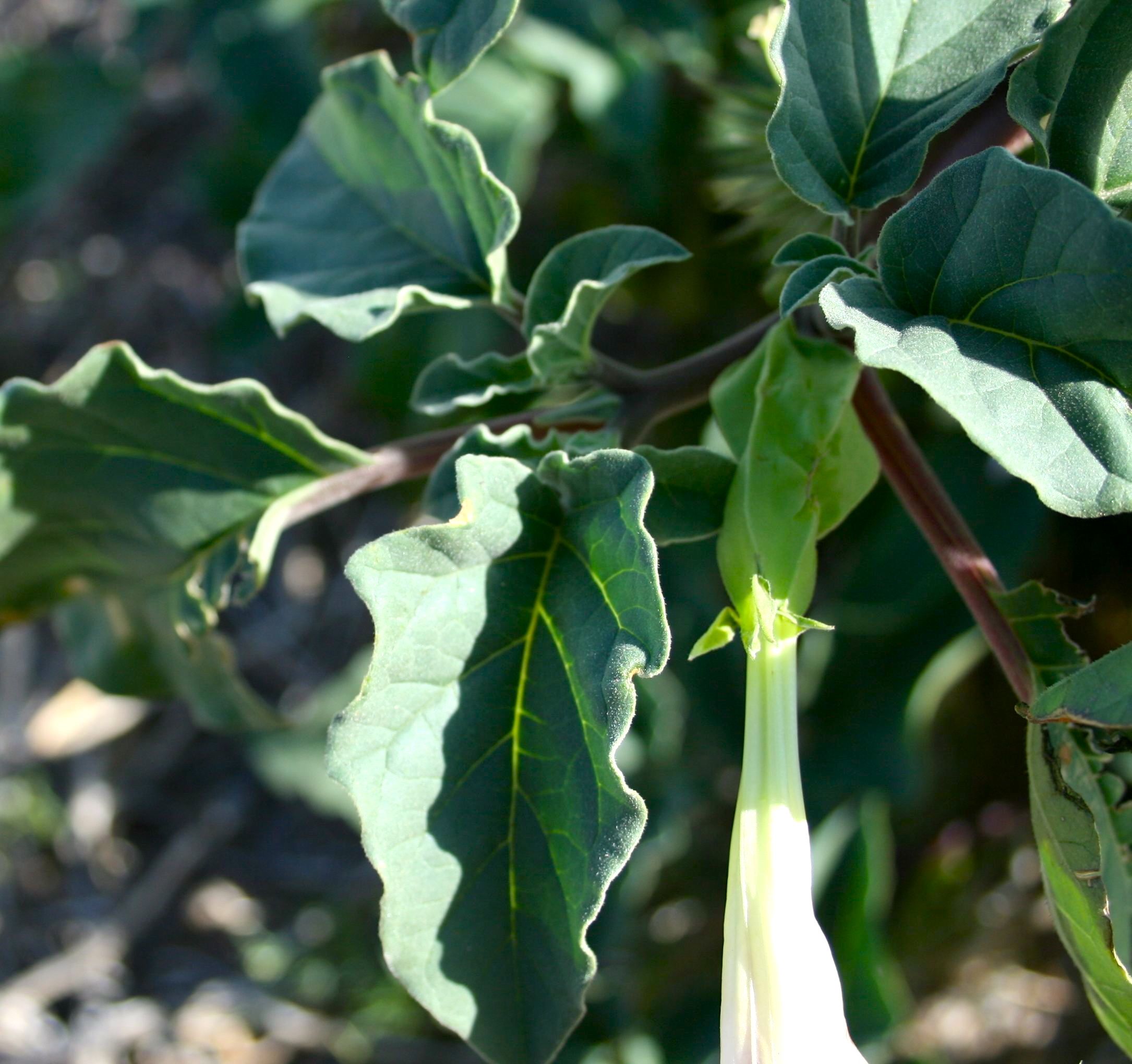
Photo by Chez Brungraber
Family: Solanaceae · Type: Herb · Native
Datura discolor (Desert thorn-apple) is a native California herb in the Solanaceae family, recognized by (D. wrightii). Distinguished by smaller flowers, nodding fruits, and desert habitat.
Desert thorn-apple is a California native perennial found in the southern desert regions in sandy, gravelly washes and dry habitats at elevations below 600 meters. Flowering from February to May and August to December, this plant produces spectacular white flowers with purple markings in the throat, reaching 10 to 16 centimeters long. Growing with gray-hairy stems up to one meter tall, it forms a distinctive short-lived perennial with widely spreading branches. Its large leaves are widely ovate, measuring 6 to 12 centimeters long and 4 to 10 centimeters wide, with coarse tooth-like edges. The plant develops distinctive nodding fruits approximately 35 millimeters wide, covered in weak prickles less than 2 centimeters long.
Identification and appearance
Key characters: 1 sympatric species (D. wrightii). Distinguished by smaller flowers, nodding fruits, and desert habitat.
Habitat and range
Habitat: Sandy, gravelly soils, washes
Elevation: < 600 m
California counties: Imperial, Riverside, Inyo, San Diego, San Bernardino
Outside California: Arizona, Mexico, Central America, introduced +- worldwide
Bloom period
Datura discolor blooms (Jan) Feb-May, Aug--Dec.
How to tell it apart
vs Calystegia: Datura has spiny seed pods; Calystegia has smooth, rounded capsules.; vs Brugmansia: Datura fruits are covered in spines; Brugmansia fruits are smooth elongated pods without spines.; vs Solanum: Datura has spiny capsules; Solanum has smooth berries.; vs Marah: Datura has herbaceous stems and trumpet flowers; Marah is a vine with tendrils and separate male/female flowers.; vs Ipomoea: Datura has spiny fruits and toothed leaves; Ipomoea has smooth capsules and often lobed leaves.
Frequently asked questions
Is Datura discolor native to California?
Yes. Datura discolor is native to California (recorded as native).
When does Datura discolor bloom?
Datura discolor blooms (Jan) Feb-May, Aug--Dec.
Where in California does Datura discolor grow?
Datura discolor occurs in Imperial, Riverside, Inyo, San Diego, San Bernardino, at elevations of < 600 m.
What plant family does Datura discolor belong to?
Datura discolor is in the Solanaceae family, genus Datura.
What habitat does Datura discolor grow in?
Datura discolor grows in Sandy, gravelly soils, washes.
Related species
Other California species in the same genus, family, or bioregion.
Sources: Jepson eFlora · Index of California Plant Names · CalPhotos
Last updated 2026-10-07
Data from The California Species Project — 14,000+ California species with verified data from CNPS, CDFW, USFWS, Cal-IPC, and more.