Datura stramonium
Jimson weed
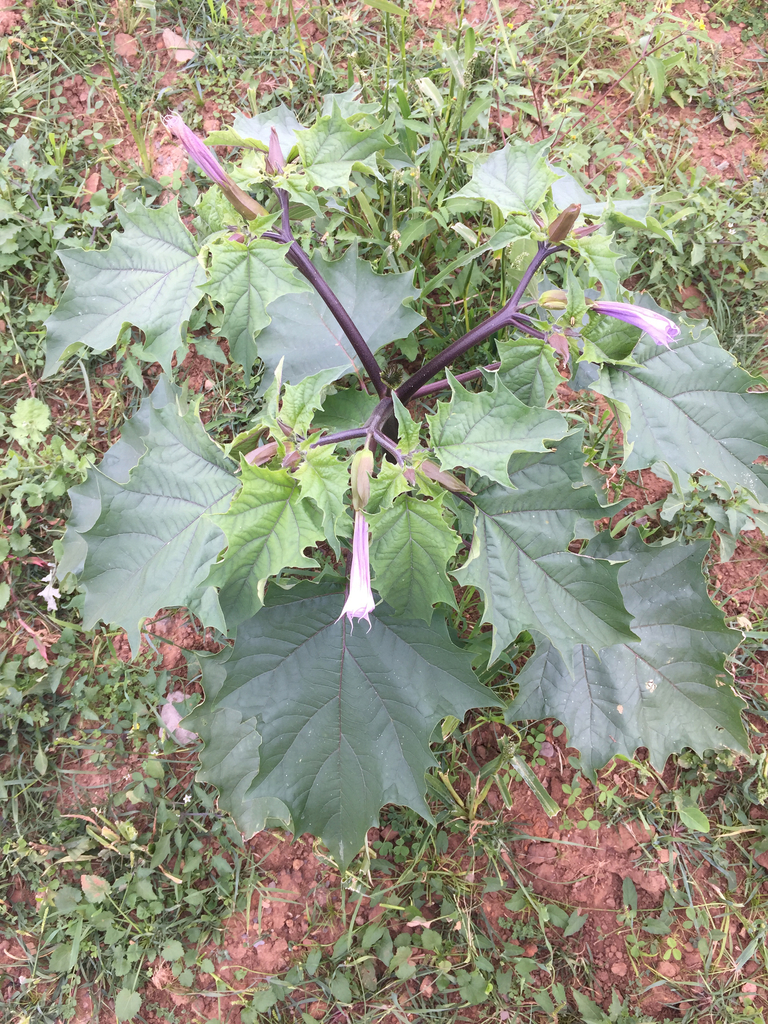
(c) Kevin Attard, some rights reserved (CC BY), uploaded by Kevin Attard · licence
Family: Solanaceae · Type: Subshrub · Not Native
Datura stramonium (Jimson weed) is a non-native California subshrub in the Solanaceae family, recognized by . Distinguished by erect fruits with uniform spine length and smaller flowers.
Jimson weed is a naturalized annual found in California Floristic Province and Mountain Province in sandy soils and open, often disturbed areas at elevations below 1,425 meters. Flowering from June to August, this plant produces white or pale blue-purple flowers with spreading, long and narrow lobes reaching 6 to 9 centimeters in length. Growing up to 1.5 meters tall with erect stems that are nearly smooth or sparsely hairy, it forms a robust and distinctive plant. Its large ovate leaves measure 5 to 15 centimeters long, with coarse teeth and shallow lobes, creating a broad, irregular leaf shape. The fruit is a distinctive, erect capsule densely covered with prickles 3 to 15 millimeters long, which split open into four regular valves when mature.
Identification and appearance
Key characters: 2 sympatric species. Distinguished by erect fruits with uniform spine length and smaller flowers.
Habitat and range
Habitat: Sandy soils, open, often disturbed areas
Elevation: < 1425 m
California counties: Orange, Santa Clara, Los Angeles, Stanislaus, Riverside, Kern, Lake, Ventura, Contra Costa, Monterey, Sonoma, Siskiyou, Alameda, Glenn, Mendocino, Santa Barbara, Marin, San Bernardino, Santa Cruz, Humboldt, San Diego, San Luis Obispo, Kings, Yolo, Sacramento, Trinity, Butte, Tehama, Modoc, Amador, Napa, El Dorado, Colusa, San Mateo, San Joaquin
Outside California: to eastern United States, native to Mexico, introduced +- worldwide
Bloom period
Datura stramonium blooms Jun-Aug.
How to tell it apart
vs Calystegia: Datura has spiny seed pods; Calystegia has smooth, rounded capsules.; vs Brugmansia: Datura fruits are covered in spines; Brugmansia fruits are smooth elongated pods without spines.; vs Solanum: Datura has spiny capsules; Solanum has smooth berries.; vs Marah: Datura has herbaceous stems and trumpet flowers; Marah is a vine with tendrils and separate male/female flowers.; vs Ipomoea: Datura has spiny fruits and toothed leaves; Ipomoea has smooth capsules and often lobed leaves.
Frequently asked questions
Is Datura stramonium native to California?
No. Datura stramonium is not native to California (recorded as not native).
When does Datura stramonium bloom?
Datura stramonium blooms Jun-Aug.
Where in California does Datura stramonium grow?
Datura stramonium occurs in Orange, Santa Clara, Los Angeles, Stanislaus, Riverside, Kern, Lake, Ventura and other counties, at elevations of < 1425 m.
What plant family does Datura stramonium belong to?
Datura stramonium is in the Solanaceae family, genus Datura.
What habitat does Datura stramonium grow in?
Datura stramonium grows in Sandy soils, open, often disturbed areas.
Related species
Other California species in the same genus, family, or bioregion.
Sources: Jepson eFlora · Index of California Plant Names · CalPhotos
Last updated 2026-10-07
Data from The California Species Project — 14,000+ California species with verified data from CNPS, CDFW, USFWS, Cal-IPC, and more.