Datura wrightii
Sacred datura, angel's trumpet
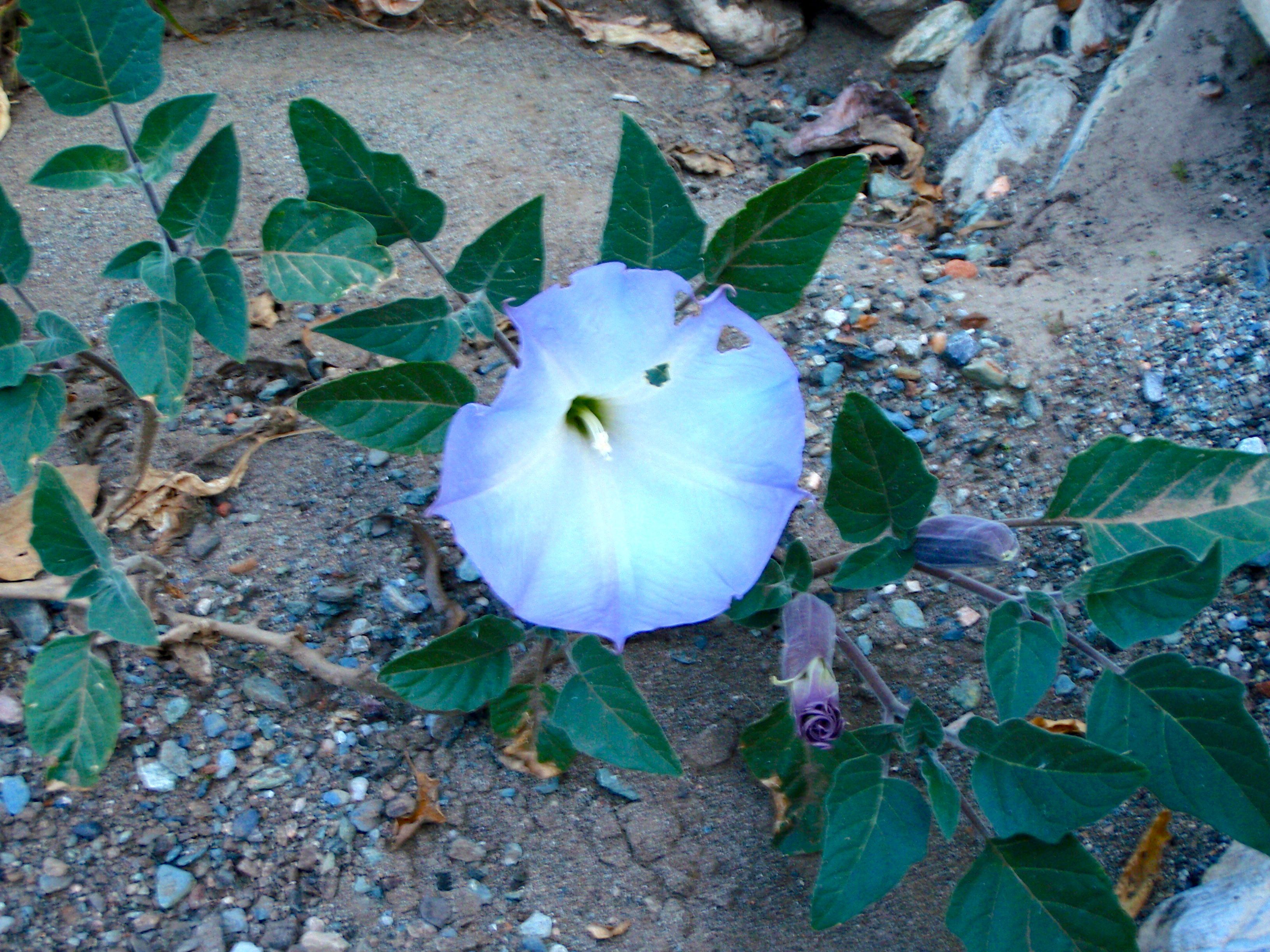
Photo by Chez Brungraber
Family: Solanaceae · Type: Subshrub · Native
Conservation status: Cal-IPC Yes
Datura wrightii (Sacred datura) is a native California subshrub in the Solanaceae family, recognized by . Distinguished by largest flowers, perennial habit, fuzzy pubescence, and nodding fruits.
Sacred datura is a California native perennial herb found in the North Coast Ranges Interior, central Sierra Nevada Foothills, Tehama County, Central Valley, Central Western California, Southwestern California, and Desert regions in sandy or gravelly open areas at elevations below 2,200 meters. Flowering from April to October, this plant produces large white flowers up to 20 centimeters long with long, narrow corolla lobes that open in the evening. Growing with densely puberulent stems 50 to 150 centimeters tall, it forms a robust and spreading habit. Its large ovate leaves measuring 7 to 20 centimeters are either entire or coarsely lobed, creating a dramatic architectural presence in its habitat. The fruit is a distinctive nodding capsule 25 to 30 millimeters wide, covered in short prickles and containing flat tan seeds with a white appendage.
Identification and appearance
Key characters: 3 sympatric species. Distinguished by largest flowers, perennial habit, fuzzy pubescence, and nodding fruits.
Habitat and range
Habitat: Sandy or gravelly open areas
Elevation: < 2200 m
California counties: San Bernardino, San Diego, Kern, Ventura, Sonoma, Riverside, Los Angeles, Tulare, Orange, Fresno, Merced, Stanislaus, Tuolumne, Imperial, San Joaquin, Colusa, Inyo, Butte, Monterey, Santa Barbara, Marin, Santa Clara, Solano, Mono, Yolo, San Luis Obispo, Sutter, Glenn, Contra Costa, San Benito, Mariposa, Alameda, Madera, Napa, Sacramento, Shasta, Santa Cruz, Kings
Outside California: to Utah, Texas, Mexico
Bloom period
Datura wrightii blooms Apr-Oct.
Conservation status
Cal-IPC Yes
How to tell it apart
vs Calystegia: Datura has spiny seed pods; Calystegia has smooth, rounded capsules.; vs Brugmansia: Datura fruits are covered in spines; Brugmansia fruits are smooth elongated pods without spines.; vs Solanum: Datura has spiny capsules; Solanum has smooth berries.; vs Marah: Datura has herbaceous stems and trumpet flowers; Marah is a vine with tendrils and separate male/female flowers.; vs Ipomoea: Datura has spiny fruits and toothed leaves; Ipomoea has smooth capsules and often lobed leaves.
Frequently asked questions
Is Datura wrightii native to California?
Yes. Datura wrightii is native to California (recorded as native).
When does Datura wrightii bloom?
Datura wrightii blooms Apr-Oct.
Where in California does Datura wrightii grow?
Datura wrightii occurs in San Bernardino, San Diego, Kern, Ventura, Sonoma, Riverside, Los Angeles, Tulare and other counties, at elevations of < 2200 m.
What plant family does Datura wrightii belong to?
Datura wrightii is in the Solanaceae family, genus Datura.
Is Datura wrightii invasive in California?
Datura wrightii is listed by Cal-IPC with an invasiveness rating of Yes.
Related species
Other California species in the same genus, family, or bioregion.
- Datura discolor — Desert thorn-apple
- Datura ferox — Long-spined thorn-apple
- Datura innoxia — pricklyburr
- Datura quercifolia — Oak-leaved thorn-apple
- Datura sp. — Jimson weed
- Datura stramonium — Jimson weed
- Hyoscyamus niger — Black henbane
- Hyoscyamus sp. — Henbane
- Leucophysalis nana — Dwarf leucophysalis
- Leucophysalis sp.
Sources: Jepson eFlora · Index of California Plant Names · CalPhotos
Last updated 2026-10-08
Data from The California Species Project — 14,000+ California species with verified data from CNPS, CDFW, USFWS, Cal-IPC, and more.