Deinandra conjugens
Otay tarplant
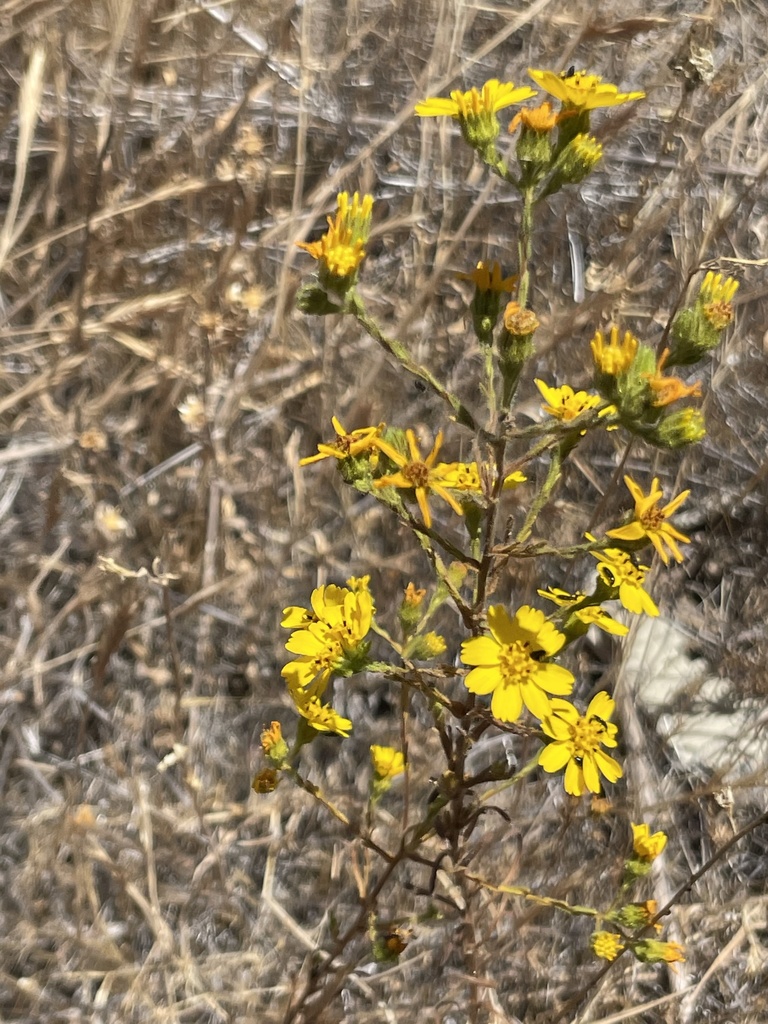
(c) Sula Vanderplank, some rights reserved (CC BY) · licence
Family: Asteraceae · Type: Herb · Native
Conservation status: CNPS 1B.1 · Threatened
Deinandra conjugens (Otay tarplant) is a native California herb in the Asteraceae family, recognized by ridged phyllary body is key feature.
Otay tarplant is a rare (CNPS 1B.1) California native annual found in southern Southern California Coast and western Peninsular Ranges in San Diego County, growing in coastal scrub and grassland openings on clayey soils at elevations of 20 to 300 meters. Flowering from April to June, this plant produces deep yellow ray flowers 3 to 6 millimeters long with distinctive yellow disk flowers featuring red to dark purple anthers. Growing 10 to 50 centimeters tall with an open, branching habit, it develops slender stems with coarse hairs. Its lower leaves are pinnately lobed or toothed, with proximal leaves showing rough, somewhat dense hairiness. The plant's flower heads form distinctive panicle-like clusters with phyllaries that are unevenly covered with variable-sized glandular hairs.
Identification and appearance
Key characters: 8 sympatric species; ridged phyllary body is key feature
Habitat and range
Habitat: Clayey soils of coastal scrub openings, grassland
Elevation: 20-300 m
Outside California: northern Baja California
Bloom period
Deinandra conjugens blooms Apr-Jun.
Conservation status
CNPS 1B.1 · Threatened
How to tell it apart
vs Hemizonia: Deinandra rays pure yellow; Hemizonia rays often purple-veined beneath.; vs Holocarpha: Deinandra stalk bracts lack pit glands; Holocarpha has distinctive pit-gland tips.; vs Madia: Deinandra ray fruits with beaks; Madia ray fruits enclosed by phyllaries, different appearance.; vs Eriophyllum: Deinandra is resinous/sticky; Eriophyllum is woolly-hairy, not sticky.; vs Layia: Deinandra lacks ray pappus scales; Layia has prominent white/tan pappus bristles on ray flowers.
Frequently asked questions
Is Deinandra conjugens native to California?
Yes. Deinandra conjugens is native to California (recorded as native).
When does Deinandra conjugens bloom?
Deinandra conjugens blooms Apr-Jun.
What plant family does Deinandra conjugens belong to?
Deinandra conjugens is in the Asteraceae family, genus Deinandra.
Is Deinandra conjugens rare or endangered?
Deinandra conjugens carries California Rare Plant Rank 1B.1, state rank S1.
What habitat does Deinandra conjugens grow in?
Deinandra conjugens grows in Clayey soils of coastal scrub openings, grassland.
Related species
Other California species in the same genus, family, or bioregion.
Sources: Jepson eFlora · CalPhotos · CDFW CNDDB
Last updated 2026-10-07
Data from The California Species Project — 14,000+ California species with verified data from CNPS, CDFW, USFWS, Cal-IPC, and more.