Delairea odorata
Cape ivy
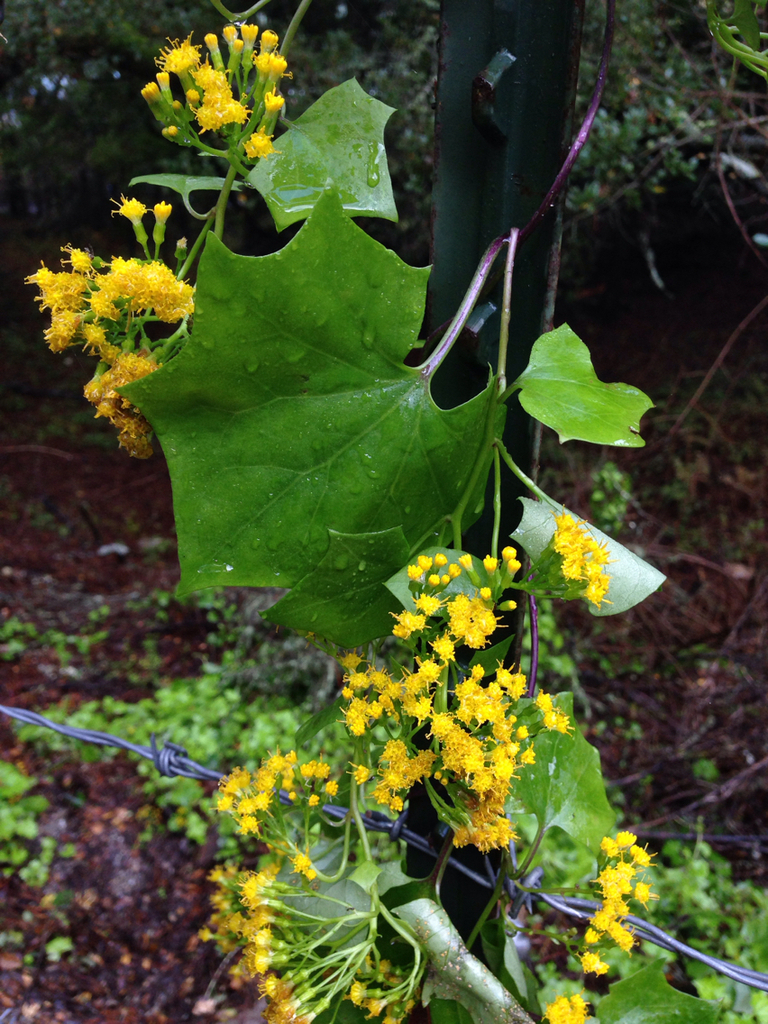
(c) Ken-ichi Ueda, some rights reserved (CC BY), uploaded by Ken-ichi Ueda · licence
Family: Asteraceae · Type: Vine · Not Native
Conservation status: Cal-IPC Yes
Delairea odorata (Cape ivy) is a non-native California vine in the Asteraceae family, recognized by Invasive South African species, the only climbing member of Asteraceae established in California.
Cape ivy is a naturalized perennial vine found in coastal and central California regions including the North Coast, southern North Coast Ranges, western-central Great Valley, Central Coast, San Francisco Bay Area, western South Coast Ranges, and western Southwest at elevations below 1,500 meters in shady, disturbed places, riparian woodlands, and coastal scrub. Flowering from November to March, this plant produces bright yellow flowers in small discoid heads arranged in terminal and axillary clusters. Growing as a twining vine 1 to 6 meters long with green or purple stems that become woody and root at nodes, it spreads extensively through coastal landscapes. Its alternate leaves are widely deltate, palmately divided into 5 to 9 acute lobes, measuring 3 to 8 centimeters across and appearing shiny green to yellow-green. The vine creates dense, fleshy growth that can quickly cover surrounding vegetation, with white, minutely barbed bristles accompanying its cylindrical fruits.
Identification and appearance
Key characters: Invasive South African species, the only climbing member of Asteraceae established in California
Habitat and range
Habitat: Shady, +- disturbed places, riparian woodland, coastal scrub
Elevation: < 1500 m
California counties: Los Angeles, Ventura, San Diego, Alameda, Humboldt, Mendocino, Monterey, Sonoma, Marin, San Francisco, San Luis Obispo, San Mateo, Santa Barbara, Santa Clara, Santa Cruz, Contra Costa, Napa, Riverside, Yolo, Sacramento, Orange
Outside California: native to southern Africa
Bloom period
Delairea odorata blooms Nov-Mar.
Conservation status
Cal-IPC Yes
How to tell it apart
vs Hedera: Delairea has yellow daisy flowers and soft stems; ivy has berry clusters and woody stems.; vs Marah: Delairea has yellow daisy flowers and soft leaves; wild cucumber has white flowers and prickly fruits.; vs Vitis: Delairea has yellow composite flowers; grape has clusters of berries and tendril climbers.; vs Echinocystis: Delairea has yellow asteraceae flowers; Echinocystis has white star-shaped cucumber flowers.; vs Platanus: Delairea is a climbing vine; sycamore is an upright tree with peeling bark.
Frequently asked questions
Is Delairea odorata native to California?
No. Delairea odorata is not native to California (recorded as not native).
When does Delairea odorata bloom?
Delairea odorata blooms Nov-Mar.
Where in California does Delairea odorata grow?
Delairea odorata occurs in Los Angeles, Ventura, San Diego, Alameda, Humboldt, Mendocino, Monterey, Sonoma and other counties, at elevations of < 1500 m.
What plant family does Delairea odorata belong to?
Delairea odorata is in the Asteraceae family, genus Delairea.
Is Delairea odorata invasive in California?
Delairea odorata is listed by Cal-IPC with an invasiveness rating of Yes.
Related species
Other California species in the same genus, family, or bioregion.
Sources: Jepson eFlora · Index of California Plant Names · CalPhotos
Last updated 2026-10-07
Data from The California Species Project — 14,000+ California species with verified data from CNPS, CDFW, USFWS, Cal-IPC, and more.