Delphinium andersonii
Anderson's larkspur
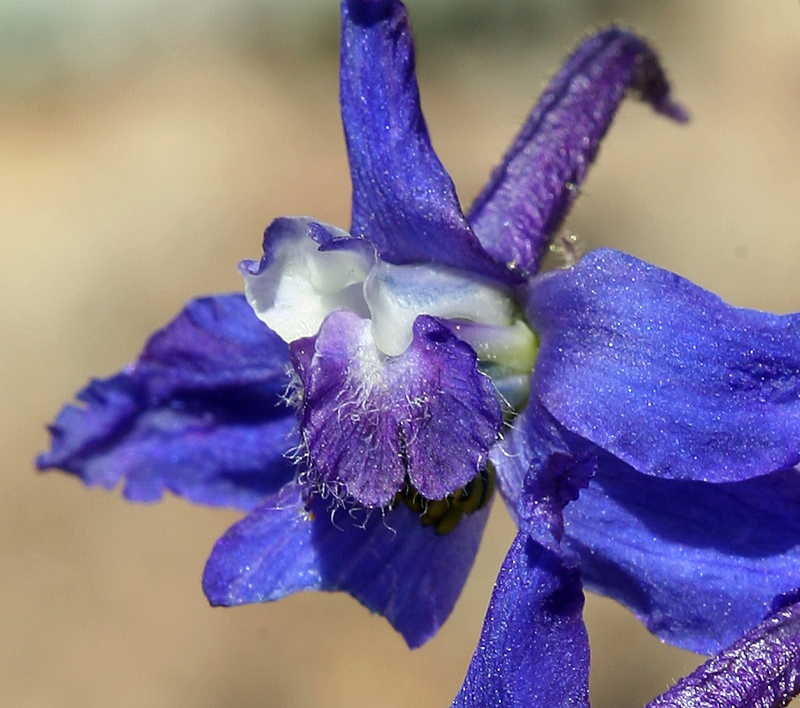
(c) Steve Matson, some rights reserved (CC BY), uploaded by Steve Matson · licence
Family: Ranunculaceae · Type: Herb · Native
Delphinium andersonii (Anderson's larkspur) is a native California herb in the Ranunculaceae family, recognized by unique seed characteristics and habitat preference.
Anderson's larkspur is a California native perennial found in the northeastern Sierra Nevada, Great Basin, and California Ranges in talus and dry sandy sagebrush scrub at elevations of 1,300 to 2,700 meters. Flowering from May to June, this plant produces dark blue flowers with distinctive lateral sepals 9 to 16 millimeters long and an elegant curved spur 11 to 18 millimeters long. Growing 30 to 60 centimeters tall with stems firmly attached to a branched root system more than 10 centimeters deep, it develops an upright, slender form. Its leaves are primarily located on the lower half of the stem, featuring 7 to 30 narrow lobes less than 4 millimeters wide. The fruit is elongated, measuring 17 to 32 millimeters in length and typically more than four times longer than its width.
Identification and appearance
Key characters: 10 sympatric species; unique seed characteristics and habitat preference
Habitat and range
Habitat: Talus, dry sandy soils in sagebrush scrub
Elevation: 1300-2700 m
California counties: Mono, Plumas, Lassen, Los Angeles, Inyo, Siskiyou, Modoc, Alpine, Sierra, Placer, Lake, Tehama, Humboldt, Trinity, Nevada, El Dorado, San Bernardino
Outside California: to southeastern Oregon, central Idaho, southern Utah
Bloom period
Delphinium andersonii blooms May-Jun.
How to tell it apart
vs Lupinus: Delphinium has backward-pointing spurs on flowers; Lupinus has pea-family flowers with banner-wing-keel structure.; vs Geranium: Delphinium has spurred bilateral flowers; Geranium has radially symmetric 5-petaled flowers with no spur.; vs Epilobium: Delphinium has spurred flowers and palmately divided leaves; Epilobium has unspurred 4-petaled flowers and simple or opposite leaves.; vs Aquilegia: Delphinium has a single spur per flower; Aquilegia has 5 spurs radiating from the center.; vs Aconitum: Delphinium has an open spur with visible stamens; Aconitum has a closed hood hiding the stamens.
Frequently asked questions
Is Delphinium andersonii native to California?
Yes. Delphinium andersonii is native to California (recorded as native).
When does Delphinium andersonii bloom?
Delphinium andersonii blooms May-Jun.
Where in California does Delphinium andersonii grow?
Delphinium andersonii occurs in Mono, Plumas, Lassen, Los Angeles, Inyo, Siskiyou, Modoc, Alpine and other counties, at elevations of 1300-2700 m.
What plant family does Delphinium andersonii belong to?
Delphinium andersonii is in the Ranunculaceae family, genus Delphinium.
What habitat does Delphinium andersonii grow in?
Delphinium andersonii grows in Talus, dry sandy soils in sagebrush scrub.
Related species
Other California species in the same genus, family, or bioregion.
- Delphinium antoninum — Anthony peak larkspur
- Delphinium bakeri — Baker's larkspur
- Delphinium californicum — California larkspur
- Delphinium californicum subsp. californicum — Coast or california larkspur
- Delphinium californicum subsp. interius — Hospital canyon larkspur
- Delphinium cardinale — Cardinal or scarlet larkspur
Sources: Jepson eFlora · Index of California Plant Names · CalPhotos
Last updated 2026-10-07
Data from The California Species Project — 14,000+ California species with verified data from CNPS, CDFW, USFWS, Cal-IPC, and more.