Delphinium gypsophilum
Gypsum-loving larkspur
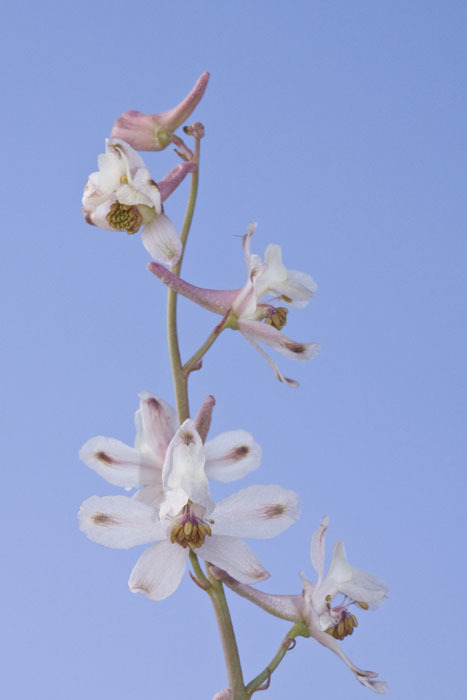
(c) marlin harms, some rights reserved (CC BY) · licence
Family: Ranunculaceae · Type: Herb · Native
Conservation status: CNPS 3.2
Delphinium gypsophilum (Gypsum-loving larkspur) is a native California herb in the Ranunculaceae family, recognized by white-pink flowers and waxy stem coating.
Gypsum-loving larkspur is a California native perennial found in southern Sierra Nevada foothills, Tehachapi, San Joaquin Valley, and southern Coast Ranges in grassland and open oak woodland slopes at elevations of 90 to 1,200 meters. Flowering from February to June, this plant produces white to pink flowers that interestingly dry to sky blue on herbarium specimens, with delicate lateral sepals 7 to 19 millimeters long. Growing 30 to 150 centimeters tall with glaucous stems that are generally glabrous and firmly attached to a sometimes branched root, it creates an elegant vertical presence in its grassland habitat. Its leaves are nearly glabrous with 3 to 12 lobes, ranging from 3 to 24 millimeters wide on basal leaves and 1 to 8 millimeters wide on stem leaves. The fruit is relatively compact, measuring 9 to 18 millimeters long and typically no more than three times as wide as its length.
Identification and appearance
Key characters: 27 sympatric species; distinguished by white-pink flowers and waxy stem coating
Habitat and range
Habitat: Slopes in grassland, open oak woodland
Elevation: 90-1200 m
California counties: Kern, San Luis Obispo, San Benito, Monterey, Fresno, Ventura, San Joaquin, Kings, Stanislaus, Santa Barbara, Merced, Riverside, Alameda
Bloom period
Delphinium gypsophilum blooms Feb-Jun.
Conservation status
CNPS 3.2
How to tell it apart
vs Lupinus: Delphinium has backward-pointing spurs on flowers; Lupinus has pea-family flowers with banner-wing-keel structure.; vs Geranium: Delphinium has spurred bilateral flowers; Geranium has radially symmetric 5-petaled flowers with no spur.; vs Epilobium: Delphinium has spurred flowers and palmately divided leaves; Epilobium has unspurred 4-petaled flowers and simple or opposite leaves.; vs Aquilegia: Delphinium has a single spur per flower; Aquilegia has 5 spurs radiating from the center.; vs Aconitum: Delphinium has an open spur with visible stamens; Aconitum has a closed hood hiding the stamens.
Frequently asked questions
Is Delphinium gypsophilum native to California?
Yes. Delphinium gypsophilum is native to California (recorded as native).
When does Delphinium gypsophilum bloom?
Delphinium gypsophilum blooms Feb-Jun.
Where in California does Delphinium gypsophilum grow?
Delphinium gypsophilum occurs in Kern, San Luis Obispo, San Benito, Monterey, Fresno, Ventura, San Joaquin, Kings and other counties, at elevations of 90-1200 m.
What plant family does Delphinium gypsophilum belong to?
Delphinium gypsophilum is in the Ranunculaceae family, genus Delphinium.
Is Delphinium gypsophilum rare or endangered?
Delphinium gypsophilum carries California Rare Plant Rank 3.2, state rank S2S3.
Related species
Other California species in the same genus, family, or bioregion.
- Delphinium gypsophilum ssp. parviflorum — Small-flowered Gypsum-loving Larkspur
- Delphinium hansenii — Eldorado larkspur
- Delphinium hansenii subsp. ewanianum — Ewan's larkspur
- Delphinium hansenii subsp. hansenii — Hansen's larkspur
- Delphinium hansenii subsp. kernense — Kern county larkspur
- Delphinium hesperium — Foothill larkspur
Sources: Jepson eFlora · CNPS Rare Plant Inventory · Index of California Plant Names · CalPhotos
Last updated 2026-10-07
Data from The California Species Project — 14,000+ California species with verified data from CNPS, CDFW, USFWS, Cal-IPC, and more.