Delphinium nudicaule
Red or orange larkspur, Red Or Orange Larkspur
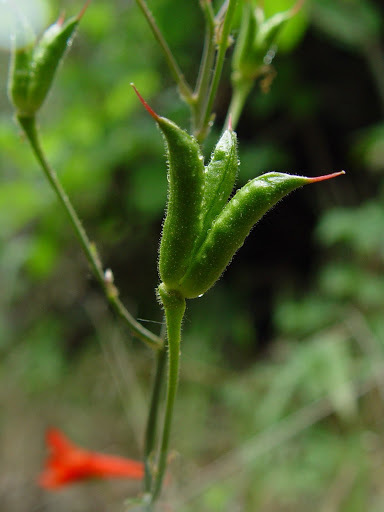
(c) 114397479669890378989, some rights reserved (CC BY), uploaded by 114397479669890378989 · licence
Family: Ranunculaceae · Type: Herb · Native
Delphinium nudicaule (Red or orange larkspur) is a native California herb in the Ranunculaceae family, recognized by unique flower color.
Red larkspur is a California native perennial found in northwestern California, the Cascade Range, northern and central Sierra Nevada, Sacramento Valley, central western California, and northwestern Great Plains in moist talus and wooded rocky slopes at elevations below 2,600 meters. Flowering from March to June, this plant produces scarlet to orange-red flowers with distinctive forward-pointing sepals and long spurs 12 to 34 millimeters in length. Growing with slender stems 15 to 50 centimeters tall, occasionally reaching up to 125 centimeters, the plant has a root system more than 15 centimeters deep with distally branched structure. Its leaves are primarily located on the lower third of the stem, featuring 3 to 10 lobes typically wider than 6 millimeters and appearing nearly hairless. The plant produces curved fruits 13 to 26 millimeters long with smooth seeds featuring an inflated collar.
Identification and appearance
Key characters: 40 sympatric species; unique flower color is diagnostic
Habitat and range
Habitat: Moist talus, wooded, rocky slopes
Elevation: < 2600 m
California counties: San Luis Obispo, Sonoma, Plumas, Butte, Napa, Colusa, Trinity, Marin, Lake, Lassen, Mendocino, Monterey, Santa Cruz, Santa Clara, Shasta, Tulare, San Mateo, Solano, Alameda, Del Norte, Siskiyou, Tehama, Humboldt, Glenn, Contra Costa, Modoc, Yolo, Sierra, Stanislaus, Sutter, San Francisco, Tuolumne
Outside California: to southwestern Oregon
Bloom period
Delphinium nudicaule blooms Mar-Jun.
How to tell it apart
vs Lupinus: Delphinium has backward-pointing spurs on flowers; Lupinus has pea-family flowers with banner-wing-keel structure.; vs Geranium: Delphinium has spurred bilateral flowers; Geranium has radially symmetric 5-petaled flowers with no spur.; vs Epilobium: Delphinium has spurred flowers and palmately divided leaves; Epilobium has unspurred 4-petaled flowers and simple or opposite leaves.; vs Aquilegia: Delphinium has a single spur per flower; Aquilegia has 5 spurs radiating from the center.; vs Aconitum: Delphinium has an open spur with visible stamens; Aconitum has a closed hood hiding the stamens.
Frequently asked questions
Is Delphinium nudicaule native to California?
Yes. Delphinium nudicaule is native to California (recorded as native).
When does Delphinium nudicaule bloom?
Delphinium nudicaule blooms Mar-Jun.
Where in California does Delphinium nudicaule grow?
Delphinium nudicaule occurs in San Luis Obispo, Sonoma, Plumas, Butte, Napa, Colusa, Trinity, Marin and other counties, at elevations of < 2600 m.
What plant family does Delphinium nudicaule belong to?
Delphinium nudicaule is in the Ranunculaceae family, genus Delphinium.
What habitat does Delphinium nudicaule grow in?
Delphinium nudicaule grows in Moist talus, wooded, rocky slopes.
Related species
Other California species in the same genus, family, or bioregion.
Sources: Jepson eFlora · Index of California Plant Names · CalPhotos
Last updated 2026-10-07
Data from The California Species Project — 14,000+ California species with verified data from CNPS, CDFW, USFWS, Cal-IPC, and more.