Deschampsia cespitosa subsp. cespitosa
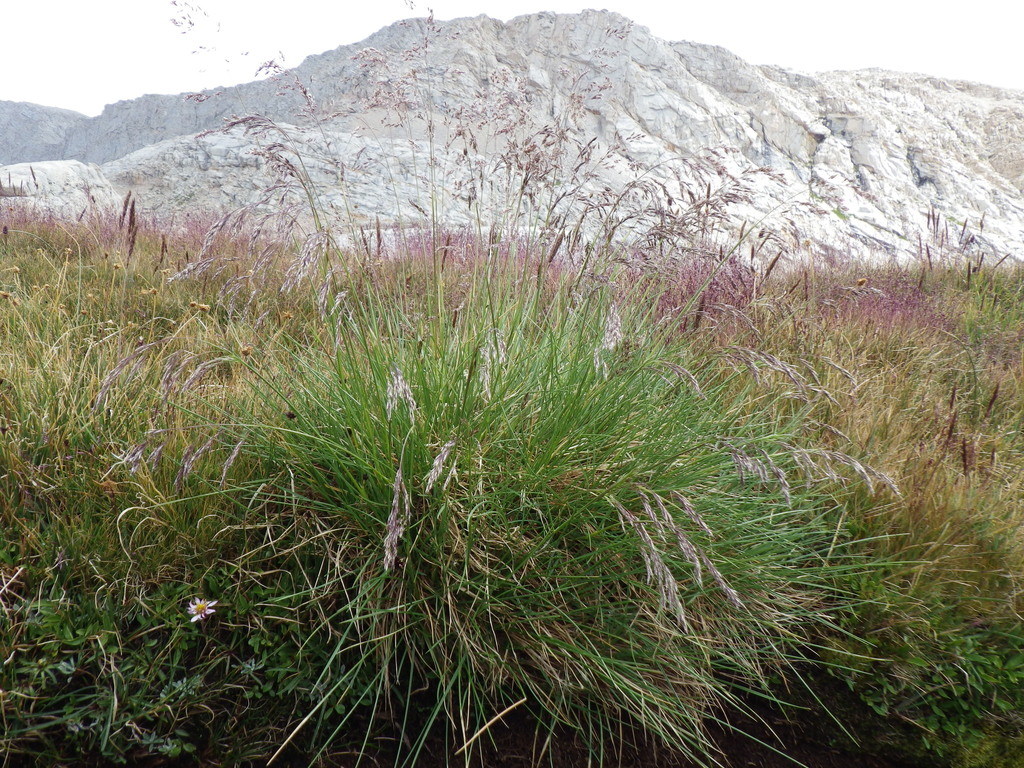
(c) Matt Lavin, some rights reserved (CC BY) · licence
Family: Poaceae · Type: Perennial · Native
Deschampsia cespitosa subsp. cespitosa is a native California perennial in the Poaceae family, recognized by dense clumping and open inflorescence.
Tufted hairgrass is a California native perennial found in the northwestern California, Cascade Range, Sierra Nevada, Central Coast, San Francisco Bay Area, Transverse Ranges, Warner Mountains, northern eastern Sierra Nevada, and White and Inyo Mountains in meadows, streambanks, coastal marshes, forest, and alpine habitats at elevations up to 3,820 meters. Flowering from July to August, this plant produces delicate open panicles with spreading to drooping branches that create a soft, airy appearance. Growing in dense, tightly clustered clumps with erect stems reaching up to one meter tall, it forms robust green tussocks that provide important ground cover in mountain environments. Its leaves are narrow and grass-like, forming dense basal clusters that create a compact, rounded base beneath the open flower branches. The fine, pale flower branches bear small spikelets with delicate awns that shimmer and move gracefully in alpine and mountain breezes.
Identification and appearance
Key characters: 5 sympatric species; distinguished by dense clumping and open inflorescence
Habitat and range
Habitat: Meadows, streambanks, coastal marshes, forest, alpine
Elevation: < 3820 m
California counties: Inyo, Butte, Del Norte, El Dorado, Fresno, Humboldt, Lassen, Madera, Mariposa, Mendocino, Modoc, Mono, Nevada, Plumas, San Bernardino, Shasta, Sierra, Siskiyou, Sonoma, Trinity, Tulare, Tuolumne, Kern, Lake, Marin, Napa, San Diego, Solano, Amador, Alpine, Placer, Calaveras, San Luis Obispo, Santa Cruz, Colusa, Tehama, Monterey, Alameda, Ventura, San Mateo
Outside California: Alaska, Canada, eastern United States, Eurasia
Bloom period
Deschampsia cespitosa subsp. cespitosa blooms Jul-Aug.
How to tell it apart
vs Oloptum: Deschampsia has hairy spikelet extensions and thread-like basal leaves; Oloptum lacks the fuzzy extension and has wiry, needle-like leaves.; vs Festuca: Deschampsia has airy, open panicles with fuzzy spikelet extensions; Festuca has denser flower clusters without hairy extensions.; vs Panicum: Deschampsia forms basal leaf tufts with hairy spikelet extensions; Panicum has stem leaves and smooth, rounded spikelets.; vs Melica: Deschampsia has hairy spikelet extensions; Melica has a distinctive club-shaped sterile floret cluster at spikelet tips.; vs Poa: Deschampsia has prominent hairy extensions beyond florets; Poa has boat-shaped lemmas with cobwebby hairs at the base only.
Frequently asked questions
Is Deschampsia cespitosa subsp. cespitosa native to California?
Yes. Deschampsia cespitosa subsp. cespitosa is native to California (recorded as native).
When does Deschampsia cespitosa subsp. cespitosa bloom?
Deschampsia cespitosa subsp. cespitosa blooms Jul-Aug.
Where in California does Deschampsia cespitosa subsp. cespitosa grow?
Deschampsia cespitosa subsp. cespitosa occurs in Inyo, Butte, Del Norte, El Dorado, Fresno, Humboldt, Lassen, Madera and other counties, at elevations of < 3820 m.
What plant family does Deschampsia cespitosa subsp. cespitosa belong to?
Deschampsia cespitosa subsp. cespitosa is in the Poaceae family, genus Deschampsia.
What habitat does Deschampsia cespitosa subsp. cespitosa grow in?
Deschampsia cespitosa subsp. cespitosa grows in Meadows, streambanks, coastal marshes, forest, alpine.
Related species
Other California species in the same genus, family, or bioregion.
Sources: Jepson eFlora · Index of California Plant Names · CalPhotos
Last updated 2026-10-06
Data from The California Species Project — 14,000+ California species with verified data from CNPS, CDFW, USFWS, Cal-IPC, and more.