Descurainia incisa subsp. incisa
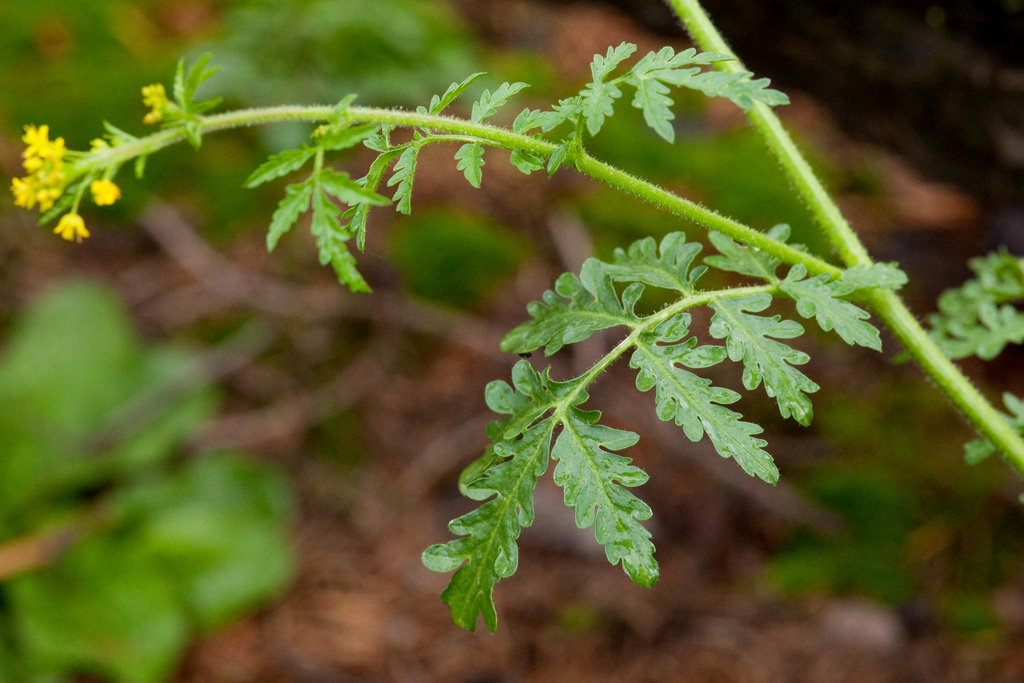
no rights reserved · CC0
Family: Brassicaceae · Type: Herb · Native
Descurainia incisa subsp. incisa is a native California herb in the Brassicaceae family, recognized by linear straight fruits and annual habit.
Descurainia incisa is a California native annual herb found in the Transverse Ranges, Peninsular Ranges, and Great Basin in dry creeks, streambanks, sagebrush scrub, and open woodland at elevations of 900 to 2,900 meters. Flowering from June to August, this plant produces pale yellow flowers on slender stems that branch in the upper portions. Growing 1.3 to 8.2 decimeters tall with green stems that can be glabrous or slightly hairy, it develops delicate, finely divided leaves with 5 to 9 pairs of lateral lobes that are oblong to lanceolate in shape. Its leaves are predominantly obovate to oblanceolate, measuring 1.5 to 10.3 centimeters long, with intricate pinnate structures. The fruit is a slender, erect linear pod 0.8 to 2 centimeters long, containing 14 to 26 small oblong seeds arranged in a single row.
Identification and appearance
Key characters: 10 sympatric species; linear straight fruits and annual habit help distinguish
Habitat and range
Habitat: dry creeks, streambanks, disturbed areas, meadows, sagebrush scrub, open woodland, talus, alpine areas
Elevation: 900-2900 m
Outside California: to British Columbia, Yukon Territory, New Mexico, northern Mexico
Bloom period
Descurainia incisa subsp. incisa blooms Jun-Aug.
How to tell it apart
vs Sisymbrium: Descurainia has soft fuzzy many-branched hairs; Sisymbrium is smooth or has simple unbranched hairs.; vs Lepidium: Descurainia has feathery divided leaves; Lepidium has simple or less-divided leaves and round flat pods.; vs Hirschfeldia: Descurainia has finely divided feathery leaves; Hirschfeldia has lobed but not finely dissected leaves.; vs Brassica: Descurainia has finely divided lacy leaves; Brassica has lobed or simple leaves, not finely dissected.; vs Erodium: Descurainia has four petals and cylindrical pods; Erodium has five petals and long-beaked fruits.
Frequently asked questions
Is Descurainia incisa subsp. incisa native to California?
Yes. Descurainia incisa subsp. incisa is native to California (recorded as native).
When does Descurainia incisa subsp. incisa bloom?
Descurainia incisa subsp. incisa blooms Jun-Aug.
What plant family does Descurainia incisa subsp. incisa belong to?
Descurainia incisa subsp. incisa is in the Brassicaceae family, genus Descurainia.
What habitat does Descurainia incisa subsp. incisa grow in?
Descurainia incisa subsp. incisa grows in dry creeks, streambanks, disturbed areas, meadows, sagebrush scrub, open woodland, talus, alpine areas.
Related species
Other California species in the same genus, family, or bioregion.
Sources: Jepson eFlora · CalPhotos
Last updated 2026-10-07
Data from The California Species Project — 14,000+ California species with verified data from CNPS, CDFW, USFWS, Cal-IPC, and more.