Descurainia paradisa
Great basin tansy mustard
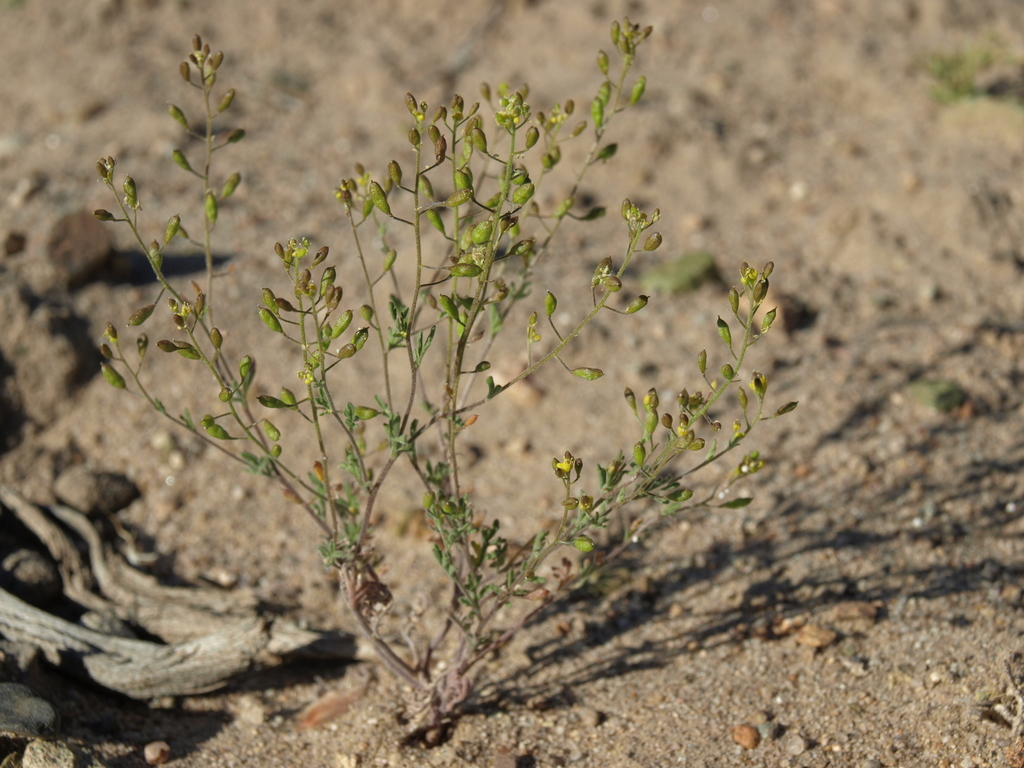
(c) Jim Morefield, some rights reserved (CC BY) · licence
Family: Brassicaceae · Type: Herb · Native
Descurainia paradisa (Great basin tansy mustard) is a native California herb in the Brassicaceae family, recognized by obovate fruits are uniquely diagnostic.
Great basin tansy mustard is a California native annual found in the Great Basin in sandy washes, dunes, and sagebrush scrub at elevations of 1,000 to 2,300 meters. Flowering from April to June, this plant produces pale yellow flowers less than 1.5 millimeters long with delicate spreading sepals. Growing with branched stems 15 to 32 centimeters tall that are sparsely to densely hairy, the plant develops intricate branching throughout its structure. Its leaves are pinnately lobed, with oblanceolate to obovate basal leaves having small ultimate lobes 1 to 5 millimeters long that are oblong or linear in shape. The fruit is an obovate pod 2.5 to 4 millimeters long with glabrous valves and a very short style.
Identification and appearance
Key characters: 9 sympatric species; obovate fruits are uniquely diagnostic
Habitat and range
Habitat: Sandy washes, dunes, sagebrush scrub
Elevation: 1000-2300 m
Outside California: to Oregon, Nevada
Bloom period
Descurainia paradisa blooms Apr-Jun.
How to tell it apart
vs Sisymbrium: Descurainia has soft fuzzy many-branched hairs; Sisymbrium is smooth or has simple unbranched hairs.; vs Lepidium: Descurainia has feathery divided leaves; Lepidium has simple or less-divided leaves and round flat pods.; vs Hirschfeldia: Descurainia has finely divided feathery leaves; Hirschfeldia has lobed but not finely dissected leaves.; vs Brassica: Descurainia has finely divided lacy leaves; Brassica has lobed or simple leaves, not finely dissected.; vs Erodium: Descurainia has four petals and cylindrical pods; Erodium has five petals and long-beaked fruits.
Frequently asked questions
Is Descurainia paradisa native to California?
Yes. Descurainia paradisa is native to California (recorded as native).
When does Descurainia paradisa bloom?
Descurainia paradisa blooms Apr-Jun.
What plant family does Descurainia paradisa belong to?
Descurainia paradisa is in the Brassicaceae family, genus Descurainia.
What habitat does Descurainia paradisa grow in?
Descurainia paradisa grows in Sandy washes, dunes, sagebrush scrub.
Related species
Other California species in the same genus, family, or bioregion.
Sources: Jepson eFlora · CalPhotos
Last updated 2026-10-07
Data from The California Species Project — 14,000+ California species with verified data from CNPS, CDFW, USFWS, Cal-IPC, and more.