Descurainia sophia
Flix weed
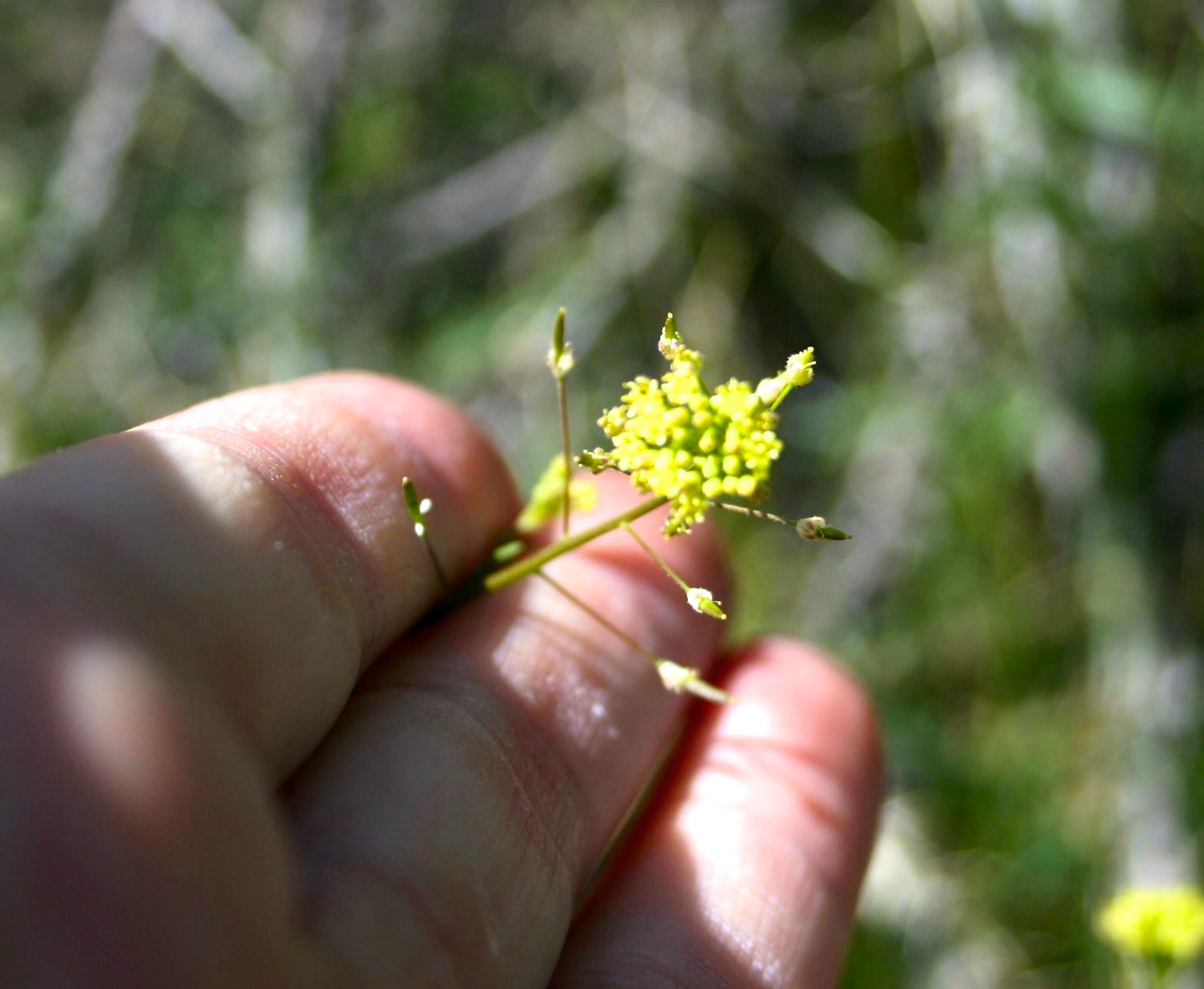
Photo by Chez Brungraber
Family: Brassicaceae · Type: Herb · Not Native
Conservation status: Cal-IPC Yes
Descurainia sophia (Flix weed) is a non-native California herb in the Brassicaceae family, recognized by highly dissected leaves and long spreading fruits diagnostic.
Flix weed is a naturalized annual herb found throughout California in disturbed areas, fields, canyon bottoms, and desert habitats at elevations below 3,000 meters. Flowering from May to August, this plant produces small yellow-white flowers on delicate branching stems. Growing with erect stems 20 to 70 centimeters tall, it is hairy throughout and can be simple or branched in its upper portions. Its leaves are intricately divided, with finely cut 2 to 10 millimeter segments that create a lacy, delicate appearance. The plant produces linear fruits 1.5 to 2.7 centimeters long, spreading outward from thin stems.
Identification and appearance
Key characters: 10 sympatric species; highly dissected leaves and long spreading fruits diagnostic
Habitat and range
Habitat: Common. Disturbed areas, fields, canyon bottoms, desert
Elevation: < 3000 m
California counties: Lassen, San Bernardino, Los Angeles, Inyo, Kern, Mono, Siskiyou, Yuba, Riverside, San Diego, Tulare, Modoc, Plumas, San Francisco, Shasta, Santa Barbara, San Luis Obispo, Alameda, Ventura, Sierra, Tuolumne, Glenn, Nevada, Marin, Sutter, Napa, El Dorado, Alpine, Monterey, Stanislaus, Merced, Placer, Butte, Tehama, Colusa, Mendocino, Humboldt, San Mateo, Solano, Yolo, Sacramento, Mariposa
Outside California: throughout Canada, United States, native to Eurasia
Bloom period
Descurainia sophia blooms May-Aug.
Conservation status
Cal-IPC Yes
How to tell it apart
vs Sisymbrium: Descurainia has soft fuzzy many-branched hairs; Sisymbrium is smooth or has simple unbranched hairs.; vs Lepidium: Descurainia has feathery divided leaves; Lepidium has simple or less-divided leaves and round flat pods.; vs Hirschfeldia: Descurainia has finely divided feathery leaves; Hirschfeldia has lobed but not finely dissected leaves.; vs Brassica: Descurainia has finely divided lacy leaves; Brassica has lobed or simple leaves, not finely dissected.; vs Erodium: Descurainia has four petals and cylindrical pods; Erodium has five petals and long-beaked fruits.
Frequently asked questions
Is Descurainia sophia native to California?
No. Descurainia sophia is not native to California (recorded as not native).
When does Descurainia sophia bloom?
Descurainia sophia blooms May-Aug.
Where in California does Descurainia sophia grow?
Descurainia sophia occurs in Lassen, San Bernardino, Los Angeles, Inyo, Kern, Mono, Siskiyou, Yuba and other counties, at elevations of < 3000 m.
What plant family does Descurainia sophia belong to?
Descurainia sophia is in the Brassicaceae family, genus Descurainia.
Is Descurainia sophia invasive in California?
Descurainia sophia is listed by Cal-IPC with an invasiveness rating of Yes.
Related species
Other California species in the same genus, family, or bioregion.
- Descurainia sp. — Tansy mustard
- Descurainia adenophora — White tansy mustard
- Descurainia californica — Sierra tansy mustard
- Descurainia incana — Mountain tansy mustard
- Descurainia incisa subsp. incisa
- Descurainia longipedicellata
- Diplotaxis muralis — Annual wall rocket
- Diplotaxis sp. — Wall rocket
- Diplotaxis tenuifolia — Perennial wall rocket
Sources: Jepson eFlora · Index of California Plant Names · CalPhotos
Last updated 2026-10-07
Data from The California Species Project — 14,000+ California species with verified data from CNPS, CDFW, USFWS, Cal-IPC, and more.