Dianthus barbatus subsp. barbatus
Sweet-william, Sweet-William
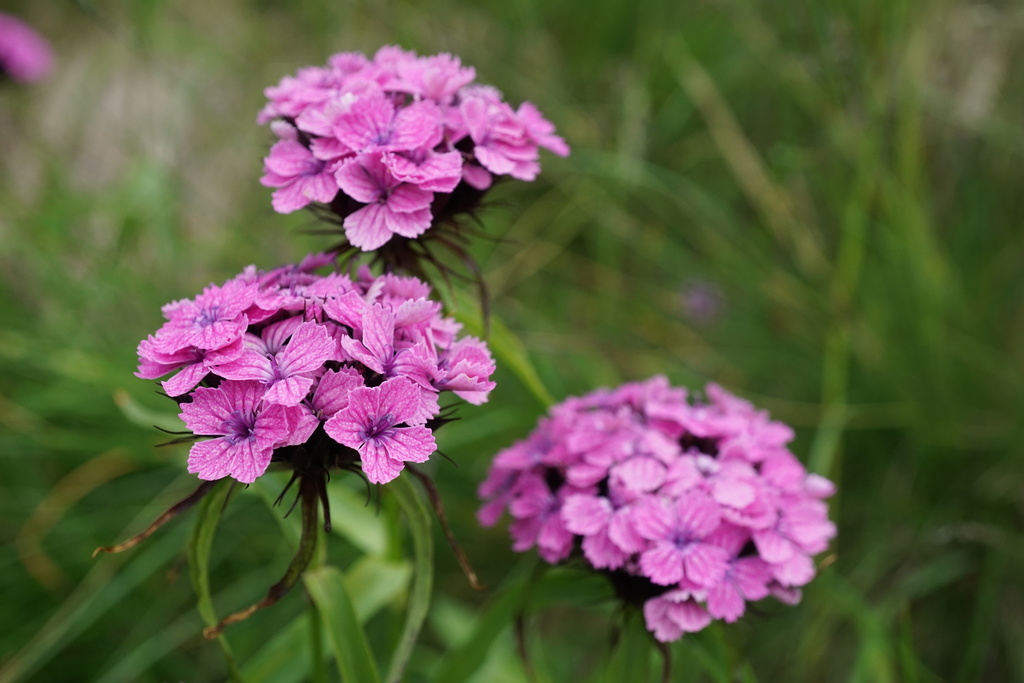
(c) xulescu_g, some rights reserved (CC BY-SA) · licence
Family: Caryophyllaceae · Type: Perennial · Not Native
Dianthus barbatus subsp. barbatus (Sweet-william) is a non-native California perennial in the Caryophyllaceae family, recognized by dense flower clusters, glabrous calyx with 40 ribs.
Sweet-william is a naturalized perennial herb found in northwestern California, the California Ranges, and central coastal areas in disturbed areas at elevations below 1,500 meters. Flowering from spring to early summer, this plant produces white to pink, purple, or violet flowers, sometimes two-colored, in dense terminal clusters with many flowers. Growing 30 to 60 centimeters tall with a stout rhizome, it has both basal and cauline lanceolate leaves. Its leaves range from oblanceolate at the base to narrower lanceolate leaves along the stem, creating a varied foliage profile. The flower clusters feature bracts that are mostly as long as or longer than the calyx tube, with acute to short-tapered lobes that frame the delicate, multi-colored petals.
Identification and appearance
Key characters: Co-occurs with 2 species; key features are dense flower clusters, glabrous calyx with 40 ribs
Habitat and range
Habitat: Disturbed areas
Elevation: < 1500 m
Outside California: to British Columbia, Alberta, eastern North America, Texas, native to southern Europe
Bloom period
Dianthus barbatus subsp. barbatus blooms Spring-early summer.
How to tell it apart
vs Rosa: Dianthus has tubular flowers with 5 petals and green bracts; Rosa has flat flowers with many petals and compound leaves.; vs Pelargonium: Dianthus has radially symmetric tubular flowers; Pelargonium has bilaterally symmetric flowers in umbrella-like clusters.; vs Phlox: Dianthus has tubular flowers with green bracts at base; Phlox has flat-faced flowers without bracts and opposite leaves.; vs Clarkia: Dianthus has tubular flowers with many-veined tubes; Clarkia has 4-petaled flowers with inferior ovaries.; vs Portulaca: Dianthus has tubular flowers with green bracts; Portulaca has flat flowers and succulent leaves.
Frequently asked questions
Is Dianthus barbatus subsp. barbatus native to California?
No. Dianthus barbatus subsp. barbatus is not native to California (recorded as not native).
When does Dianthus barbatus subsp. barbatus bloom?
Dianthus barbatus subsp. barbatus blooms Spring-early summer.
What plant family does Dianthus barbatus subsp. barbatus belong to?
Dianthus barbatus subsp. barbatus is in the Caryophyllaceae family, genus Dianthus.
What habitat does Dianthus barbatus subsp. barbatus grow in?
Dianthus barbatus subsp. barbatus grows in Disturbed areas.
Related species
Other California species in the same genus, family, or bioregion.
Sources: Jepson eFlora · CalPhotos
Last updated 2026-09-30
Data from The California Species Project — 14,000+ California species with verified data from CNPS, CDFW, USFWS, Cal-IPC, and more.