Dicentra formosa
Pacific bleeding heart
(c) giantcicada, some rights reserved (CC BY) · licence
Family: Papaveraceae · Type: Herb · Native
Dicentra formosa (Pacific bleeding heart) is a native California herb in the Papaveraceae family, recognized by size, flower number, and color persistence.
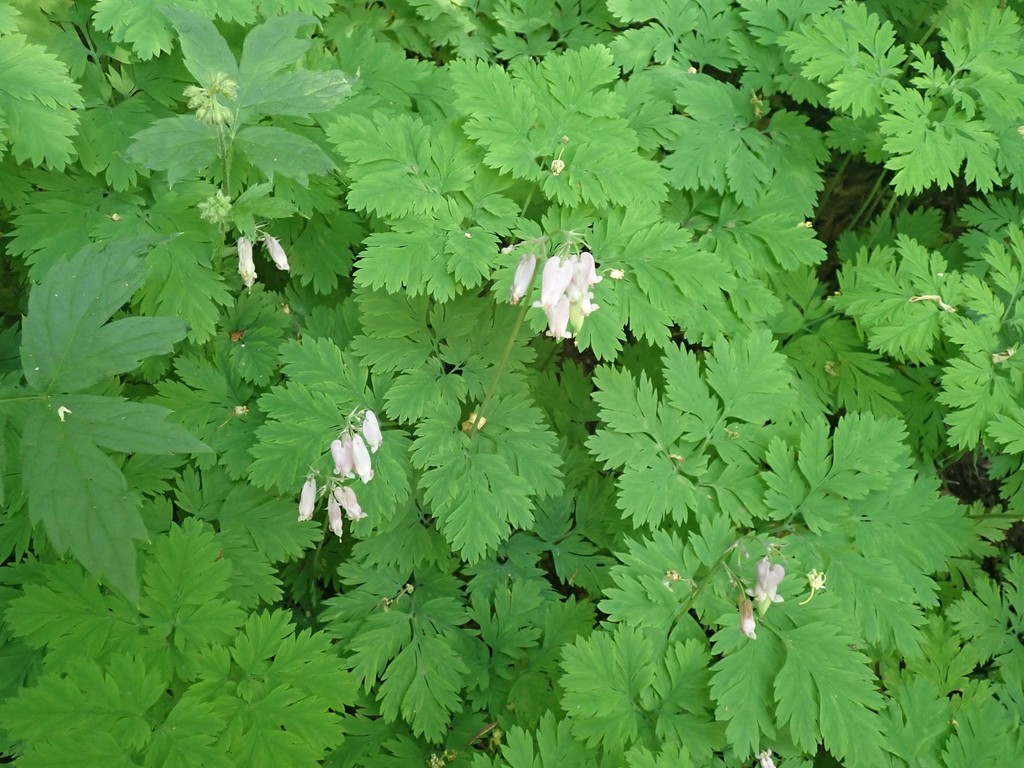
Pacific bleeding heart is a California native perennial found in northwestern California, the Cascade Range, Sierra Nevada, and northern central western California in damp, shaded areas at elevations below 2,400 meters. Flowering from March to July, this plant produces rose-purple to cream or pale yellow flowers nodding delicately on graceful stems. Growing 20 to 45 centimeters tall with a rhizomatous root system, it spreads gently through woodland understories. Its complex leaves are 2-ternate-dissected, creating intricate feathery foliage spanning 20 to 50 centimeters with delicate green leaflets. The plant develops oblong fruits 14 to 20 millimeters long, adding subtle visual interest to its elegant botanical structure.
Identification and appearance
Key characters: Co-occurs with 3 species; distinguished by size, flower number, and color persistence
Habitat and range
Habitat: Damp, shaded areas
Elevation: < 2400 m
California counties: Humboldt, Amador, Los Angeles, San Bernardino, Tulare, Placer, Butte, El Dorado, Shasta, Nevada, San Mateo, Trinity, Plumas, Tehama, Marin, Siskiyou, Calaveras, Yuba, San Francisco, Santa Cruz, Sierra, Del Norte, Glenn, Mendocino, Mariposa, Contra Costa, Fresno, Lake, Tuolumne, Colusa, Sonoma, Santa Clara, Madera, Alameda, Kern, Lassen, Monterey
Outside California: to British Columbia
Bloom period
Dicentra formosa blooms Mar-Jul.
How to tell it apart
vs Fumaria: Dicentra has matching pouched outer petals; Fumaria has lopsided flowers with one spur.; vs Geranium: Dicentra has hanging heart flowers; Geranium has flat 5-petaled flowers facing up.; vs Lamprocapnos: Dicentra is native California wildflower; Lamprocapnos is cultivated Asian bleeding heart.; vs Ehrendorferia: Dicentra has no leafy stems; Ehrendorferia has obvious stems with leaves.; vs Fuchsia: Dicentra has two-pouched hearts; Fuchsia has dangling bells with protruding stamens.
Frequently asked questions
Is Dicentra formosa native to California?
Yes. Dicentra formosa is native to California (recorded as native).
When does Dicentra formosa bloom?
Dicentra formosa blooms Mar-Jul.
Where in California does Dicentra formosa grow?
Dicentra formosa occurs in Humboldt, Amador, Los Angeles, San Bernardino, Tulare, Placer, Butte, El Dorado and other counties, at elevations of < 2400 m.
What plant family does Dicentra formosa belong to?
Dicentra formosa is in the Papaveraceae family, genus Dicentra.
What habitat does Dicentra formosa grow in?
Dicentra formosa grows in Damp, shaded areas.
Related species
Other California species in the same genus, family, or bioregion.
Sources: Jepson eFlora · Index of California Plant Names · CalPhotos
Last updated 2026-10-07
Data from The California Species Project — 14,000+ California species with verified data from CNPS, CDFW, USFWS, Cal-IPC, and more.